Best AI Workflow Automation Tools for Small Businesses (2026 Guide)


Small businesses are no longer experimenting with AI workflows. They are depending on them. What used to be optional automation is now part of daily operations — lead routing, client onboarding, reporting, scheduling, and internal documentation.
The problem is not access. The problem is overload. There are now dozens of AI workflow platforms claiming to “automate everything,” but many are either too complex, too limited, or too expensive for small teams.
This guide breaks down the best AI workflow automation tools for small businesses in 2026. Each tool is evaluated for usability, integration depth, AI decision capability, and real business usefulness — not marketing hype.
This is a discovery and comparison guide. If you want a pre-built ROI-tested tool stack, see our separate implementation article (5 Stress-Tested Tools That Deliver ROI).
What Are AI Workflow Automation Tools?
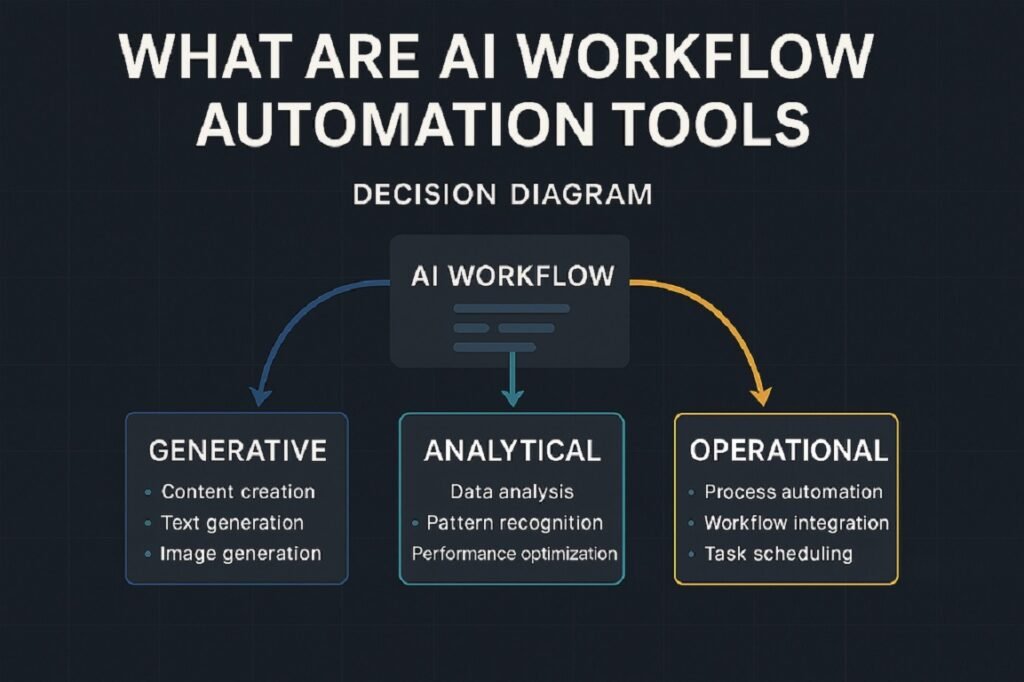
AI workflow automation tools go beyond simple rule triggers. Traditional automation follows fixed logic — if X happens, do Y. AI workflow systems can interpret inputs, classify intent, summarize data, and make conditional decisions inside the workflow.
Examples include:
- Routing leads based on message meaning
- Drafting responses using CRM context
- Extracting action items from meetings
- Categorizing support tickets automatically
- Generating task plans from raw notes
For small businesses, this reduces manual review time and removes repetitive decision steps.
How We Evaluated These AI Workflow Tools
Each platform in this list was evaluated using practical small business criteria:
- Ease of setup for non-developers
- Integration coverage
- AI decision usefulness
- Workflow flexibility
- Stability of automations
- Security basics and permissions
- Pricing for small teams
- Learning curve
This keeps the guide grounded in real adoption conditions.
Quick Comparison Table — Top AI Workflow Tools
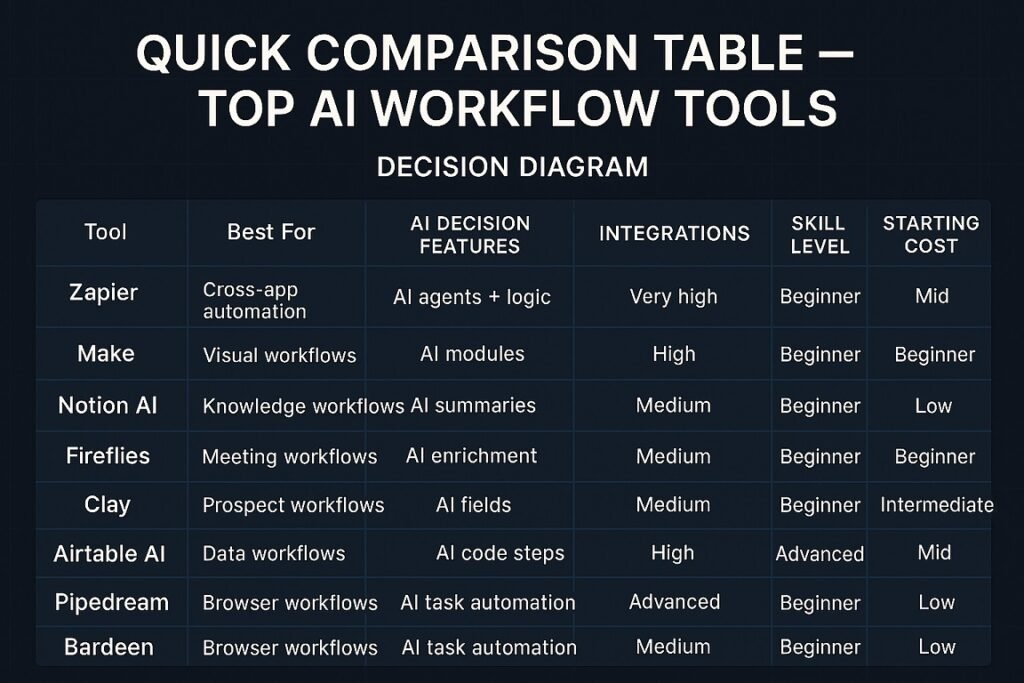
| Tool | Best For | AI Decision Features | Integrations | Skill Level | Starting Cost |
| Zapier | Cross-app automation | AI agents + logic | Very high | Beginner | Mid |
| Make | Visual workflows | AI modules | High | Intermediate | Low |
| Notion AI | Knowledge workflows | AI content + tasks | Medium | Beginner | Low |
| Fireflies | Meeting workflows | AI summaries | Medium | Beginner | Low |
| Clay | Prospect workflows | AI enrichment | Medium | Intermediate | High |
| Airtable AI | Data workflows | AI fields | Medium | Beginner | Mid |
| Pipedream | Dev workflows | AI code steps | High | Advanced | Low |
| Bardeen | Browser workflows | AI task automation | Medium | Beginner | Low |
If you’re deciding between leading automation platforms, see our detailed comparison of Zapier vs Make vs n8n, including pricing, flexibility, and real-world workflow performance.
Best AI Workflow Automation Tools — Detailed Reviews
Zapier — Best All-Around AI Workflow Platform
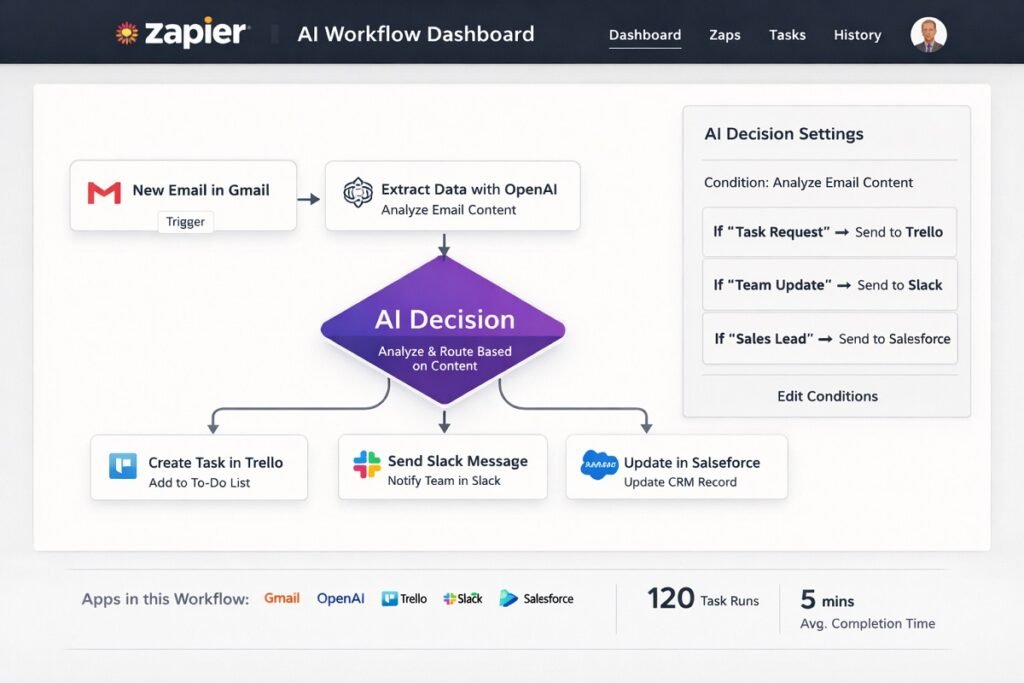
Zapier remains the most widely adopted automation platform for small businesses. Its AI upgrades now allow workflows to classify, summarize, and respond rather than just pass data between apps.
It works well for teams that need reliability and broad app support. Setup is straightforward and templates reduce build time.
Key AI Workflow Features
- AI decision steps
- Text classification
- AI response drafting
- Multi-app branching logic
Best Use Cases
- Lead routing
- CRM updates
- Email automation
- Client onboarding flows
Pros
- Massive integration library
- Easy setup
- Stable execution
- Strong templates
Cons
- Can get expensive at scale
- Complex flows cost more tasks
Make — Best Visual Workflow Builder
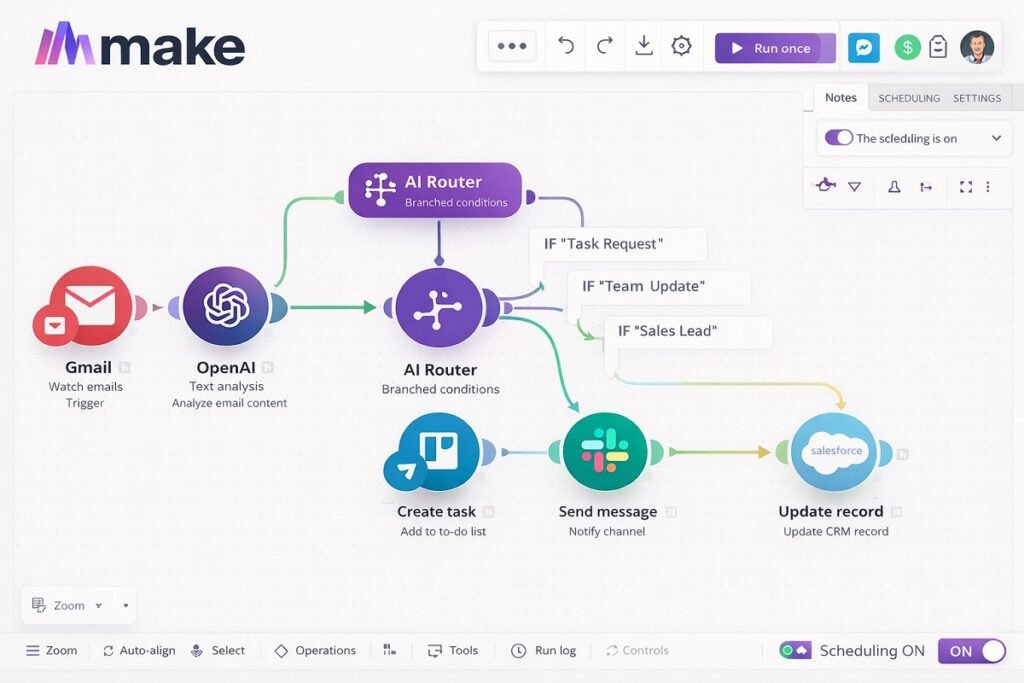
Make uses a visual canvas builder that gives more control over workflow structure. It suits users who want deeper logic without coding.
It supports conditional routing and AI modules inside flows.
Key AI Workflow Features
- Visual logic branching
- AI text tools
- Data transformation steps
Best Use Cases
- Multi-step business processes
- Data transformation flows
- Advanced routing
Pros
- Visual clarity
- Deep logic control
- Cost efficient at volume
Cons
- Learning curve higher than Zapier
- UI feels technical
Notion AI — Best Internal Workflow Knowledge Tool
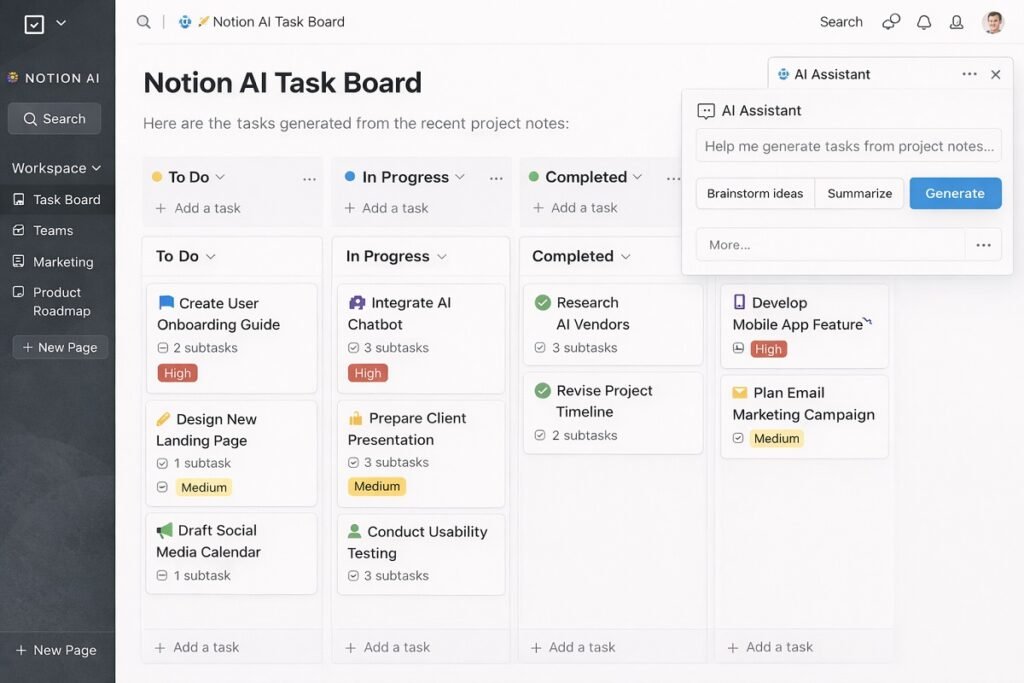
Notion AI turns internal documentation into a working knowledge assistant. It converts notes into structured plans and tasks.
It is strong for internal operations workflows.
Key AI Workflow Features
- SOP generation
- Task extraction
- Brainstorm summarization
- Database task creation
Best Use Cases
- SOP building
- Project planning
- Internal documentation
Pros
- Simple to adopt
- Strong for teams
- Combines docs and workflows
Cons
- Limited external integrations
- Not cross-app automation focused
Fireflies — Best Meeting Workflow Automation
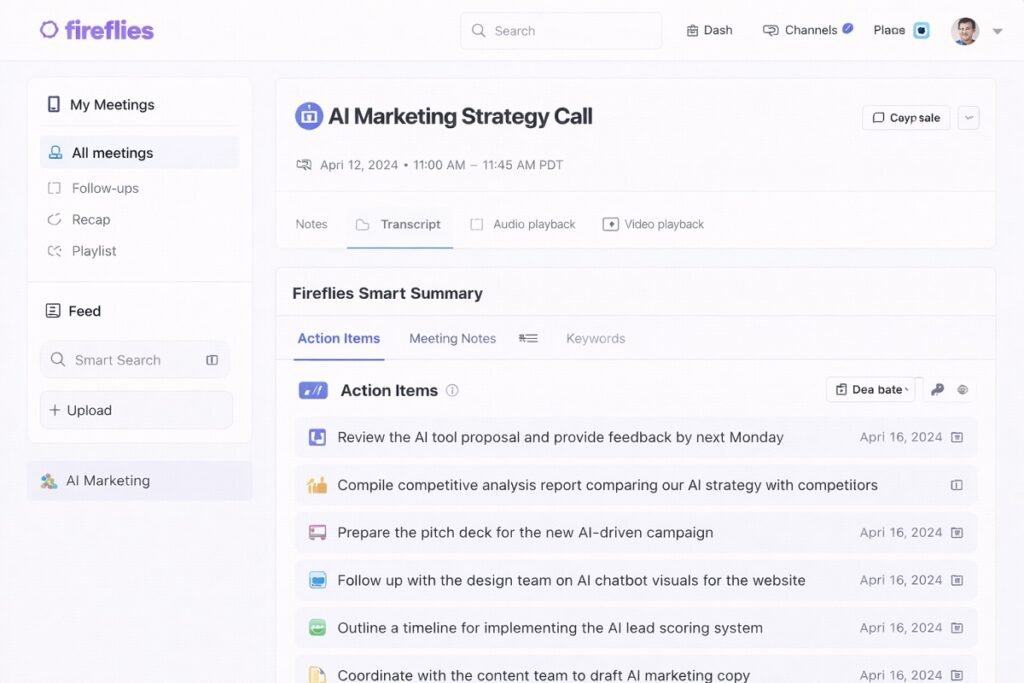
Fireflies captures meetings and converts them into searchable knowledge. Workflows can trigger follow-ups and task creation from calls.
Key AI Workflow Features
- Call transcription
- Action item detection
- Topic tracking
Best Use Cases
- Sales calls
- Client discovery
- Team meetings
Pros
- Saves admin time
- Searchable meeting memory
- Easy deployment
Cons
- Meeting focused only
- Needs call volume to justify
Clay — Best AI Prospect Workflow Tool
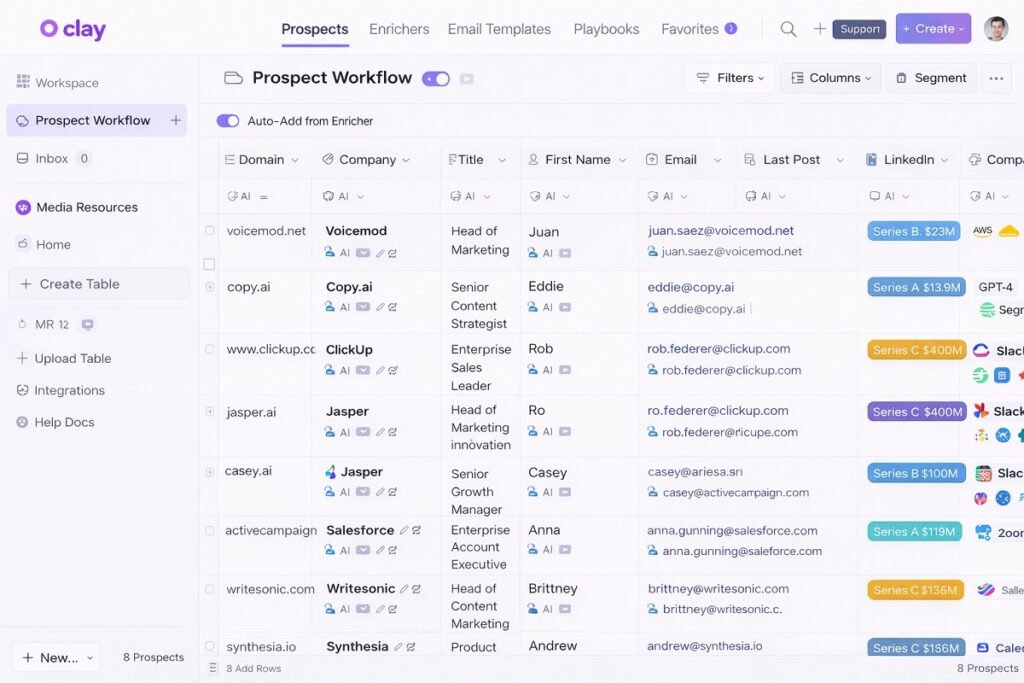
Clay focuses on lead enrichment workflows. It uses AI to analyze prospects and personalize outreach inputs.
Key AI Workflow Features
- Profile enrichment
- AI prospect summaries
- Outreach context generation
Best Use Cases
- B2B outreach
- Lead qualification
- Account research
Pros
- Powerful enrichment
- Personalization depth
- Sales workflow focused
Cons
- Higher cost tier
- Requires data sources
Airtable AI — Best Data-Driven Workflow Base
Airtable combines structured databases with AI fields that can summarize, classify, and generate outputs automatically.
Best Use Cases
- Operations tracking
- Content pipelines
- Structured workflows
If your workflows involve tracking equipment, inventory, or digital resources, you may also need dedicated tools. Explore our guide to the best asset management workflow software for more structured operations.
Bardeen — Best Browser Workflow Automation
Bardeen runs automations from your browser and connects apps quickly. It suits lightweight workflows and scraping tasks.
Pipedream — Best Developer Workflow Automation
Pipedream supports code-level workflows with AI steps included. Better for technical users.
Category Winners
Best for Beginners — Zapier
Best Visual Builder — Make
Best Internal Knowledge — Notion AI
Best Meetings — Fireflies
Best Prospecting — Clay
Best Budget — Bardeen
Best Technical — Pipedream
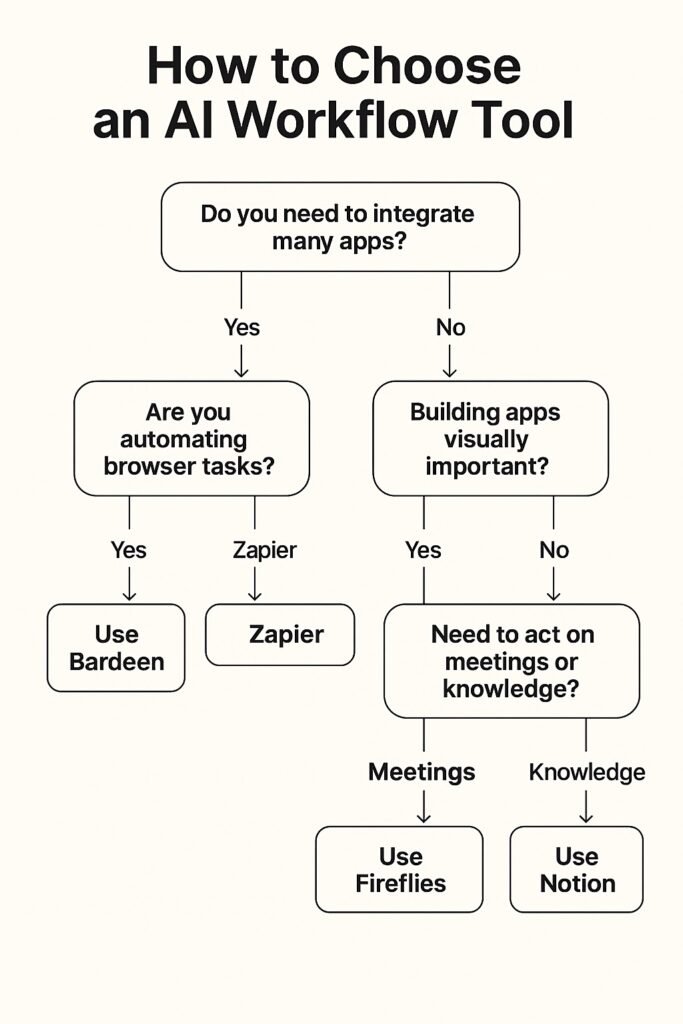
How to Choose the Right AI Workflow Tool
Choose based on:
Team size
Technical skill
Integration needs
Workflow complexity
Budget ceiling
Data sensitivity
Start with one workflow. Expand later.
Common Mistakes Small Businesses Make (And How to Avoid Them)
Many small businesses don’t fail at automation because of bad tools — they fail because of poor workflow design and strategy.
Here are the most common (and costly) mistakes to watch out for:
1. Buying Too Many Tools (Tool Overload)
Small businesses often stack multiple AI tools hoping to “cover everything.” The result? Fragmented workflows, duplicate data, and rising costs.
👉 Why it happens: Chasing trends instead of solving a specific problem
👉 Impact: Data silos, confusion, and wasted subscriptions
👉 Fix: Start with 1–2 core tools that integrate well and expand only when needed
2. Automating Broken Processes
Automation doesn’t fix inefficiency — it amplifies it. If your workflow is messy, automation just makes mistakes faster.
👉 Why it happens: Skipping process mapping
👉 Impact: Scaled chaos, more errors, harder debugging
👉 Fix: Simplify and document your workflow before automating
3. Ignoring Integration Limits
Many tools don’t “talk” to each other properly. Businesses underestimate how hard integrations can be.
👉 Why it happens: Assuming all tools connect seamlessly
👉 Impact: Broken workflows, manual workarounds
👉 Fix: Check native integrations, APIs, and compatibility before choosing tools
4. No Test Workflows (Going Live Too Fast)
Jumping straight into live automation without testing is a major risk.
👉 Why it happens: Rushing for quick results
👉 Impact: Wrong emails sent, data errors, customer trust damage
👉 Fix: Always run sandbox tests and edge-case scenarios before deployment
5. No Permission Controls (Security Risk)
Giving AI tools full access without restrictions can lead to serious issues.
👉 Why it happens: Lack of governance planning
👉 Impact: Data leaks, system errors, costly downtime
👉 Fix: Use role-based access and limit automation permissions
6. Over-Engineering Workflows
Many small businesses build overly complex automations they don’t actually need.
👉 Why it happens: Trying to replicate enterprise systems
👉 Impact: Hard-to-maintain systems, frequent breakdowns
👉 Fix: Keep workflows simple — automate one clear outcome at a time
7. No Clear Goal or KPI
Automation without a goal is just expensive experimentation.
👉 Why it happens: “AI hype” adoption
👉 Impact: No measurable ROI
👉 Fix: Define a clear objective (save time, reduce errors, increase leads)
8. Poor Data Quality (“Garbage In, Garbage Out”)
AI relies entirely on the data you feed it. Messy data = bad results.
👉 Why it happens: Unstructured or outdated data
👉 Impact: Incorrect outputs, broken automations
👉 Fix: Clean and standardize your data before automation
9. No Human Oversight
Fully trusting automation without review is risky.
👉 Why it happens: Overconfidence in AI
👉 Impact: Wrong outputs sent to customers, brand damage
👉 Fix: Keep human checkpoints for critical workflows
10. Automating Everything at Once
Trying to automate your entire business in one go is a common failure pattern.
👉 Why it happens: Lack of prioritization
👉 Impact: Confusion, poor results, hard-to-track issues
👉 Fix: Start with one workflow, optimize it, then scale gradually
Pro Tips:
The most successful small businesses don’t automate everything — they automate repeatable, high-impact tasks first, then expand step by step.
Recommended Starter Path
Start with one cross-app automation tool. Add knowledge AI next. Then layer meeting or prospect AI based on your business type.
For a ready-made ROI tested stack → see our full AI stack implementation guide.
FAQs — AI Workflow Tools
What is an AI workflow automation tool?
An AI workflow automation tool is software that automates multi-step business processes by using artificial intelligence instead of rigid, rule-based logic. Unlike traditional automation, these tools can analyze data, make decisions, and adapt over time.
They are commonly used to automate tasks like lead management, customer support, content workflows, data syncing, reporting, and internal operations. By connecting apps and applying AI decision logic, businesses can reduce manual work and improve accuracy at scale.
Are AI workflow automation tools safe for small businesses?
Most reputable AI workflow platforms are built with enterprise-grade security features, even for small businesses. These typically include data encryption, access controls, activity logs, and role-based permissions.
However, safety depends on how the tool is configured. Small businesses should always review data storage policies, third-party integrations, and compliance standards before adopting a platform. Choosing well-known providers with transparent security documentation significantly reduces risk.
Do I need coding skills to use AI workflow tools?
No, most AI workflow automation tools are designed for non-technical users. They use visual builders, drag-and-drop interfaces, and prebuilt templates to create workflows without writing code. Some platforms also offer low-code options for advanced customization, but coding is optional. This makes AI automation accessible to marketers, founders, virtual assistants, and small teams without developer support.
What is the cheapest AI workflow automation option?
The most affordable AI workflow tools usually offer free plans or low-cost entry tiers for beginners and small businesses. Platforms like Make and Bardeen are known for budget-friendly pricing while still providing powerful automation features.
The best low-cost option depends on usage limits, integrations, and automation complexity. Businesses should compare task limits, execution frequency, and AI features rather than price alone to get real value.
Can AI workflows replace employees?
AI workflows are designed to replace repetitive, time-consuming tasks, not human employees. They handle processes like data entry, follow-ups, scheduling, and routine analysis so teams can focus on strategy and creative work.
Instead of eliminating jobs, AI automation often helps businesses scale faster with smaller teams, reduce burnout, and improve productivity. Human judgment, creativity, and relationship-building remain irreplaceable.
🔍 Real-World AI Workflow Use Cases for Small Businesses
AI workflow automation is not just for tech companies. Small teams across different industries are using it daily to remove repetitive work and reduce response time.
Here are practical workflow examples that show how these tools are actually used.
Lead Handling and Qualification Workflows
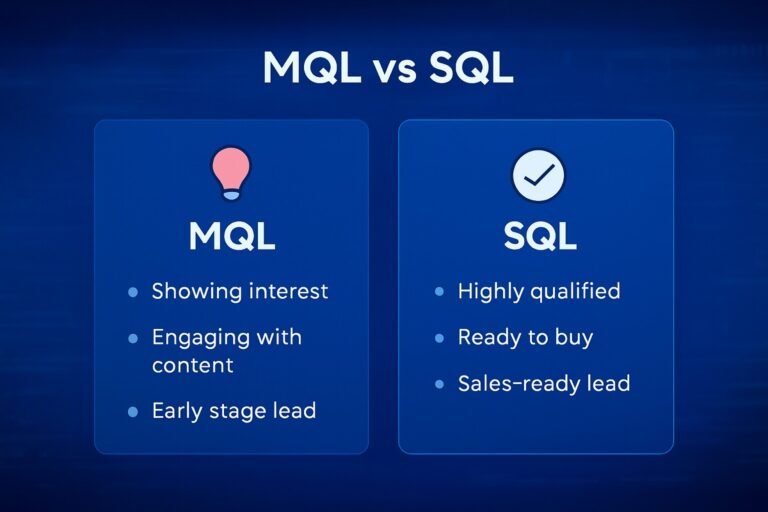
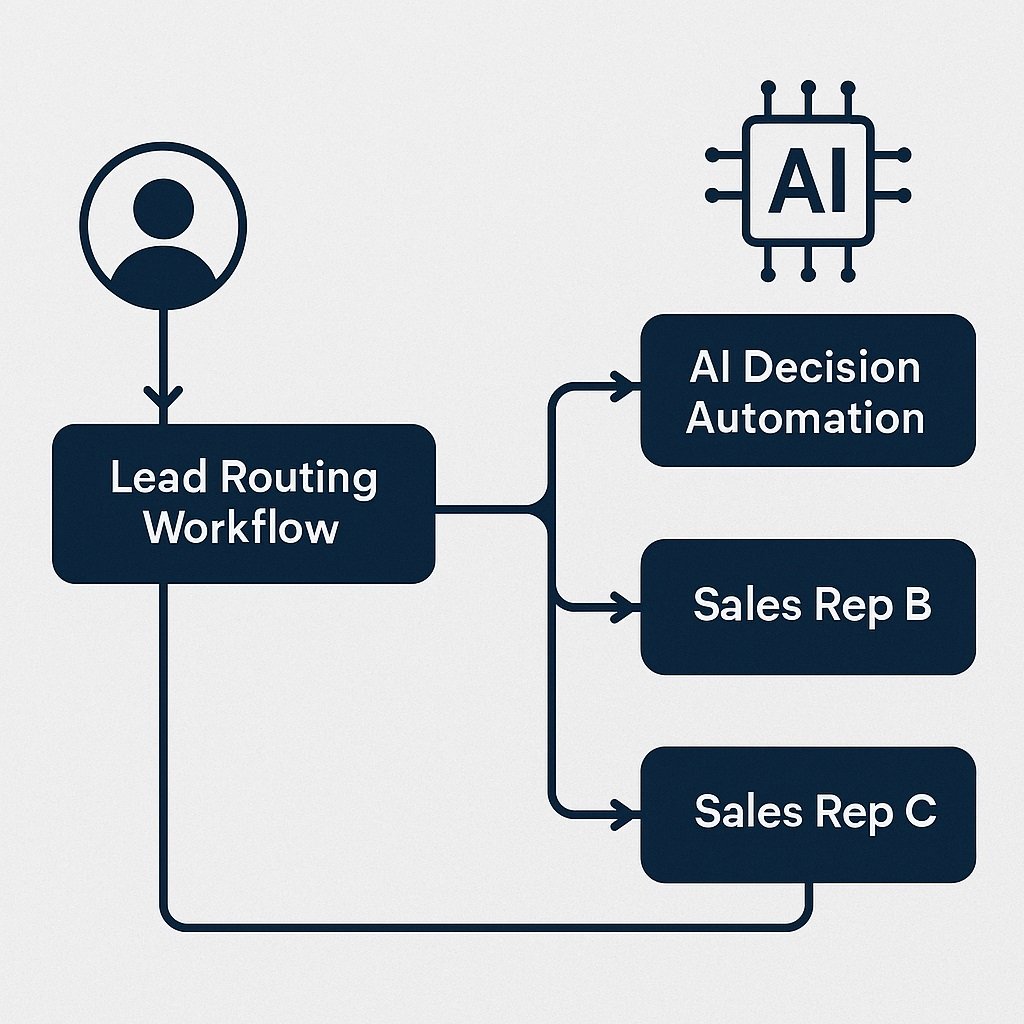
Many small businesses lose leads because responses are delayed. AI workflow tools can monitor inboxes, forms, and chat tools, then classify urgency and intent automatically.
For industry-specific examples, real estate businesses are already using these workflows for lead qualification, follow-ups, and client tracking. See how it works in our guide on AI automation for real estate.
A typical flow:
Form submission → AI intent check → CRM lookup → lead score → auto-reply draft → task creation → sales alert This reduces response time from hours to minutes and keeps hot leads from going cold.
Client Onboarding Automation
Onboarding often includes repeated steps — sending documents, collecting details, assigning tasks, and creating project folders.
AI workflows can:
- Read intake forms
- Extract key requirements
- Create project records
- Assign onboarding checklists
- Draft welcome messages
This removes manual setup steps and keeps onboarding consistent.
AI Workflow for Marketing Operations
Marketing teams use AI workflows to handle content and campaign operations.
Examples include:
- Turning briefs into task lists
- Generating first draft outlines
- Scheduling cross-channel posts
- Tagging and categorizing content
- Extracting SEO entities from drafts
This improves output speed without increasing headcount.
🧪 Beginner vs Advanced AI Workflow Tools
Not every small business should start with complex automation platforms. Choosing the wrong complexity level causes abandonment.
Beginner Friendly Tools
Best for:
- Solo founders
- Small teams
- Non-technical users
Traits:
- Template based
- Minimal logic setup
- Visual builders
- Guided setup
Examples: Zapier, Notion AI, Bardeen
Intermediate Tools
Best for:
- Growing agencies
- Ops managers
- Technical marketers
Traits:
- Branching logic
- Data mapping
- Conditional routing
Examples: Make, Airtable AI, Clay
Advanced Tools
Best for:
- Technical teams
- Product workflows
- API heavy environments
Traits:
- Code steps
- Custom endpoints
- Event triggers
Examples: Pipedream
💰 Cost vs Value — What Small Businesses Should Expect
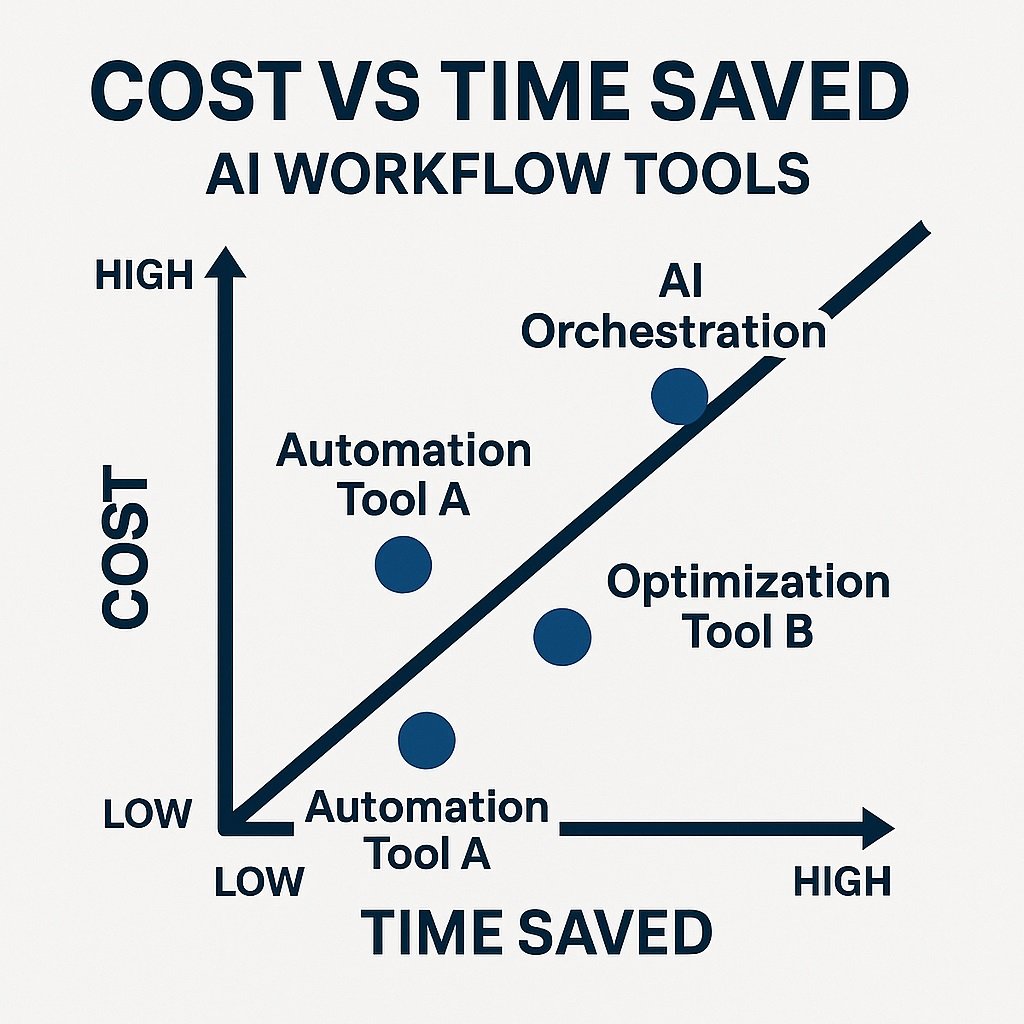
One mistake small businesses make is comparing tool cost without measuring time saved. A $50/month workflow tool that saves 10 staff hours per week is cheaper than manual labor.
Evaluate value using:
- Hours saved weekly
- Error reduction
- Response speed
- Client experience
- Workflow consistency
Think in time recovered, not subscription price.
🔐 Security and Data Handling Considerations
AI workflow tools often connect multiple systems. That means data flows across platforms.
Small businesses should check:
- Permission controls
- Workspace roles
- Encryption basics
- Data retention settings
- Integration access limits
- Activity logs
Never give full access tokens when scoped permissions are available.
🧩 How AI Workflow Tools Fit Into a Full Automation Stack
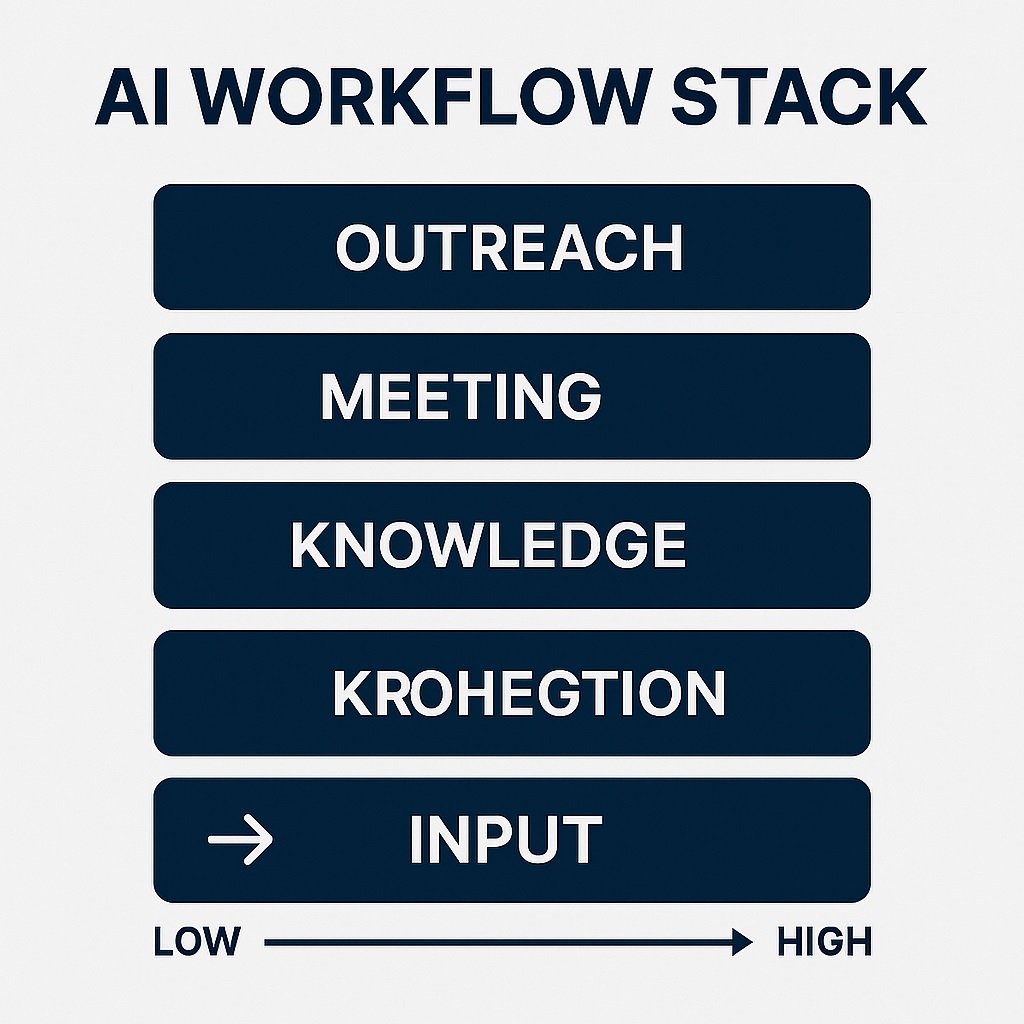
AI workflow tools are one layer — not the entire stack.
Typical small business stack layers:
Input layer — forms, inbox, chat
Workflow layer — Zapier / Make
Knowledge layer — Notion AI
Meeting layer — Fireflies
Data layer — Airtable
Outreach layer — Clay
This layered view helps planning.
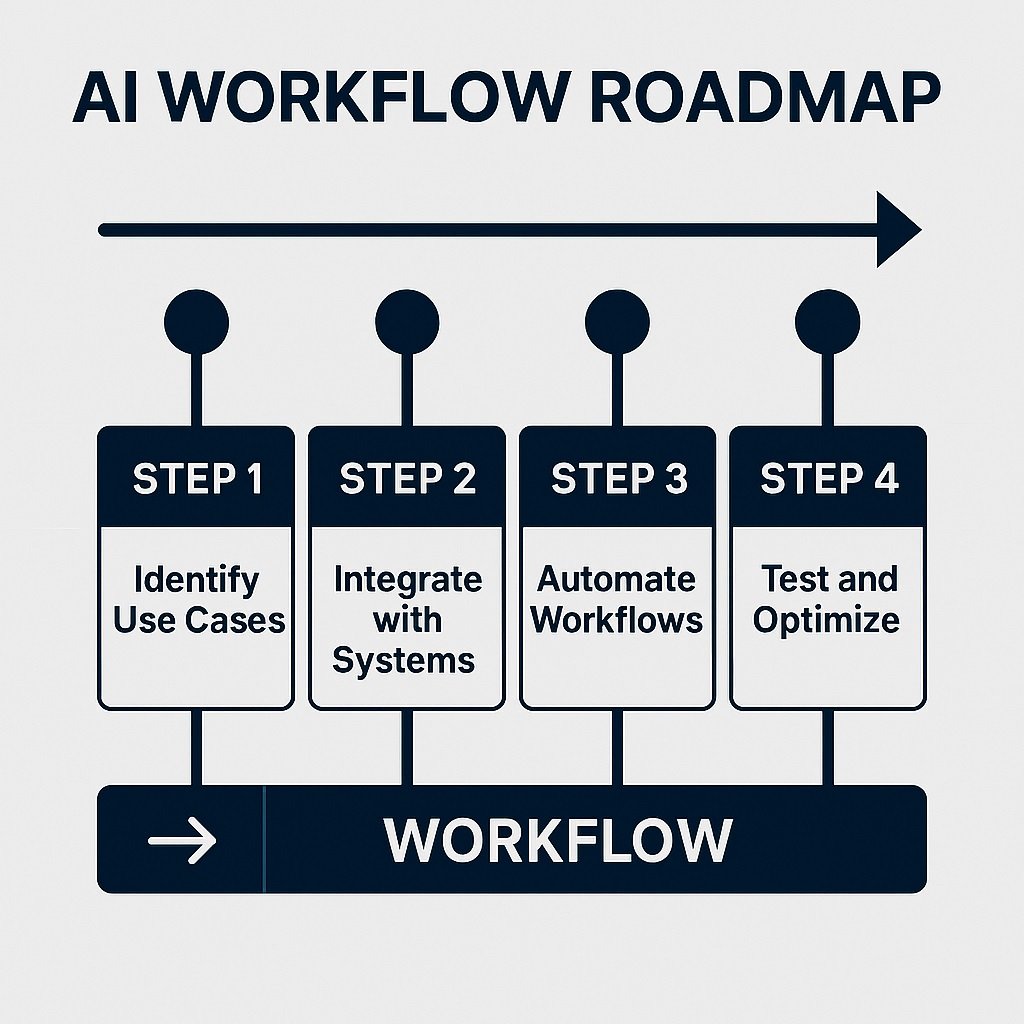
📈 Implementation Roadmap for Small Teams
Most automation failures happen from trying to automate everything at once.
Better roadmap:
Step 1 — Map one workflow
Step 2 — Identify manual steps
Step 3 — Automate one decision point
Step 4 — Test with low volume
Step 5 — Monitor results
Step 6 — Expand gradually
Small wins build adoption.
⚖️ AI Workflow Tools vs Traditional Automation Tools
Traditional automation:
- Fixed rules
- Binary triggers
- No interpretation
AI workflow automation:
- Context interpretation
- Text understanding
- Classification
- Summarization
- Smart routing
AI adds decision capability, not just speed.
Conclusion
AI workflow automation is no longer optional for small businesses that want operational efficiency. The right platform depends on your workflow type, team skill level, and integration needs. Start with one process. Automate it fully. Measure results. Then expand your workflow layer by layer.