Beyond Research: The 7 Best AI Workflow Tools for Law Firms in 2026


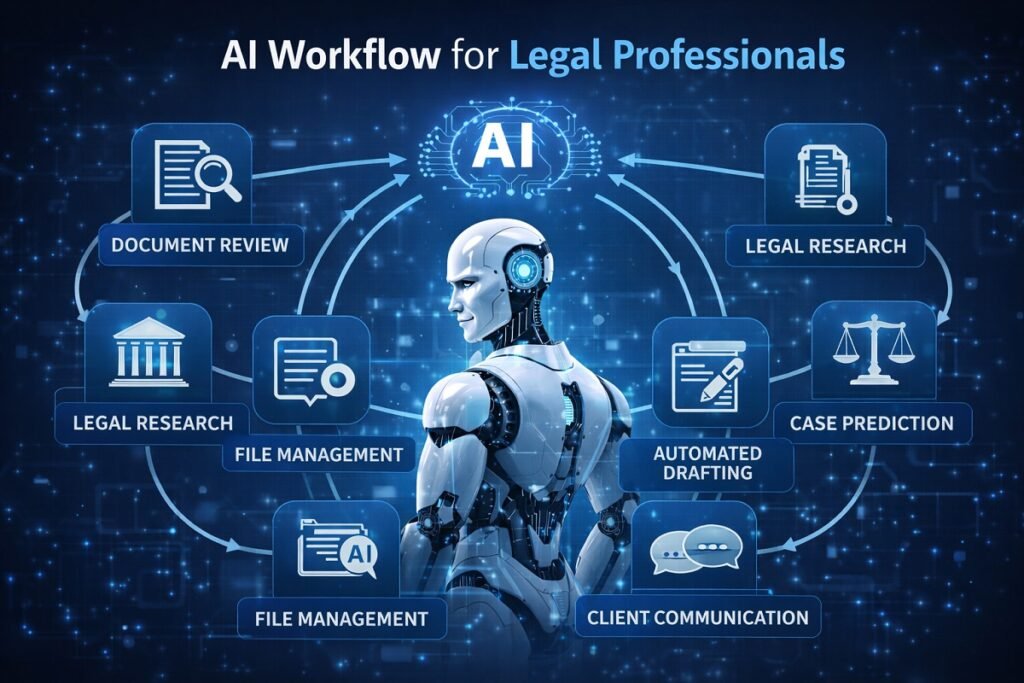
The legal industry is developing faster than ever. AI workflow for legal professionals is no longer just a trend—it’s a necessity. Law firms are using AI to streamline operations, automate repetitive tasks, enhance legal research, and improve client outcomes. From document review to case management and contract analysis, AI tools are reshaping how attorneys work.
In this guide, we’ll explore the 7 best AI workflow tools for law firms in 2026, their features, pros and cons, and how to choose the right tool for your firm.
Why Law Firms Need AI Workflow Tools
Legal professionals face intense workloads. Drafting contracts, reviewing documents, and conducting case research can take hours—or even days. AI-powered legal software automates these tasks, allowing attorneys to focus on strategic decision-making.
Benefits of using AI workflow tools in law firms include:
- Faster legal research: AI scans thousands of cases in minutes, saving time.
- Document automation: Draft contracts, agreements, and pleadings faster with AI.
- Task management: Track deadlines, tasks, and client communication in one place.
- Risk mitigation: AI flags inconsistencies, risks, and compliance issues.
- Client insights: Predictive analytics for case outcomes and billing efficiency.
AI Workflow Tools Comparison Table
| Tool | Best For | AI Features | Integration | Budget |
| Luminance | Contract review | Clause extraction, risk detection | Doc mgmt systems | $$$ |
| ROSS Intelligence | Legal research | NLP search, case summaries | Legal DBs | $$ |
| Casetext | Brief drafting | CARA AI, citation checks | Doc mgmt | $$ |
| Kira Systems | Due diligence | Clause extraction, risk analysis | Doc mgmt | $$$ |
| LawGeex | Standard contracts | Policy compliance, workflow | Cloud storage | $$ |
| Evisort | Contract lifecycle | Analytics, risk detection | CRM, Doc mgmt | $$$ |
| DoNotPay | Client tasks | Automated letters, chatbot | Web | $ |
1. Luminance – AI-Powered Contract Analysis (Best for Contract Review Automation)
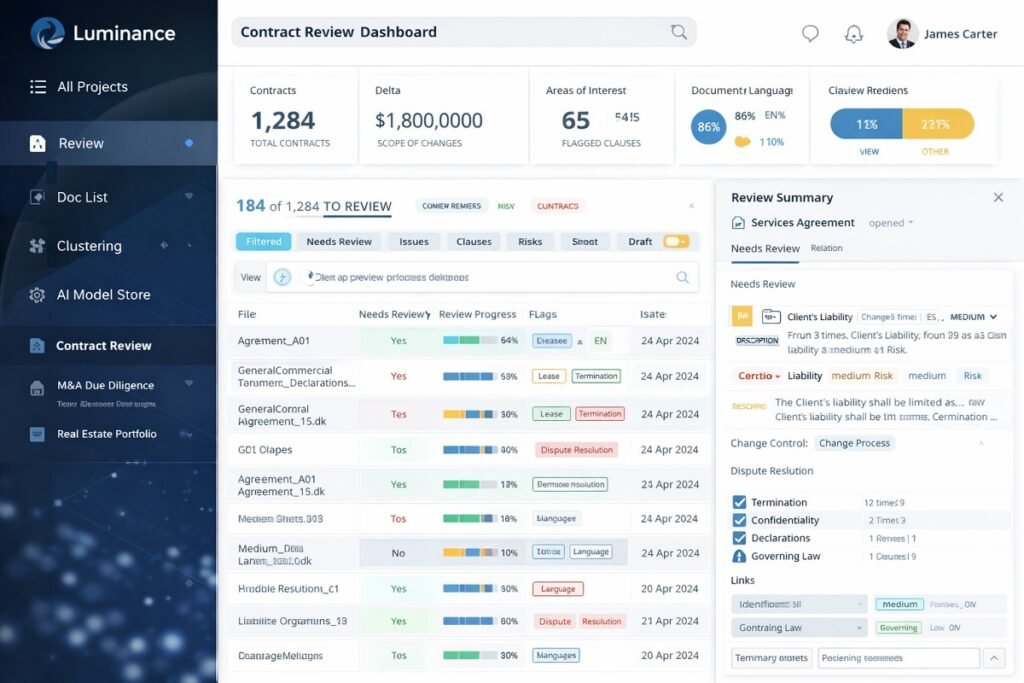
Luminance is a powerful AI tool designed to automate contract analysis and review. It uses machine learning to scan, understand, and categorize documents, highlighting anomalies and potential risks. For law firms handling large volumes of contracts, Luminance significantly reduces manual workload.
The platform’s AI can learn a firm’s review style, adapting over time to provide more accurate insights. Beyond contract review, Luminance also provides dashboards to track progress, identify bottlenecks, and measure risk exposure. Law firms report that they can review hundreds of documents in a fraction of the time it would take manually.
Key Features:
- AI-driven contract analysis for large document sets
- Automated risk detection and clause categorization
- Summarization of key clauses
- Integration with document management systems
- Multilingual document support
Pros:
- Reduces time for large-scale contract reviews
- Minimizes human error
- Highly customizable AI models
Cons:
- High subscription cost
- Requires onboarding and training for optimal use
2. ROSS Intelligence – AI Legal Research (Best for Case Law Research)
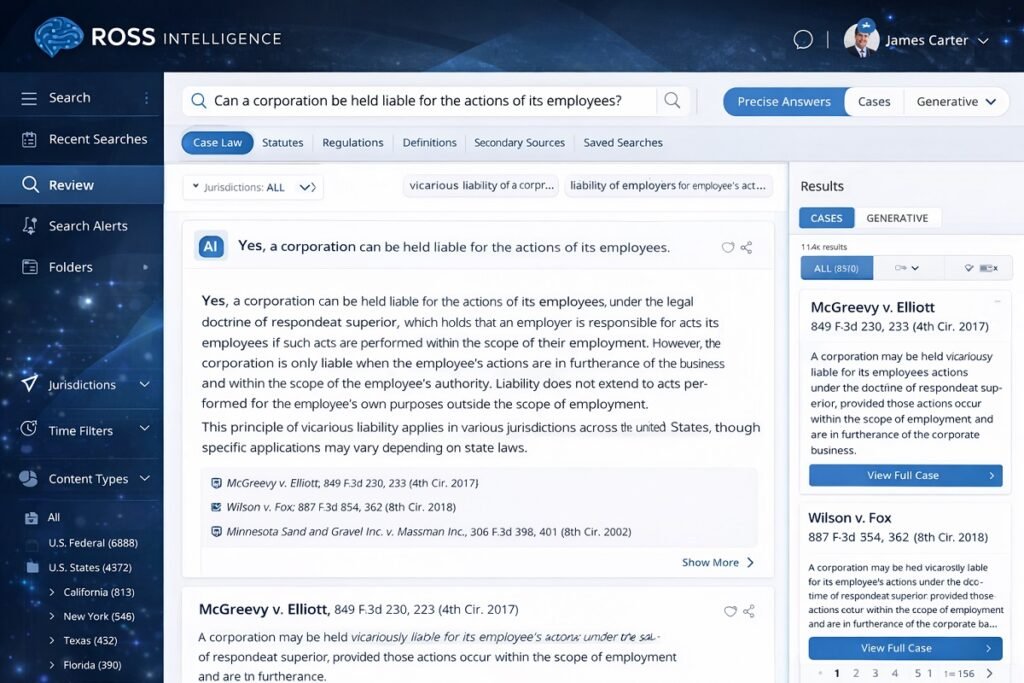
ROSS Intelligence is built for law firms that need fast, accurate legal research. Using natural language processing, attorneys can ask complex questions and get relevant case law, statutes, and legal commentary in seconds.
What sets ROSS apart is its ability to provide context-aware suggestions, helping attorneys identify precedents and citations more efficiently. It also integrates with case management tools, making research workflows seamless. Law firms with large litigation practices find ROSS particularly valuable for reducing research hours while improving the quality of legal briefs.
Key Features:
- Natural language search for case law and statutes
- AI-generated summaries of relevant cases
- Citation tracking and analysis
- Workflow automation for research tasks
- Integration with legal databases
Pros:
- Accelerates legal research
- Improves case accuracy and argument strength
- Saves attorney time
Cons:
- Limited coverage in some jurisdictions
- Subscription cost can be high for small firms
3. Casetext – AI for Litigation and Brief Analysis (Best for Legal Brief Drafting)
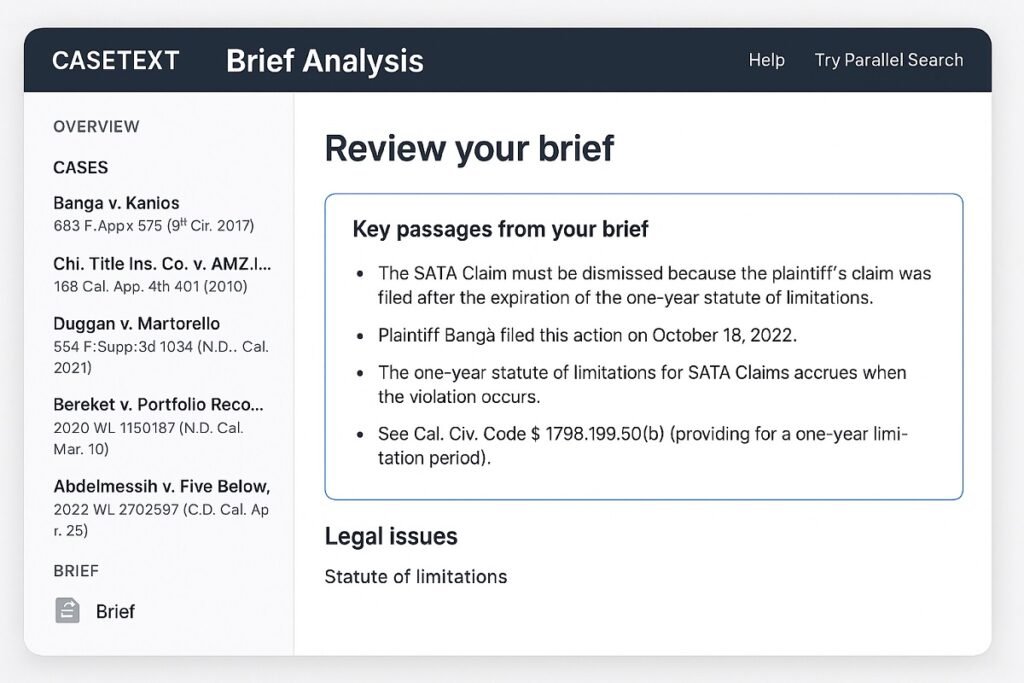
Casetext helps law firms with litigation support, brief drafting, and legal research. Its AI-powered CARA system analyzes legal briefs and recommends supporting cases, improving argument quality.
Casetext also performs citation verification, ensuring your briefs meet professional standards. Collaboration features allow multiple attorneys to work on briefs simultaneously, streamlining team workflows. With Casetext, law firms can reduce research time, avoid missed citations, and focus on strategy rather than manual tasks.
Key Features:
- CARA AI for brief analysis and argument recommendations
- Automated citation checks
- AI-based case prediction
- Collaboration tools for legal teams
- Integration with document management systems
Pros:
- Speeds up brief drafting and research
- Ensures citation accuracy
- Supports collaborative legal workflows
Cons:
- Learning curve for new users
- Limited offline capabilities
4. Kira Systems – AI Contract & Document Review (Best for Due Diligence)
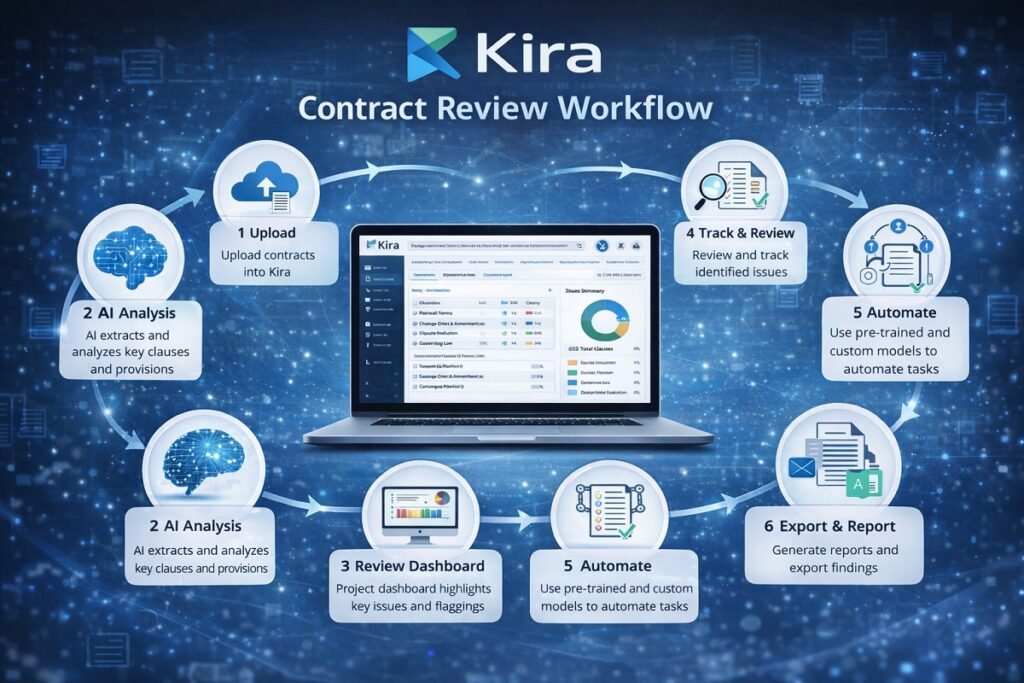
Kira Systems specializes in AI-assisted contract review and due diligence. Its platform identifies, extracts, and categorizes critical clauses from large volumes of documents. This makes it ideal for law firms managing mergers, acquisitions, or compliance audits.
Kira’s AI can be trained on firm-specific document patterns, improving accuracy over time. Advanced analytics dashboards allow attorneys to track review progress, detect bottlenecks, and make data-driven decisions. Many large firms report that Kira reduces contract review times by over 50%.
Key Features:
- Machine learning-based document review
- Clause extraction and categorization
- Risk and compliance detection
- Collaboration tools for legal teams
- Analytics dashboards
Pros:
- Highly accurate AI for complex contracts
- Saves hours on due diligence
- Reduces human error
Cons:
- High costs for small firms
- Requires training for optimal performance
5. LawGeex – AI Contract Review & Approval (Best for Automation of Standard Contracts)
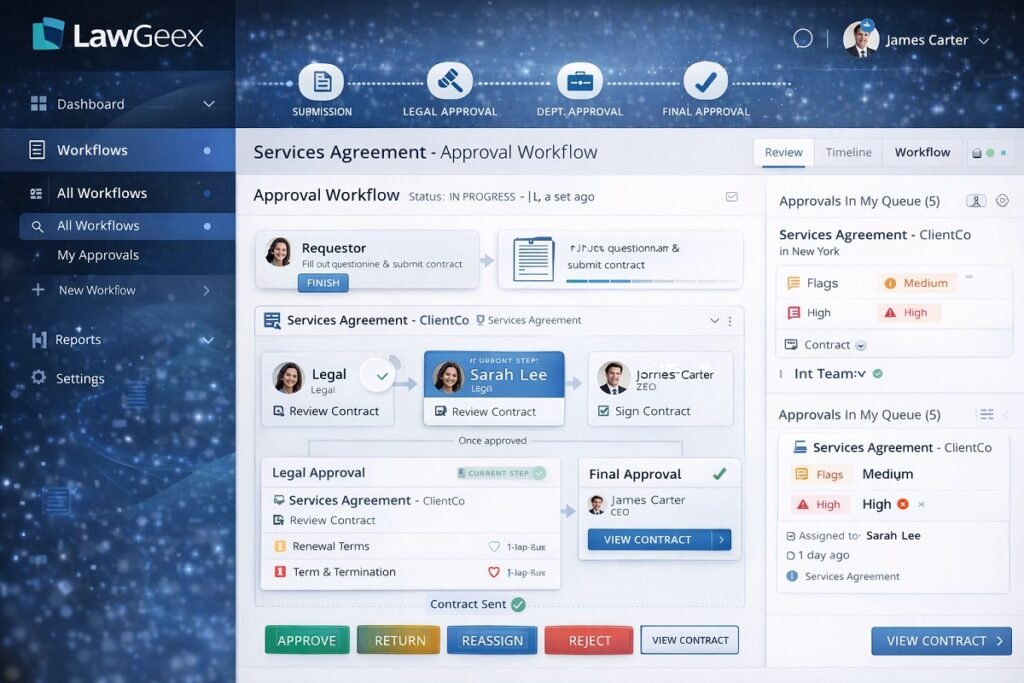
LawGeex automates standard contract review and approval, allowing attorneys to focus on higher-value tasks. Its AI compares contracts against predefined legal policies, flagging deviations and ensuring compliance.
LawGeex works well for firms handling repetitive contract types, such as NDAs, vendor agreements, or employment contracts. Its intuitive interface allows non-technical staff to manage approvals efficiently to reduce bottlenecks in legal workflows.
Key Features:
- AI-powered contract review and approval
- Policy compliance checks
- Workflow automation
- Cloud integration
- Customizable AI rules
Pros:
- Speeds up routine contract tasks
- Ensures policy compliance
- Easy to use for non-technical staff
Cons:
- Limited to standard contracts
- Customization setup may require assistance
6. Evisort – AI Contract Lifecycle Management (Best for Enterprise Legal Teams)
Evisort focuses on contract lifecycle management, automating creation, review, and renewal processes. Its AI provides clause extraction, risk detection, and actionable analytics, which gives law firms insights into contracts and obligations.
Evisort’s dashboards help legal teams track contracts from draft to execution, improving operational efficiency. Integration with CRM and document management systems allows smooth data flow. Large firms use Evisort to reduce administrative overhead and improve visibility into contract obligations.
Key Features:
- Contract creation, tracking, and renewal automation
- AI-powered clause extraction and risk detection
- Analytics dashboards for insights
- CRM and document system integration
- Collaboration tools
Pros:
- Simplifies contract lifecycle management
- Reduces administrative burden
- Provides actionable insights
Cons:
- Higher subscription costs
- Complex implementation for smaller firms
7. DoNotPay – AI Legal Assistant (Best for Client-Facing Automation)
DoNotPay acts as an AI legal assistant for clients, automating tasks like drafting letters, filing small claims, and managing consumer rights. Although it doesn’t replace professional legal advice, it can handle repetitive tasks efficiently.
Law firms can use DoNotPay to enhance client services, reduce low-value tasks, and improve accessibility. Its AI chatbot interface allows clients to complete routine legal tasks without attorney intervention, saving time for both parties.
Key Features:
- Automated legal documents
- AI chatbot for client queries
- Payment dispute automation
- Subscription and billing management
- Guided legal assistance
Pros:
- Improves client experience
- Reduces attorney workload for simple tasks
- Low-cost automation option
Cons:
- Limited to simple legal tasks
- Jurisdiction coverage may vary
FAQs About AI Workflow Tools for Law Firms
Are AI workflow tools secure for sensitive legal data?
Yes, most top AI legal tools use enterprise-level encryption and comply with privacy standards. Always verify compliance with local regulations.
Can small law firms benefit from AI workflow tools?
Absolutely. Tools like LawGeex and DoNotPay are cost-effective options for smaller teams.
Do these tools replace lawyers?
No. AI tools assist lawyers, reducing repetitive tasks but attorneys remain essential for strategy and decision-making.
How difficult is it to implement AI tools in a law firm?
Implementation ranges from a few hours to several weeks, depending on the tool’s complexity and firm size. Most vendors offer onboarding support.
Can AI improve client satisfaction?
Yes, AI can speed up response times, automate routine tasks, and provide predictive insights, enhancing the client experience.

Conclusion
AI workflow tools are revolutionizing the legal industry. From automated contract review to streamlined legal research, law firms can save time, reduce errors, and focus on high-value tasks. Selecting the right AI tool depends on your firm’s size, workflow, and budget, but the benefits are clear: smarter, faster, and more efficient legal practice in 2026.