
AI Automation for Real Estate: How Agents Close Deals Faster in 2026


Real estate has always been fast-paced. Leads come in at odd hours. Follow-ups slip through the cracks. Admin work eats up time that should be spent closing deals. That’s exactly where AI automation for real estate is changing the game.
In 2026, agents are not just working harder. They are working smarter. With the right AI tools and workflows, you can automate repetitive tasks, respond instantly to leads, and move prospects through your pipeline faster than ever before. This guide breaks down how it all works and how you can start using it right away.
What Is AI Automation in Real Estate?
AI automation in real estate refers to using artificial intelligence tools to handle repetitive tasks, analyze data, and streamline workflows across your business.
This includes:
- Lead generation and qualification
- Automated follow-ups
- Smart CRM workflows
- Property recommendations
- Marketing automation
Instead of manually chasing every lead, AI helps you focus only on high-intent prospects. Today, AI automation isn’t limited to real estate. Many industries already use advanced systems to streamline operations. If you want a broader view, check out this guide on AI workflow automation tools for businesses.
Why Real Estate Agents Are Adopting AI in 2026
The competition is tighter than ever. Speed matters. Response time matters even more.
Here’s what’s driving adoption:
- Buyers expect instant replies
- Lead volume is increasing
- Manual processes slow down conversions
- Data-driven decisions outperform guesswork
Agents using real estate automation software are closing deals faster because they eliminate delays at every stage.
Key Benefits of AI for Real Estate Agents
AI automation delivers value across nearly every aspect of a real estate business. From reducing repetitive work to improving client experiences, these benefits help agents operate more efficiently while creating opportunities for long-term growth.
1. Faster Response Times
AI helps businesses respond to inquiries more quickly, reducing delays and improving responsiveness throughout the customer journey.
2. Smarter Lead Prioritization
Automation identifies high-priority opportunities, allowing agents to focus their time on prospects with the greatest potential.
3. Increased Operational Efficiency
Routine administrative tasks can be streamlined, giving teams more time to concentrate on client relationships and business growth.
4. Better Client Experience
Consistent communication, timely updates, and organized processes contribute to a smoother experience for buyers, sellers, and property owners.
5. Improved Business Scalability
Standardized automation makes it easier to manage increasing workloads without significantly expanding administrative resources.
Manual vs. AI-Powered Real Estate Processes
The comparison below shows how AI streamlines routine business activities across a modern real estate agency.
| Business Area | Manual Process | AI Automation |
|---|---|---|
| Lead Capture | Manual | Automatic |
| CRM Updates | Manual | Automatic |
| Appointment Booking | Manual | AI Scheduler |
| Listing Marketing | Manual | AI Generated |
| Client Follow-up | Manual | Trigger-based |
| Reporting | Manual | Live Dashboard |
Types of AI Tools Used in Real Estate
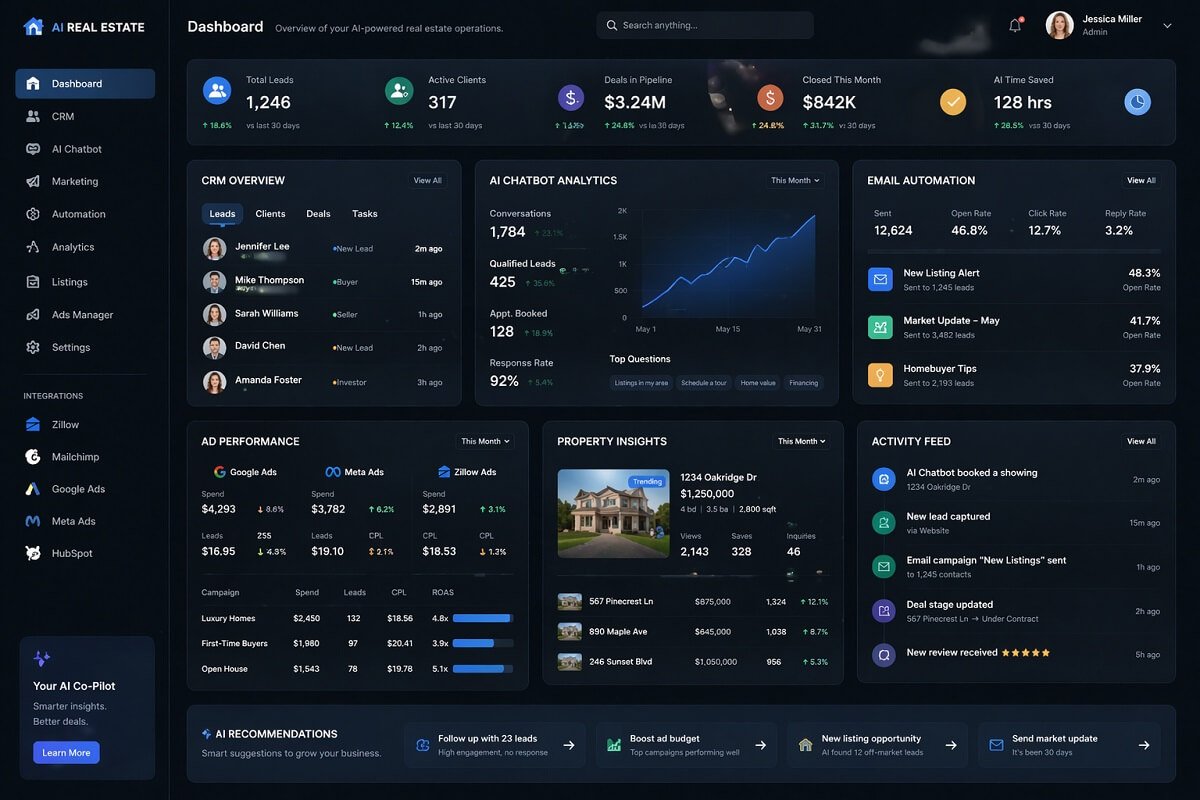
To build a powerful system, you need the right stack:
- AI CRM for real estate → Manages contacts and automates pipelines
- AI chatbots → Engage website visitors instantly
- Lead generation AI tools → Capture and score leads
- Marketing automation platforms → Email, ads, and content
- Workflow automation tools → Connect everything together
Each tool plays a role in creating a seamless process.
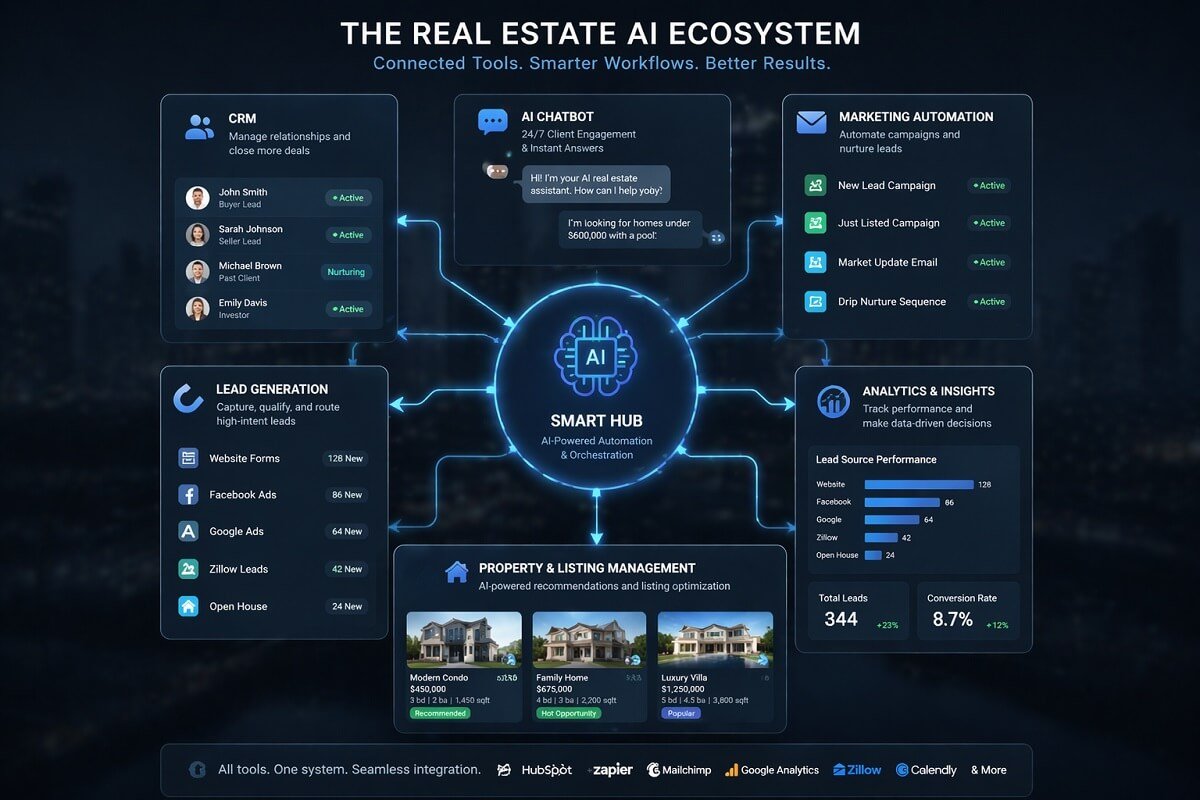
Best AI Tools for Real Estate Automation (2026)
Here are some widely used tools agents rely on:
| Tool Type | Example Use | Benefit |
| AI CRM | Automate pipeline tracking | Never miss a follow-up |
| Chatbots | Website lead capture | 24/7 engagement |
| Email AI | Smart follow-ups | Higher open rates |
| Ad AI | Targeted campaigns | Better ROI |
| Workflow Automation | Connect apps | Saves time |
Choose tools that integrate well. That’s more important than features. Workflow automation tools → Connect everything together. These platforms act as the backbone of your system by integrating CRM, chatbots, and marketing tools into one seamless process. If you want to compare top platforms, see this detailed guide on AI automation tools for businesses.
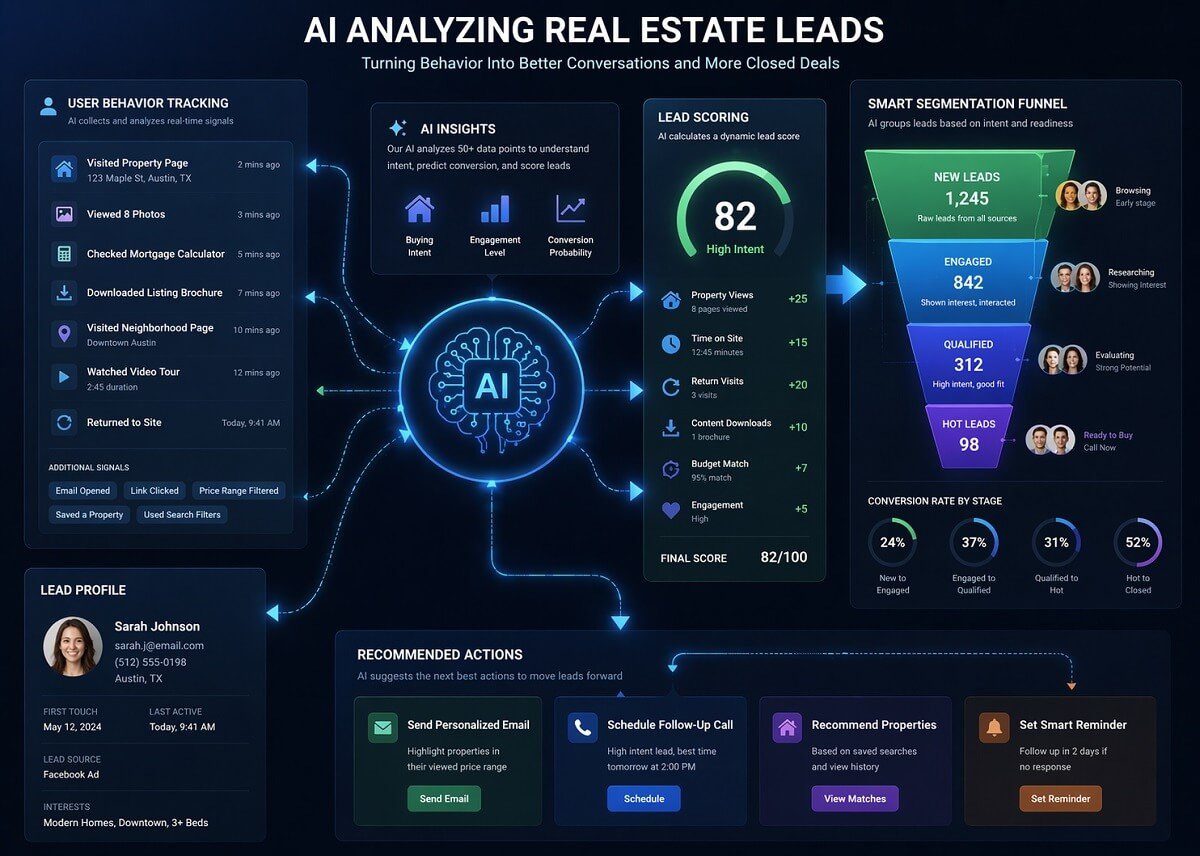
How AI Helps Generate and Qualify Leads
Lead generation is no longer just about volume. It’s about quality.
AI improves this by:
- Tracking user behavior (clicks, time on page, searches)
- Scoring leads based on intent
- Segmenting audiences automatically
For example:
- A user browsing multiple listings gets flagged as high intent
- AI pushes them into a priority follow-up sequence
This is where AI lead generation for real estate becomes powerful.
Automating Follow-Ups and Client Communication
Most deals are lost because of poor follow-up. AI fixes that.
You can automate:
- Email sequences
- SMS reminders
- Appointment confirmations
- Check-ins after property visits
Example Workflow:
- Lead submits form
- Instant AI response sent
- Follow-up email after 1 hour
- SMS reminder next day
- Call scheduled automatically
This keeps you top of mind without manual effort.
AI for Property Marketing and Listings
Marketing is one of the biggest time drains. AI speeds it up.
You can use AI to:
- Write property descriptions
- Generate ad copy
- Create social media posts
- Optimize listing titles
AI tools also analyze which listings perform best and suggest improvements.
Using AI Chatbots in Real Estate
Chatbots are one of the easiest wins.
They can:
- Answer FAQs instantly
- Schedule property visits
- Capture contact details
- Recommend listings
A well-trained real estate chatbot AI can handle hundreds of conversations at once.
AI CRM and Workflow Automation
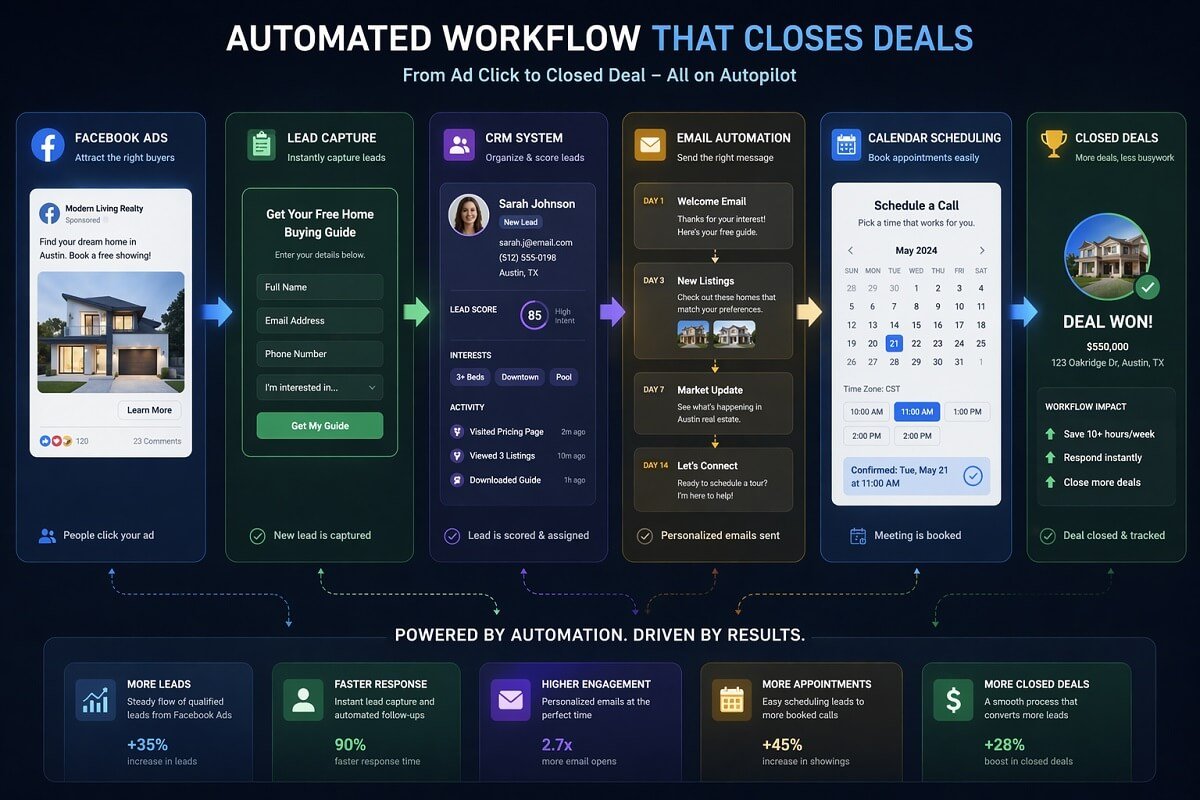
This is the core of your system.
An AI CRM for real estate:
- Tracks every interaction
- Automates deal stages
- Sends reminders
- Integrates with email, ads, and chat
Many agents also rely on systems similar to asset management workflows to organize and track information at scale. Here’s a breakdown of the best asset management workflow software.
Real Estate Workflow Automation Examples
Understanding AI is one thing, but seeing how it fits into everyday operations makes implementation much easier. Real estate workflow automation connects multiple business processes into a single automated system, reducing manual handoffs, preventing missed tasks, and keeping every transaction moving forward. Instead of automating individual tasks, these workflows automate the entire process from start to finish.
Below are practical examples of how modern real estate businesses use workflow automation to improve efficiency while maintaining a better client experience.
1. Buyer Inquiry to Property Showing Workflow
- A buyer submits an inquiry through your website or listing portal.
- The inquiry is automatically assigned to the appropriate agent.
- The buyer receives available viewing times instantly.
- Appointments are added to both the client’s and agent’s calendars.
- Reminder notifications are sent before the scheduled viewing.
This workflow minimizes scheduling delays and ensures every qualified inquiry progresses quickly toward an in-person property visit.
2. New Property Listing Workflow
- Property information is submitted once.
- Listing details are reviewed automatically.
- Required documents are requested from the property owner.
- Internal approval tasks are assigned to the marketing team.
- The completed listing is published across connected marketing channels.
Automating listing preparation reduces administrative delays while helping maintain consistent property information across every platform.
3. Transaction Management Workflow
- An accepted offer triggers the transaction workflow.
- Inspection, financing, and legal milestones are created automatically.
- Responsible team members receive task notifications.
- Completion status is tracked in a centralized dashboard.
- Closing documents are prepared once every milestone is complete.
This workflow helps real estate teams manage complex transactions without relying on manual spreadsheets or constant status checks.
4. Referral Management Workflow
- A referral is submitted through an online form.
- The referral is matched with the appropriate agent or office.
- Progress updates are logged automatically.
- Referral partners receive milestone notifications.
- Commission tracking begins after a successful closing.
Automating referral management improves transparency while reducing administrative work associated with partner relationships.
5. Client Onboarding Workflow
- A signed agreement starts the onboarding process.
- Welcome documents are delivered automatically.
- Required identification and paperwork are collected.
- Important deadlines are scheduled.
- The client receives progress updates throughout the engagement.
A structured onboarding workflow creates a consistent experience for every client while ensuring that important documentation and compliance requirements are completed on time.
Key takeaway: The biggest advantage of real estate workflow automation is not replacing agents—it is eliminating repetitive coordination between people, software, and departments. As more processes become connected, businesses spend less time on administration and more time serving clients and closing transactions.
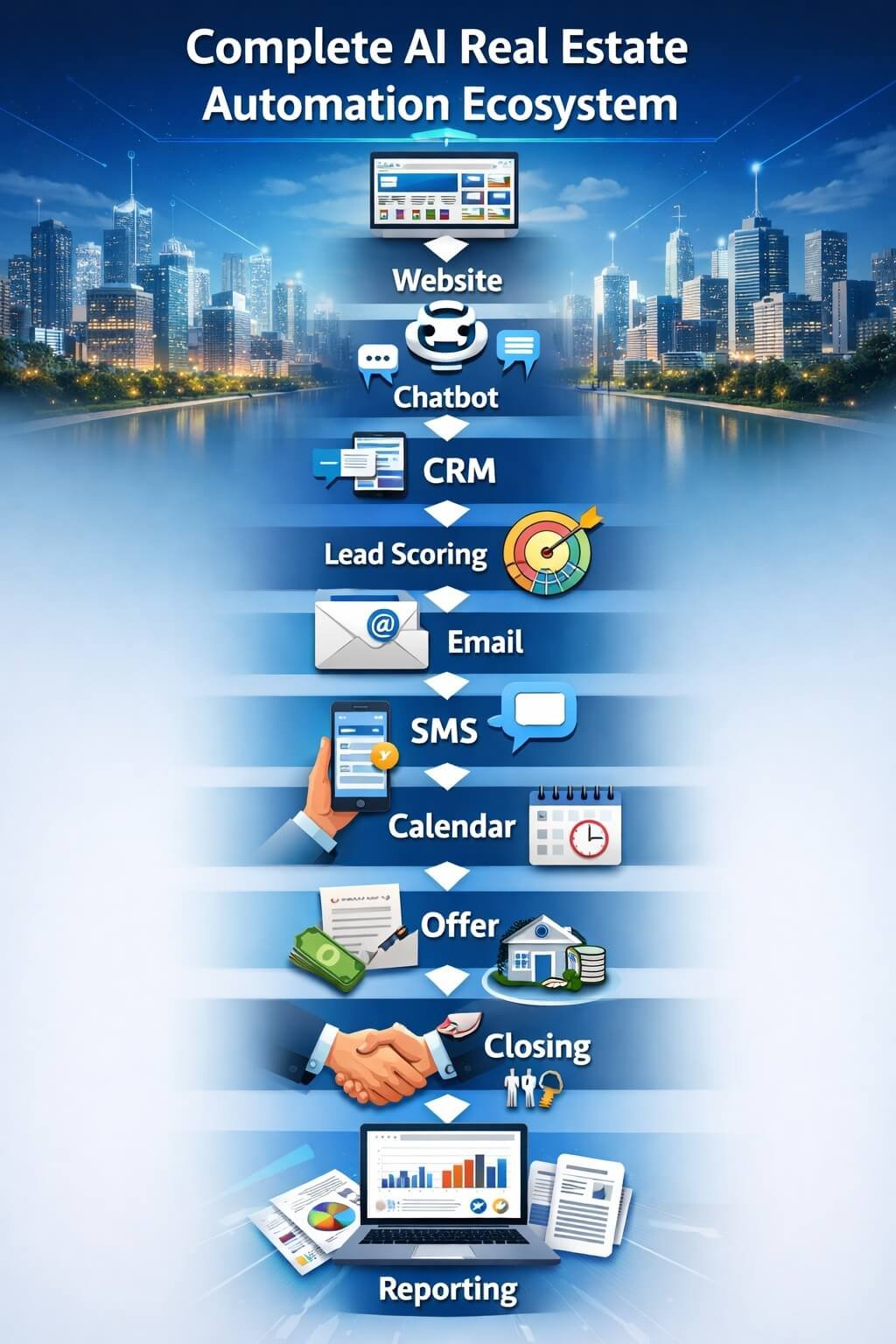
Real Estate Operations Automation
While many discussions around AI focus on generating leads and improving client communication, much of a real estate company’s workload happens behind the scenes. Administrative processes, transaction coordination, compliance, reporting, and internal approvals often consume hours every week. Real estate operations automation helps eliminate these repetitive manual tasks, creating a more organized and scalable business.
Rather than relying on spreadsheets, emails, and manual reminders, modern real estate automation systems connect internal operations so information flows automatically between departments, reducing delays and minimizing human error.
Document and Contract Management
Managing purchase agreements, disclosure forms, inspection reports, and closing documents manually can quickly become overwhelming as transaction volume increases. Automation centralizes these documents, tracks version history, requests missing paperwork, and alerts team members whenever approvals are required.
This reduces paperwork bottlenecks while helping ensure every transaction follows a consistent documentation process.
Task Assignment and Team Coordination
Every property transaction involves multiple stakeholders, including agents, transaction coordinators, photographers, inspectors, lenders, and legal professionals. Automation assigns responsibilities automatically whenever a transaction reaches a new milestone, ensuring that each team member knows exactly what needs to be completed next.
This creates greater accountability while reducing the need for constant manual follow-ups between departments.
Commission and Payment Tracking
Calculating commissions manually can become complicated when multiple agents, referral partners, or broker splits are involved. Automated commission tracking applies predefined rules, calculates payouts, monitors payment status, and generates accurate records for accounting purposes.
Besides saving administrative time, automated calculations also reduce costly payment errors.
Compliance and Audit Preparation
Real estate businesses must maintain complete records for regulatory compliance and internal audits. Automation helps by tracking document completion, recording activity logs, maintaining approval histories, and notifying staff whenever required information is missing before a transaction progresses.
This creates a standardized process that makes compliance easier without adding extra administrative work.
Performance Reporting and Business Insights
Business decisions become more effective when they’re based on accurate operational data rather than assumptions. Automated reporting systems consolidate information from multiple sources into live dashboards, allowing brokers and managers to monitor transaction volume, team productivity, operational efficiency, and overall business performance in real time.
Instead of spending hours compiling reports, leadership can focus on identifying opportunities to improve efficiency and support business growth.
Why Operations Automation Matters
Successful real estate businesses don’t scale simply by generating more leads—they scale by building efficient internal operations. When administrative work, document handling, reporting, approvals, and coordination become automated, agents and support teams spend less time managing processes and more time delivering value to clients.
Key takeaway: Real estate operations automation focuses on improving the internal systems that keep a brokerage running efficiently. By automating administrative workflows instead of customer interactions, businesses reduce operational costs, improve consistency, and create a stronger foundation for long-term growth.
AI Customer Service Automation for Real Estate
Once a client enters an active transaction, their needs shift from sales communication to ongoing support. AI customer service automation helps real estate businesses deliver timely updates, coordinate services, and improve the overall client experience throughout the buying, selling, or property management process.
Instead of replacing personal relationships, automation handles routine service requests so agents can dedicate more time to negotiations, consultations, and high-value conversations that require human expertise.
24/7 Client Support
Real estate questions don’t always arrive during business hours. Automated customer service systems provide immediate responses to common inquiries, ensuring clients receive helpful information even during evenings, weekends, and holidays.
Providing continuous support improves responsiveness while reducing the number of routine questions agents need to answer manually.
Appointment and Service Coordination
Property inspections, appraisals, photography sessions, walkthroughs, and closing appointments often require careful coordination between multiple parties. AI-powered service automation sends confirmations, rescheduling options, reminders, and status updates automatically, helping every participant stay informed throughout the process.
This minimizes missed appointments while creating a smoother experience for both clients and internal teams.
Transaction Status Updates
Clients often want visibility into their transaction without repeatedly contacting their agent. AI automation can provide milestone notifications whenever inspections are completed, financing conditions change, contracts are approved, or closing dates are updated. Providing proactive status updates keeps clients informed while reducing routine status inquiries.
Post-Closing Client Support
Support doesn’t stop once a property changes hands. AI automation can organize warranty information, deliver homeowner resources, schedule annual property check-ins, and provide useful reminders that help clients long after closing.
Multilingual Customer Support
Many real estate businesses serve clients who speak different languages. AI-powered customer service platforms can translate conversations, provide multilingual responses, and route complex requests to the appropriate team members when needed. This makes communication more accessible while improving the experience for a broader range of clients.
Measuring Customer Satisfaction Automatically
Understanding how clients feel about their experience is essential for continuous improvement. Automated customer service systems can send satisfaction surveys after key milestones, collect feedback, identify recurring service issues, and generate reports that help managers improve overall service quality.
By monitoring customer satisfaction consistently, real estate businesses can resolve problems earlier and deliver a more reliable client experience over time.
Key takeaway: AI customer service automation extends beyond answering questions. It creates a connected support experience before, during, and after every transaction by delivering timely updates, coordinating appointments, collecting feedback, and keeping clients informed without adding extra administrative work.
Managing the Real Estate Sales Pipeline with AI
A successful real estate transaction involves much more than generating leads. Every prospect moves through a series of stages before becoming a satisfied client, and each stage requires timely actions, accurate information, and consistent communication. Automating the real estate sales pipeline helps ensure that opportunities continue moving forward without unnecessary delays or missed responsibilities.
Rather than managing every stage manually, AI-powered sales automation coordinates activities across the pipeline, helping agents focus on relationship building while routine processes continue automatically in the background.
Typical AI-Powered Real Estate Sales Pipeline
| Pipeline Stage | How Automation Supports the Process |
|---|---|
| Initial Inquiry | Captures inquiries from multiple sources into a centralized system. |
| Needs Assessment | Collects buyer or seller preferences through automated forms and questionnaires. |
| Property Matching | Recommends suitable listings based on predefined client preferences. |
| Property Viewing | Coordinates viewing schedules and sends appointment confirmations. |
| Offer Management | Tracks submitted offers and keeps transaction records organized. |
| Negotiation | Monitors progress, deadlines, and outstanding action items. |
| Closing | Coordinates final documentation, approvals, and completion milestones. |
| Client Retention | Schedules ongoing communication and long-term relationship management. |
Keeping Every Opportunity Moving Forward
One of the biggest challenges in real estate sales is maintaining momentum between stages. Delays in scheduling, incomplete paperwork, or overlooked tasks can slow transactions and reduce client satisfaction. Sales pipeline automation keeps every opportunity progressing by automatically triggering the next operational step whenever a milestone is completed.
This structured approach creates greater consistency across the entire sales process while reducing the risk of stalled transactions.
Improving Sales Visibility
Automation also provides brokers and sales managers with a real-time view of every active opportunity. Instead of manually reviewing spreadsheets or requesting updates from agents, dashboards display where each transaction currently stands, which activities are overdue, and which opportunities require immediate attention.
“For real estate businesses looking to automate prospect outreach alongside pipeline management, AI SDR services can help qualify inbound inquiries, initiate personalized conversations, and move prospects through the early stages of the sales process more efficiently.”
This level of visibility makes it easier to allocate resources, forecast revenue, and identify potential bottlenecks before they impact closing timelines.
Supporting Business Growth
As transaction volume increases, manually managing dozens or hundreds of active opportunities becomes increasingly difficult. Sales pipeline automation standardizes the process so every client follows a consistent journey regardless of team size. This allows brokerages and growing agencies to handle more transactions efficiently without significantly increasing administrative overhead.
By building repeatable processes, businesses can scale operations while maintaining service quality across every transaction.
Key takeaway: Automating the real estate sales pipeline creates a structured system that keeps every transaction progressing from inquiry to closing. Instead of relying on manual coordination between stages, automation improves visibility, reduces delays, and helps real estate businesses scale with greater consistency.
AI Automation for Different Real Estate Businesses
AI automation is not a one-size-fits-all solution. Different real estate businesses have unique operational priorities, client expectations, and daily workflows. Tailoring automation strategies to specific business models helps organizations improve efficiency while addressing the challenges most relevant to their operations.
Residential Real Estate Agencies
Residential agencies often manage a high volume of buyers, sellers, and active property listings. AI automation helps standardize transaction processes, coordinate client communications, organize listing information, and streamline administrative work. This allows agents to spend more time building relationships and guiding clients through important buying or selling decisions.
Commercial Real Estate Firms
Commercial transactions typically involve longer sales cycles, multiple stakeholders, and extensive documentation. AI automation improves internal coordination by organizing project timelines, tracking transaction milestones, managing document workflows, and providing greater visibility into complex commercial deals.
Property Management Companies
Property management companies oversee ongoing operations rather than one-time transactions. AI automation supports recurring business activities such as maintenance request management, lease administration, tenant communications, inspection scheduling, and operational reporting. These improvements help property managers deliver more consistent service while reducing administrative workload.
Real Estate Investment Firms
Investment firms analyze large amounts of market information before making acquisition decisions. AI automation helps organize research, monitor portfolio performance, streamline due diligence processes, and consolidate operational data from multiple properties. This enables investment teams to make faster, data-informed decisions while maintaining oversight across growing portfolios.
Real Estate Brokerages
Brokerages coordinate multiple agents, offices, and transactions simultaneously. AI automation simplifies brokerage operations by improving transaction oversight, standardizing internal procedures, monitoring team performance, and supporting consistent service delivery across the organization. As brokerages grow, standardized automation also helps maintain operational quality without significantly increasing administrative complexity.
Choosing the Right Automation Strategy
The most effective AI automation strategy depends on your business model, operational goals, and growth plans. Rather than adopting every available automation feature, successful real estate businesses focus on streamlining the processes that have the greatest impact on productivity, service quality, and long-term scalability.
If your organization requires custom workflows, system integrations, or enterprise-level automation, partnering with an experienced provider of AI automation agency services can accelerate implementation while ensuring solutions are tailored to your business processes.
Key takeaway: AI automation delivers the greatest value when it’s aligned with the specific needs of your real estate business. Whether managing residential transactions, commercial projects, rental properties, investment portfolios, or multi-agent brokerages, a targeted automation strategy creates more efficient operations and supports sustainable growth.
Real Examples: How Real Estate Agents Use AI to Close Deals Faster
AI in real estate isn’t just theory. Agents are already using it to reduce response times, improve lead quality, and increase conversions. Furthermore, AI adoption is growing across multiple industries, not just real estate. For example, legal professionals are using similar automation systems to manage clients and workflows. You can see how it works in this guide on AI workflow tools for law firms.
However, below are real-world style use cases that show how AI delivers measurable results.
Case 1: Lead Response Automation Increased Conversions by 35%
A mid-sized real estate agent struggled with delayed responses to new inquiries. On average, it took 2 hours to reply to incoming leads, causing many prospects to lose interest or choose competitors.
After implementing an AI chatbot and automated lead response system:
- Response time dropped from 2 hours to under 10 seconds
- Every lead received an instant reply, even outside business hours
- Qualified leads were automatically routed into a CRM
Result:
- Conversion rate increased by 35%
- More appointments were booked without manual effort
- Zero missed opportunities from delayed responses
Key takeaway: Speed is critical in real estate. AI ensures you respond instantly, which dramatically improves lead conversion.
Case 2: Smart Follow-Ups Recovered Cold Leads and Boosted Deals by 20%
An independent agent had an extensive database of cold leads who never converted. Manual follow-ups were inconsistent and time-consuming.
They introduced AI-powered email and SMS automation with behavior-based triggers:
- Personalized email sequences based on user interests
- Automated SMS reminders for property updates
- Follow-ups triggered by actions like website visits or email opens
Result:
- Re-engaged inactive prospects automatically
- Increased total deals closed by 20%
- Reduced time spent on manual follow-ups
Key takeaway: Most deals are lost because of poor follow-up. AI keeps leads engaged without extra workload.
Case 3: AI Ad Targeting Improved Lead Quality and Lowered Costs
A real estate team was running paid ads but attracting low-quality leads that rarely converted. Their cost per lead was high, and ROI was inconsistent.
After switching to AI-driven ad platforms and predictive targeting:
- Ads were optimized based on user behavior and intent
- High-quality audiences were automatically prioritized
- Underperforming campaigns were adjusted in real-time
Result:
- Significant improvement in lead quality
- Lower cost per lead (CPL)
- Higher return on ad spend (ROAS)
Key takeaway: AI doesn’t just generate more leads. It brings in better leads who are more likely to convert.
What These Examples Prove
Across all three cases, the pattern is clear:
- Faster response = higher conversion
- Consistent follow-up = more closed deals
- Better targeting = higher-quality leads
Agents who use AI strategically can scale their business without increasing workload.
Step-by-Step: How to Start Using AI in Your Real Estate Business
Adopting AI in real estate doesn’t require a huge investment or technical skills. The key is to start simple, focus on high-impact areas, and scale gradually.
Step 1: Identify Repetitive Tasks That Waste Time
Start by reviewing your daily workflow. Look for tasks that are repetitive and time-consuming.
Common examples include:
- Responding to new leads
- Scheduling property viewings
- Sending follow-up emails
- Posting property listings
These are the easiest tasks to automate using AI tools. Reducing manual work here creates immediate efficiency gains.
Step 2: Choose Core AI Tools First
Avoid jumping into advanced tools right away. Focus on essential systems that deliver quick results:
- AI CRM (Customer Relationship Management): Organizes leads and automates follow-ups
- Chatbots: Handle website inquiries 24/7 and capture leads instantly
- Email automation tools: Send personalized follow-ups without manual effort
These three tools form the foundation of a strong AI-powered real estate workflow.
Step 3: Build Simple, High-Impact Workflows
Start small and keep things practical. A simple workflow could look like this:
- A lead visits your website
- The chatbot captures their details
- The CRM stores the lead automatically
- An email sequence is triggered for follow-up
This kind of automation ensures no lead is missed while keeping your system easy to manage.
Step 4: Integrate Your Tools for Seamless Automation
Disconnected tools create more problems than they solve. Use automation platforms to connect your systems so they work together smoothly.
For example:
- Connect your website forms to your CRM
- Sync your CRM with your email marketing tool
- Link chatbots with your lead database
Integration improves data flow, reduces errors, and creates a fully automated pipeline.
Step 5: Track Performance and Optimize Over Time
AI works best when it’s continuously improved. Monitor key metrics such as:
- Lead response time
- Conversion rates
- Email open and click rates
- Cost per lead
Use this data to refine your workflows, adjust messaging, and improve results over time. Small tweaks can lead to significant growth.
Common Mistakes to Avoid When Using AI in Real Estate
Many agents adopt AI tools but fail to see results because of avoidable mistakes. Understanding these pitfalls will help you get better outcomes.
1. Using Too Many Tools at Once
Trying multiple tools simultaneously creates confusion and inefficiency. It also increases costs without delivering real value. Start with a few essential tools and expand only when needed.
2. Ignoring Integration Between Tools
If your tools don’t communicate with each other, you’ll end up with scattered data and broken workflows. Always prioritize tools that integrate easily or use automation platforms to connect them.
3. Over-Automating and Losing the Personal Touch
Real estate is built on relationships. Over-automation can make communication feel robotic and impersonal. Use AI to assist, not replace, human interaction. Personal calls and messages still matter.
4. Not Tracking Performance Metrics
Without tracking results, you won’t know what’s working. Many agents set up automation and forget to measure outcomes. Regularly review performance data to improve efficiency and ROI.
5. Choosing Tools Without Clear Goals
Buying AI tools without a rational purpose leads to wasted time and money. Define your goals first, such as increasing leads, improving response time, or boosting conversions. Then choose tools that align with those goals.
Pros and Cons of AI Automation in Real Estate
Pros
- Saves time
- Improves efficiency
- Boosts lead conversion
- Scales your business
Cons
- Initial setup takes time
- Learning curve for beginners
- Cost of premium tools
- Requires ongoing optimization
Cost of AI Tools for Real Estate
Costs vary depending on your setup:
- Basic tools: $20–$50/month
- Mid-level automation: $50–$200/month
- Advanced systems: $200+
👉 Start small and scale as your business grows.
Is AI Replacing Real Estate Agents?
No. AI is not replacing agents. It’s enhancing them.
Clients still want:
- Human trust
- Negotiation skills
- Local expertise
AI handles the backend. You focus on closing.
Future of AI in Real Estate (2026 & Beyond)
Artificial intelligence is quickly reshaping how real estate professionals generate leads, manage clients, and close deals. The next few years will push AI from a “nice-to-have” tool into a core part of every successful agent’s workflow.
1. Predictive Analytics Will Drive Smarter Decisions
AI-powered predictive analytics will help agents identify high-intent buyers and sellers before they even enter the market. These tools analyze browsing behavior, pricing trends, and historical data to forecast who is most likely to convert. This means less time chasing cold leads and more time focusing on clients ready to act.
2. Voice Assistants Will Handle Client Communication
AI voice assistants are becoming more natural and responsive. Soon, they will manage initial inquiries, schedule property viewings, and answer common client questions 24/7. This ensures no missed opportunities, especially outside working hours.
3. Hyper-Personalization Will Increase Conversions
AI will tailor property recommendations, emails, and ads based on individual user behavior. Instead of generic listings, clients will see homes that match their exact preferences, budget, and lifestyle.
This level of personalization significantly improves engagement and conversion rates.
4. Automated Marketing Will Dominate Lead Generation
From AI-generated property descriptions to automated ad campaigns, marketing will become faster and more efficient. Agents will be able to launch campaigns in minutes instead of hours.
Consistent, data-driven marketing will replace guesswork.
5. Early Adopters Will Win the Market
Agents who adopt AI early will gain a competitive edge. They will respond faster, nurture leads better, and scale their business without increasing workload. Those who ignore AI risk falling behind as the industry becomes more tech-driven.
FAQs About AI in Real Estate
What is AI automation in real estate?
AI automation in real estate refers to using artificial intelligence tools to handle repetitive tasks such as lead generation, client follow-ups, appointment scheduling, and marketing campaigns.
These tools help agents save time, reduce manual work, and improve efficiency.
What are the best AI tools for real estate agents?
The most effective AI tools include:
- AI-powered CRM systems for managing leads
- Chatbots for instant client responses
- Email automation platforms for follow-ups
- AI marketing tools for ads and content creation
Using a combination of these tools creates a complete automated workflow.
How does AI help real estate agents close deals faster?
AI improves speed and efficiency at every stage of the sales process. It instantly responds to leads, qualifies prospects, and sends timely follow-ups. This reduces delays, increases engagement, and helps agents convert leads into clients more quickly.
Can AI replace real estate agents?
No, AI cannot replace real estate agents. While it can automate tasks and provide insights, real estate still relies heavily on human relationships, negotiation skills, and local expertise.
AI works best as a support tool, not a replacement.
Is AI expensive for real estate businesses?
AI tools are more affordable than ever. Many platforms offer entry-level pricing with monthly subscriptions, making them accessible even for solo agents or small teams. The return on investment often outweighs the cost because of time savings and increased conversions.
How do I start using AI in real estate?
Start with the basics:
- Implement an AI-powered CRM
- Add a chatbot to your website or landing pages
- Use email automation for follow-ups
- Gradually integrate advanced tools like predictive analytics and AI marketing
This step-by-step approach makes adoption simple and cost-effective.
Final Thoughts
AI is not just another trend. It’s becoming a core part of how modern real estate businesses operate. Agents who rely only on manual processes will fall behind. Those who adopt AI automation for real estate will move faster, respond quicker, and close more deals.
Start small. Build smart workflows. Improve over time. That’s how you turn automation into real results.
Continue Learning About AI Workflows
If you want to go deeper into AI automation, these guides will help:




One Comment