
Revenue Operations Automation: Build a Predictable Revenue Engine (2026)

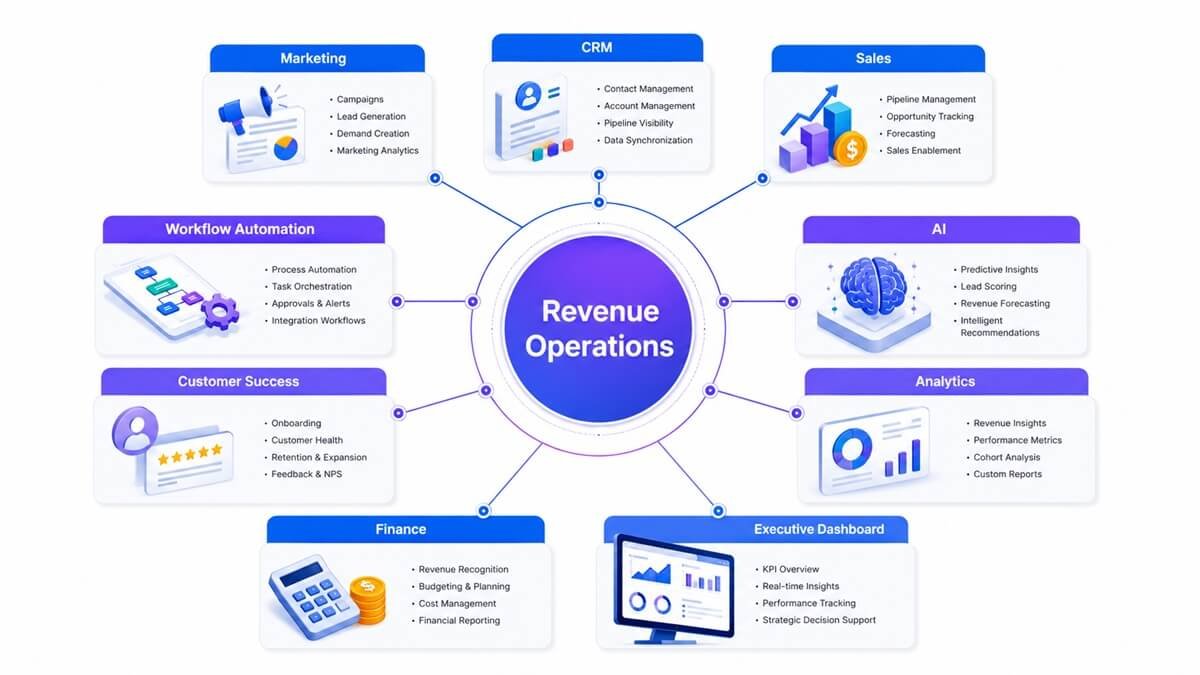
Revenue Operations Automation (RevOps Automation) is the practice of using integrated technology, standardized processes, and intelligent workflows to manage the entire revenue lifecycle—from lead generation and sales execution to customer retention and expansion. Rather than operating sales, marketing, customer success, and finance as separate functions, RevOps creates a unified operating model built around shared data, consistent processes, and measurable revenue outcomes.
As organizations adopt cloud platforms, AI-powered applications, and digital customer engagement, managing revenue operations has become increasingly complex. Revenue Operations Automation helps businesses simplify this complexity by connecting systems, reducing manual work, and providing greater visibility across every stage of the customer journey.
This guide explains the core principles of Revenue Operations Automation, its business functions, technology stack, AI applications, implementation strategies, key performance indicators, and best practices to help organizations build a scalable, data-driven revenue engine.
What Is Revenue Operations Automation?
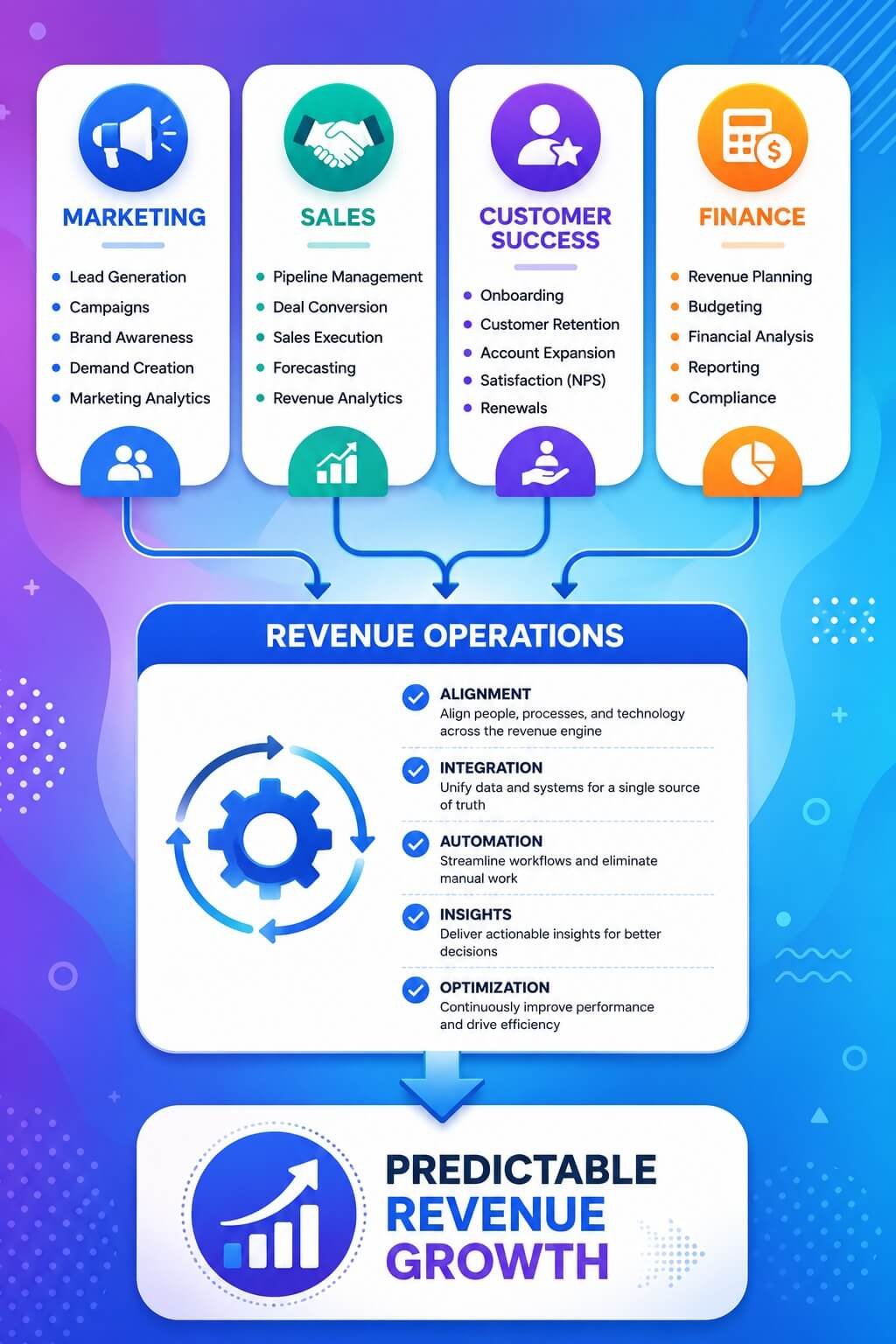
Revenue Operations Automation (RevOps Automation) is the practice of using technology, workflow automation, artificial intelligence, and standardized business processes to align marketing, sales, customer success, and finance into one coordinated revenue-generating system.
Rather than optimizing each department independently, RevOps focuses on optimizing the entire customer lifecycle—from the first marketing interaction to customer retention and expansion. A typical revenue operations system automates activities such as:
- Lead capture from multiple channels
- Lead enrichment using third-party data providers
- AI-based lead qualification and scoring
- Sales territory assignment
- CRM record creation and updates
- Meeting scheduling
- Proposal generation
- Contract approvals
- Customer onboarding
- Renewal reminders
- Upsell identification
- Executive reporting and forecasting
Instead of relying on manual handoffs between departments, AI workflow automation ensures that information moves instantly and accurately throughout the organization. For example, when a prospect downloads a whitepaper, an automated RevOps workflow can:
- Capture the lead from a website form.
- Enrich company and contact data using external data providers.
- Score the lead based on firmographic and behavioral signals.
- Route the lead to the appropriate sales representative.
- Create a CRM record automatically.
- Schedule follow-up tasks.
- Notify the assigned account executive.
- Trigger a personalized email sequence.
- Update executive dashboards in real time.
Without automation, these tasks often require manual intervention across multiple teams, increasing delays and the risk of human error.
Why Revenue Operations Automation Matters in 2026 (Business Drivers)
Digital transformation has fundamentally changed how organizations acquire, engage, and retain customers. Today’s revenue teams depend on an expanding ecosystem of cloud applications, AI assistants, customer data platforms, communication tools, and analytics solutions that must operate together throughout the customer lifecycle.
Without a coordinated Revenue Operations strategy, this growing technology landscape often results in fragmented data, inconsistent business processes, delayed decision-making, and limited visibility into revenue performance. As organizations scale, these operational challenges become increasingly difficult to manage using manual processes alone.
Several trends are accelerating the adoption of Revenue Operations Automation in 2026:
- Growing adoption of AI-powered sales and marketing tools
- Increasing demand for real-time revenue visibility
- Higher customer expectations for personalized experiences
- Expansion of multi-channel go-to-market strategies
- Greater focus on predictable revenue forecasting
- Increased emphasis on operational efficiency and scalable growth
Organizations that modernize their revenue operations are better positioned to improve collaboration across departments, maintain consistent customer data, accelerate decision-making, and support sustainable business growth in an increasingly competitive market.
The Evolution of Revenue Operations
Understanding how RevOps evolved helps explain why automation has become essential.
| Era | Primary Focus | Common Challenge |
| Sales Operations | Sales efficiency | Department silos |
| Marketing Operations | Campaign performance | Poor alignment |
| Customer Success Operations | Retention | Disconnected customer data |
| Revenue Operations | Entire customer lifecycle | Cross-functional coordination |
| AI-Powered Revenue Operations | End-to-end intelligent automation | Continuous optimization |
Revenue operations represents a shift from optimizing individual departments to optimizing the complete revenue system.
Instead of asking:
“How can marketing generate more leads?”
Organizations now ask:
“How can every customer interaction contribute to predictable revenue growth?”
Common Barriers to Revenue Operations Automation
Despite its benefits, implementing Revenue Operations Automation is not without challenges. Many organizations struggle with fragmented data, legacy systems, inconsistent CRM practices, and unclear ownership of revenue processes. Successfully overcoming these obstacles requires standardized workflows, executive alignment, and a phased implementation strategy that prioritizes data quality before automation.
Revenue Operations vs Sales Operations vs Marketing Operations vs Customer Success Operations
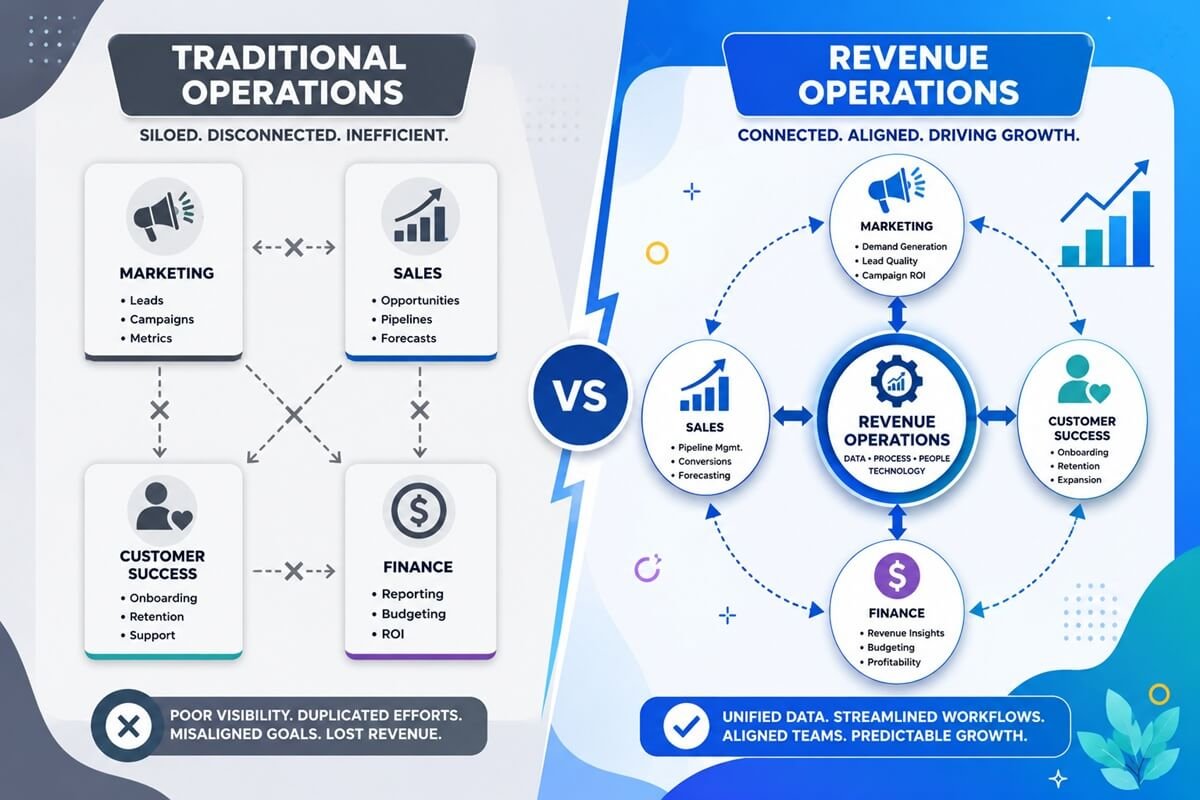
One of the biggest misconceptions is that Revenue Operations (RevOps) is simply another name for Sales Operations. Although they share similar goals—improving efficiency and driving growth—they differ significantly in scope and responsibility.
Traditional operations teams focus on optimizing individual departments. RevOps, on the other hand, optimizes the entire revenue lifecycle, ensuring every customer interaction contributes to predictable business growth. Instead of managing isolated processes, Revenue Operations Automation creates a connected system where marketing, sales, customer success, and finance all work from the same data and workflows.
Understanding Each Function
Sales Operations (Sales Ops)
Sales Operations focuses on helping sales teams sell more effectively. Responsibilities include CRM administration, territory planning, sales forecasting, compensation management, pipeline reporting, and sales enablement.
General Sales Operations responsibilities include:
- CRM administration
- Sales forecasting
- Territory management
- Sales performance dashboards
- Commission tracking
- Pipeline management
- Sales process optimization
- Quote and proposal automation
Primary Goal: Increase sales team productivity and improve win rates.
Marketing Operations (Marketing Ops)
Marketing Operations ensures marketing campaigns run efficiently and provide accurate lead data to the sales organization.
Key responsibilities include:
- Marketing automation
- Campaign management
- Lead nurturing
- Email workflows
- Attribution reporting
- Landing page optimization
- Customer segmentation
- Marketing analytics
Marketing Operations primarily measures success through:
- Marketing Qualified Leads (MQLs)
- Cost per Lead (CPL)
- Conversion Rates
- Campaign ROI
- Website Performance
Primary Goal: Generate qualified pipeline through efficient marketing systems.
Customer Success Operations (CS Ops)
Customer Success Operations begins after the sale is completed. Instead of acquiring new customers, CS Ops focuses on helping existing customers achieve success, reducing churn, and increasing expansion revenue.
Responsibilities often include:
- Customer onboarding automation
- Health score monitoring
- Renewal management
- Customer lifecycle reporting
- Upsell opportunity identification
- Support workflow optimization
- Customer satisfaction tracking
- Account health dashboards
Common KPIs include:
- Net Revenue Retention (NRR)
- Gross Revenue Retention (GRR)
- Churn Rate
- Customer Health Score
- Product Adoption
- Expansion Revenue
Primary Goal: Maximize customer retention and lifetime value.
Revenue Operations (RevOps)
Revenue Operations brings all operational functions together under one strategy. Rather than optimizing individual departments separately, RevOps manages the complete customer journey—from the first website visit to long-term customer expansion.
Common RevOps responsibilities include:
- Revenue process design
- Cross-functional workflow automation
- CRM governance
- Data quality management
- AI-powered forecasting
- Revenue analytics
- Lead routing
- Revenue attribution
- Technology integration
- KPI standardization
RevOps leaders often oversee:
- CRM systems
- Marketing automation platforms
- Sales engagement software
- Customer Success tools
- Business Intelligence dashboards
- Workflow automation platforms
- AI-powered analytics
Primary Goal: Create a predictable, scalable revenue engine.
Comparison Table
| Function | Primary Focus | Main Users | Key Metrics | Automation Examples |
| Sales Operations | Sales efficiency | Sales Team | Pipeline, Win Rate, Quota Attainment | CRM updates, quote generation, forecasting |
| Marketing Operations | Lead Generation | Marketing Team | MQLs, CPL, Campaign ROI | Email nurturing, lead scoring, campaign automation |
| Customer Success Operations | Customer Retention | Customer Success | NRR, Churn, Health Score | Onboarding, renewals, customer alerts |
| Revenue Operations | Entire Revenue Lifecycle | Entire Organization | Revenue Growth, CAC, LTV, Pipeline Velocity | End-to-end workflow automation, AI forecasting, CRM orchestration |
Why Businesses Are Moving to Revenue Operations
As companies grow, each department adopts its own software and processes. Although these tools solve immediate needs, they can create disconnected systems over time.
A typical organization might use:
- HubSpot for marketing
- Salesforce for CRM
- Gong for conversation intelligence
- Slack for communication
- Stripe for billing
- Zendesk for customer support
- Looker or Power BI for analytics
Without RevOps, these platforms frequently operate in silos, leading to issues such as:
- Duplicate customer records
- Inconsistent reporting
- Delayed lead handoffs
- Poor forecasting
- Manual data entry
- Misaligned KPIs
- Inefficient customer journeys
Revenue Operations Automation connects these systems through integrations, APIs, and workflow automation, creating a single source of truth across the business.
Example: Traditional Operations vs Revenue Operations Automation
Traditional Process
- Marketing captures a lead.
- Marketing manually exports the lead.
- Sales imports the lead into the CRM.
- Sales research the company.
- Meetings are scheduled manually.
- Customer Success is notified after the deal closes.
- Finance manually creates invoices.
- Leadership compiles reports from multiple systems.
This process is slow, inconsistent, and highly dependent on manual work.
Revenue Operations Automation Process
- A prospect submits a website form.
- AI enriches the lead with company and contact data.
- The CRM creates or updates the contact automatically.
- AI assigns a lead score based on behavior and firmographics.
- The lead is routed to the correct sales representative.
- A personalized email sequence starts automatically.
- Meetings are scheduled through integrated calendar tools.
- Once the deal closes, customer onboarding workflows begin automatically.
- Billing, product activation, and customer success tasks are triggered without manual intervention.
- Executive dashboards update in real time.
This automated approach minimizes delays, reduces human error, and provides leadership with accurate, up-to-date visibility into the revenue pipeline.
Where AI Fits into Revenue Operations
Artificial intelligence has expanded the role of RevOps beyond simple workflow automation. Instead of only automating repetitive tasks, AI can analyze data, identify patterns, and recommend actions.
Examples include:
- Predictive lead scoring
- Opportunity risk analysis
- Revenue forecasting
- AI-generated sales summaries
- Automated CRM data enrichment
- Personalized outreach recommendations
- Intelligent workflow routing
- Churn prediction
- Upsell opportunity detection
- Natural language analytics
If combine AI with automation, RevOps teams can make faster, data-driven decisions and reduce manual administrative work.
Best Practices for Defining RevOps Responsibilities
To avoid confusion and overlapping ownership, organizations should:
- Clearly document responsibilities for each operations function.
- Use shared KPIs across marketing, sales, and customer success.
- Standardize CRM data and naming conventions.
- Automate handoffs between teams.
- Establish a single source of truth for reporting.
- Review workflows regularly to eliminate bottlenecks.
- Measure the performance of the entire revenue funnel rather than individual departments.
How These Functions Create a Unified Revenue Engine
The true value of Revenue Operations Automation is realized when these operational functions no longer work in isolation. By integrating sales, marketing, customer success, and revenue operations through shared data, standardized processes, and automated workflows, organizations create a continuous flow of information across the entire customer lifecycle.
This connected operating model reduces manual handoffs, improves decision-making with real-time insights, and ensures every team works toward the same revenue objectives. As businesses continue adopting AI-powered automation, this unified approach becomes the foundation for predictable growth and long-term operational scalability.
The Revenue Operations Automation Framework
Successful Revenue Operations Automation isn’t built by purchasing a CRM or connecting a few applications. The highest-performing organizations design an integrated framework where data, technology, workflows, and teams work together as a unified revenue engine.
Think of RevOps as the operating system behind your go-to-market (GTM) strategy. Every lead, opportunity, customer interaction, and revenue event passes through this system. The framework below consists of six interconnected pillars. Weakness in any one pillar can reduce the effectiveness of the entire revenue engine.
Pillar 1: Unified Revenue Data
Data is the foundation of every successful RevOps strategy. Without clean, accurate, and standardized data, automation produces unreliable results and AI models make poor decisions.
Many businesses struggle with fragmented customer information spread across multiple systems. Marketing stores campaign data in one platform, sales updates opportunities in another, while customer success maintains health scores elsewhere. As a result, leadership often sees conflicting reports and inconsistent metrics.
A modern Revenue Operations framework establishes a single source of truth where all customer and revenue data is centralized and synchronized.
Essential Revenue Data Sources
- CRM
- Marketing Automation Platform
- Website Analytics
- Product Usage Data
- Billing Platform
- Customer Support System
- Email Platform
- Sales Engagement Software
- Data Enrichment Providers
- Financial Systems
Best Practices
- Standardize lifecycle stages.
- Eliminate duplicate records.
- Validate data automatically.
- Sync systems in real time.
- Define consistent naming conventions.
- Establish data ownership.
- Audit CRM quality regularly.
Expert Tips: Poor data quality is one of the biggest reasons RevOps initiatives fail. Before adding AI or advanced automation, ensure your CRM data is accurate, complete, and consistently maintained.
Pillar 2: Workflow Automation
Once reliable data is available, the next step is automating repetitive business processes. Instead of relying on manual handoffs between departments, workflow automation ensures every action triggers the next step automatically.
For example:
Website Form Submitted
↓
Lead enrichment
↓
AI lead scoring
↓
CRM record creation
↓
Lead assignment
↓
Sales notification
↓
Personalized outreach
↓
Meeting scheduling
↓
Opportunity creation
↓
Customer onboarding
↓
Renewal tracking
Each step occurs automatically, reducing delays and minimizing human error.
Common Revenue Workflows
Marketing
- Lead capture
- Email nurturing
- Webinar registration
- Event follow-up
- Campaign attribution
- Content personalization
Sales
- Lead routing
- Opportunity creation
- Proposal generation
- Follow-up reminders
- Meeting scheduling
- Contract approvals
Customer Success
- Customer onboarding
- Health score monitoring
- Renewal reminders
- Upsell alerts
- Support escalation
- Satisfaction surveys
Finance
- Invoice creation
- Revenue recognition
- Subscription management
- Payment reminders
- Forecast updates
The objective isn’t to automate every task. It’s to automate repetitive, rules-based work so teams can focus on higher-value activities such as relationship building, strategic planning, and problem-solving.
Pillar 3: AI-Powered Decision Making
Automation executes predefined rules. Artificial intelligence adds intelligence by analyzing data, identifying patterns, and recommending actions.
Instead of asking,
“What happened?”
AI answers,
“What is likely to happen next?”
Modern Revenue Operations teams increasingly rely on AI to improve both operational efficiency and decision-making.
AI Use Cases in Revenue Operations
- Predictive Lead Scoring
- Revenue Forecasting
- Opportunity Risk Detection
- AI Sales Assistants
- Customer Churn Prediction
Pillar 4: Revenue Technology Stack
Technology is the infrastructure supporting Revenue Operations. Insead of selecting software independently, RevOps teams build an integrated ecosystem where applications exchange information automatically.
A Modern Revenue Operations stack includes:
| Category | Purpose | Example Tools |
| CRM | Customer database | HubSpot, Salesforce |
| Marketing Automation | Campaign management | HubSpot Marketing Hub, ActiveCampaign |
| Workflow Automation | Process automation | Make, n8n, Zapier |
| Data Enrichment | Company intelligence | Clay, Apollo, Clearbit |
| AI Assistants | Productivity | ChatGPT, Claude |
| Sales Engagement | Outreach | Instantly, Lemlist |
| Conversation Intelligence | Meeting analysis | Fireflies, Otter |
| Business Intelligence | Reporting | Looker Studio, Power BI |
| Customer Success | Account management | Gainsight, Vitally |
| Project Management | Internal collaboration | ClickUp, Monday.com, Asana |
A strong RevOps stack prioritizes interoperability over the number of tools. Each platform should contribute to a connected, automated workflow rather than creating another isolated data source.
Pillar 5: Revenue Intelligence
Traditional reporting explains what happened. Revenue intelligence explains why it happened and what to do next. Revenue intelligence combines CRM data, AI analysis, customer behavior, and operational metrics to provide actionable insights.
Common metrics include:
- Pipeline Velocity
- Sales Cycle Length
- Customer Acquisition Cost (CAC)
- Customer Lifetime Value (LTV)
- Average Deal Size
- Win Rate
- Conversion Rate
- Churn Rate
- Net Revenue Retention (NRR)
- Gross Revenue Retention (GRR)
- Monthly Recurring Revenue (MRR)
- Annual Recurring Revenue (ARR)
Instead of reviewing spreadsheets once a month, RevOps leaders monitor these KPIs in real time using interactive dashboards and automated alerts.
Pillar 6: Continuous Optimization
Revenue Operations is not a one-time implementation. Customer expectations, AI capabilities, market conditions, and business strategies evolve continuously. Leading organizations treat RevOps as an ongoing improvement process.
Areas to review regularly include:
- CRM data quality
- Workflow efficiency
- AI model performance
- Sales conversion rates
- Marketing attribution
- Customer onboarding
- Automation failures
- Revenue forecasting accuracy
- Technology integrations
- Team adoption
Continuous optimization ensures your revenue engine remains efficient as your business grows.
How the Six Pillars Work Together
Website Visitors
│
▼
Unified Revenue Data
│
▼
Workflow Automation
│
▼
AI Decision Making
│
▼
Revenue Technology Stack
│
▼
Revenue Intelligence
│
▼
Continuous Optimization
│
▼
Predictable Revenue Growth
No single pillar is sufficient on its own. Clean data powers automation, automation generates operational consistency, AI improves decisions, integrated technology enables scalability, revenue intelligence provides visibility, and continuous optimization keeps the system aligned with business goals.
Common Framework Mistakes
Organizations often encounter similar challenges when implementing RevOps:
- Purchasing software before defining processes.
- Automating inefficient workflows instead of improving them.
- Neglecting CRM data governance.
- Measuring departments independently rather than the full revenue funnel.
- Creating too many disconnected automations.
- Overlooking user training and adoption.
- Failing to document workflows and ownership.
Avoiding these pitfalls leads to a more resilient and scalable revenue engine.
Why These Pillars Matter
Successful Revenue Operations Automation depends on balancing people, processes, data, and technology rather than focusing on a single capability. Organizations that strengthen all six pillars build a resilient revenue infrastructure capable of adapting to changing customer expectations, evolving AI technologies, and business growth.
Regularly evaluating each pillar helps ensure automation continues to improve operational efficiency and long-term revenue performance.
Core Components of a Revenue Operations Automation System
A high-performing Revenue Operations Automation system is more than a collection of software tools. It is an integrated ecosystem where every component contributes to acquiring, converting, retaining, and expanding customers.
Think of your RevOps platform as the central nervous system of your business. Every customer interaction, sales activity, marketing campaign, support request, and financial transaction generates valuable data. Revenue Operations connects these touchpoints into a unified process that enables teams to make faster, data-driven decisions.
Below are the essential components of a modern RevOps architecture.
1. Customer Relationship Management (CRM)
The CRM is the foundation of every Revenue Operations strategy. It serves as the central repository for customer, prospect, and revenue data. Without a well-managed CRM, automation becomes unreliable because every workflow depends on accurate and complete information.
A modern CRM should store:
- Contacts
- Companies
- Leads
- Opportunities
- Deals
- Tasks
- Activities
- Emails
- Meeting history
- Products
- Contracts
- Revenue records
Instead of acting as a simple database, today’s CRM platforms function as intelligent revenue hubs that integrate with marketing, finance, customer success, and AI applications.
CRM Best Practices
- Standardize lifecycle stages.
- Define mandatory fields for every record.
- Eliminate duplicate contacts and companies.
- Automate CRM updates wherever possible.
- Restrict manual edits for critical data.
- Review data quality on a regular schedule.
Expert Insight: Organizations often invest heavily in automation while overlooking CRM governance. Clean, standardized CRM data is the foundation of every successful RevOps initiative.
2. Marketing Automation Platform
Marketing automation captures demand and nurtures prospects before they engage with the sales team. Rather than manually sending emails or tracking campaign performance, marketing automation platforms deliver personalized experiences at scale.
Common capabilities include:
- Email automation
- Landing pages
- Lead nurturing
- Campaign management
- Form creation
- Webinar registration
- Behavioral tracking
- Customer segmentation
- Dynamic content
- Lead scoring
When integrated with the CRM, marketing automation ensures that qualified leads are passed to sales at the right time with complete engagement history.
Example Marketing Workflow
A visitor downloads an industry report.
↓
The system creates a new CRM contact.
↓
The contact enters a personalized email sequence.
↓
AI evaluates engagement signals.
↓
The lead reaches the qualification threshold.
↓
The system automatically assigns the lead to an Account Executive.
↓
A follow-up task is created.
↓
The sales representative receives an instant notification.
No manual intervention is required.
3. AI Intelligence Layer
Artificial intelligence has become one of the most valuable components of modern Revenue Operations. Instead of simply automating predefined rules, AI continuously analyzes customer behavior, identifies patterns, predicts future outcomes, and recommends actions.
Examples include:
Predictive Lead Scoring
AI evaluates factors such as:
- Company size
- Industry
- Website visits
- Content downloads
- Email engagement
- Historical conversion patterns
The result is a prioritized list of leads most likely to convert.
Opportunity Intelligence
AI analyzes sales opportunities by identifying:
- Stalled deals
- Missing stakeholders
- Buying intent signals
- Competitive risks
- Forecast confidence
- Recommended next actions
Sales managers gain greater visibility into pipeline health without manually reviewing every opportunity.
AI Sales Assistants
Modern AI assistants can:
- Summarize meetings
- Generate follow-up emails
- Recommend sales content
- Update CRM records
- Answer internal questions
- Draft proposals
- Create call summaries
This allows sales teams to spend more time selling and less time on administrative work.
4. Workflow Automation Platform
Workflow automation platforms connect applications and eliminate repetitive manual work. These platforms act as orchestration engines that synchronize data and trigger actions across multiple systems.
Examples of automated workflows include:
- Lead assignment
- CRM synchronization
- Email notifications
- Slack alerts
- Invoice creation
- Customer onboarding
- Renewal reminders
- Proposal approvals
- Data enrichment
- Executive reporting
Modern workflow platforms support hundreds or even thousands of integrations. This enable organizations to automate complex, multi-step business processes.
Example Revenue Workflow
Website Form
↓
CRM Contact Created
↓
Company Data Enriched
↓
AI Lead Score Calculated
↓
Sales Representative Assigned
↓
Email Sequence Starts
↓
Meeting Scheduled
↓
Opportunity Created
↓
Deal Closed
↓
Customer Onboarded
↓
Executive Dashboard Updated
This connected workflow minimizes delays, reduces human error, and improves the customer experience.
5. Data Enrichment
Many CRM records contain incomplete or outdated information. Data enrichment services automatically supplement customer records with additional business intelligence.
General enrichment includes:
- Company size
- Industry
- Employee count
- Revenue estimates
- Technology stack
- Funding history
- Job titles
- Social profiles
- Geographic information
- Buying intent signals
Improved data quality leads to:
- Better lead scoring
- More accurate segmentation
- Improved personalization
- Higher conversion rates
6. Sales Engagement
Sales engagement platforms help representatives manage outreach across multiple channels.
Capabilities often include:
- Email sequences
- Phone dialing
- LinkedIn outreach
- Meeting scheduling
- Call recording
- Engagement analytics
- A/B testing
- Automated reminders
Rather than replacing sales representatives, these AI automation tools ensure consistent communication while reducing repetitive work.
7. Customer Success Platform
Revenue growth doesn’t end when a deal closes. Customer Success platforms help organizations retain customers, improve product adoption, and identify expansion opportunities.
Common features include:
- Customer onboarding
- Product usage monitoring
- Health scoring
- Renewal tracking
- Expansion alerts
- Customer satisfaction surveys
- Success planning
- Executive business reviews
Automation helps Customer Success Managers focus on high-value customer interactions rather than administrative tasks.
8. Revenue Analytics & Business Intelligence
Executives need visibility into the entire revenue lifecycle. Business Intelligence platforms consolidate information from CRM, marketing automation, customer success, finance, and operational systems into interactive dashboards.
Dashboards include:
Executive Dashboard
- Revenue growth
- Forecast accuracy
- Pipeline value
- Win rate
- ARR
- MRR
Sales Dashboard
- Opportunities by stage
- Activity volume
- Sales cycle length
- Average deal size
- Conversion rates
Marketing Dashboard
- Lead sources
- Campaign ROI
- Customer acquisition cost
- Marketing-qualified leads
- Website conversions
Customer Success Dashboard
- Churn rate
- Renewal pipeline
- Net Revenue Retention
- Product adoption
- Customer health
Instead of waiting for monthly reports, stakeholders gain access to real-time performance data.
9. Security & Compliance
Revenue Operations systems manage sensitive customer and financial information. Security should be integrated into every stage of the architecture.
Key security practices include:
- Multi-factor authentication (MFA)
- Role-based access controls
- Single Sign-On (SSO)
- API authentication
- Data encryption
- Audit logs
- Regular security reviews
- Backup and disaster recovery planning
- Compliance with GDPR, CCPA, or other applicable regulations
A secure RevOps environment protects both customer trust and business continuity.
10. Governance & Process Documentation
Technology alone cannot guarantee successful Revenue Operations. Organizations need clear governance that defines:
- Data ownership
- Workflow ownership
- Approval processes
- Naming conventions
- Lifecycle stages
- Automation standards
- Change management procedures
Documented governance ensures consistency as the business scales and new team members join.
Modern Revenue Operations Architecture
WEBSITE
│
▼
Marketing Automation
│
▼
AI Lead Qualification
│
▼
CRM (Single Source of Truth)
│
┌───────────────────┼───────────────────┐
▼ ▼ ▼
Sales Automation Customer Success Finance
│ │ │
└───────────────┬───┴───────────────────┘
▼
Workflow Automation Platform
│
▼
Business Intelligence
│
▼
Executive Revenue Dashboard
This architecture demonstrates how each component contributes to a unified revenue engine. Information flows seamlessly between systems, reducing manual effort while providing every team with consistent, real-time insights.
Integration Best Practices
Implementing a modern Revenue Operations Automation ecosystem requires more than selecting the right technologies. Organizations should prioritize seamless system integrations, standardized data governance, secure API connections, and regular performance monitoring to ensure every platform operates as part of a unified revenue strategy.
Establishing these best practices helps maximize automation efficiency, at the same time, reduces data inconsistencies and operational bottlenecks.
How AI Is Transforming Revenue Operations
Artificial intelligence has fundamentally changed how Revenue Operations teams manage growth. While traditional automation follows predefined rules, AI introduces adaptability, prediction, and decision support.
For example, a workflow automation platform can automatically assign every new lead to a sales representative. AI, however, can determine which representative is most likely to close that lead, estimate the probability of conversion, recommend the next best action, and even generate a personalized outreach email.
This shift moves Revenue Operations beyond automation into intelligent revenue optimization. Organizations that combine AI with RevOps gain faster decision-making, improved forecasting accuracy, better customer experiences, and more efficient operations.
From Rule-Based Automation to Intelligent Automation
Traditional automation answers:
“If this happens, then do that.”
Examples include:
- Create a CRM contact after a form submission.
- Send a welcome email after registration.
- Notify a sales manager when a deal closes.
- Create an invoice after payment.
These workflows are valuable but static—they only execute predefined instructions.
AI expands this capability by answering questions such as:
- Which leads are most likely to convert?
- Which deals are at risk?
- Which customers may churn?
- What is the expected revenue this quarter?
- Which outreach message is most likely to receive a reply?
- Which accounts should sales prioritize today?
This combination of automation and intelligence enables RevOps teams to focus on strategic decisions rather than repetitive administrative work.
AI Across the Revenue Lifecycle
Artificial intelligence supports every stage of the customer journey.
| Revenue Stage | Traditional Automation | AI Enhancement |
| Lead Generation | Capture form submissions | Predict high-intent visitors |
| Qualification | Assign leads using fixed rules | AI lead scoring and prioritization |
| Sales | Schedule follow-ups | Recommend next best actions |
| Customer Success | Send renewal reminders | Predict churn and expansion opportunities |
| Reporting | Static dashboards | AI-powered forecasting and insights |
Rather than replacing existing processes, AI enhances them by making automation more adaptive and data driven.
1. AI-Powered Lead Scoring
One of the most impactful AI applications in Revenue Operations is predictive lead scoring. Traditional lead scoring assigns points based on predefined criteria such as:
- Downloaded an eBook (+10)
- Visited the pricing page (+15)
- Opened an email (+5)
Although useful, these rules can be simplistic and don’t not reflect actual buying intent. AI models analyze a much broader set of signals, including:
- Industry
- Company size
- Revenue
- Technology stack
- Hiring activity
- Website behavior
- Historical conversion data
- Email engagement
- CRM interactions
- Sales conversations
The result is a dynamic score that continuously updates as new information becomes available.
Benefits
- Higher conversion rates
- Better sales prioritization
- Faster response times
- Reduced manual qualification
- More accurate pipeline management
2. Intelligent Lead Routing
Not every lead should be assigned using simple geographic or round-robin rules. AI can evaluate multiple factors to determine the best representative for each opportunity.
These factors include:
- Industry specialization
- Product expertise
- Territory
- Language
- Historical win rate
- Current workload
- Customer segment
- Previous relationship history
Instead of distributing leads evenly, AI distributes them strategically to maximize conversion potential.
3. Predictive Revenue Forecasting
Forecasting has traditionally relied on spreadsheets, historical trends, and sales manager estimates. These methods often struggle to account for rapidly changing market conditions and evolving buyer behavior.
AI forecasting models analyze:
- Historical revenue
- Deal progression
- Sales velocity
- Customer engagement
- Pipeline health
- Seasonality
- Win rates
- Market trends
The outcome is a more accurate and continuously updated revenue forecast.
Business Benefits
- Improved financial planning
- Better hiring decisions
- Smarter inventory management
- Stronger investor reporting
- Reduced forecasting bias
4. Opportunity Intelligence
Revenue Operations teams need visibility into which deals are progressing—and which are likely to stall. AI continuously monitors opportunities and identifies early warning signs, such as:
- Reduced email engagement
- Missed meetings
- Long periods of inactivity
- Missing decision-makers
- Limited product interest
- Decreasing communication frequency
Rather than discovering problems during quarterly reviews, sales leaders receive proactive alerts while there is still time to intervene.
5. AI Sales Assistants
Administrative work often consumes a significant portion of a salesperson’s day. AI assistants reduce this burden by handling repetitive tasks automatically.
Examples include:
- Meeting transcription
- Conversation summaries
- CRM updates
- Follow-up email drafting
- Call coaching recommendations
- Proposal generation
- Objection analysis
- Task creation
As a result, sales representatives can dedicate more time to customer conversations and relationship building.
6. Conversational Intelligence
Every customer conversation contains valuable insights. AI-powered conversation intelligence platforms analyze calls, video meetings, and emails to identify patterns that would be difficult to detect manually.
Useful insights include:
- Frequently discussed competitors
- Common customer objections
- Buying signals
- Pricing concerns
- Product feedback
- Customer sentiment
- Rep talk-to-listen ratio
- Compliance risks
Revenue Operations leaders can use these insights to improve coaching, messaging, and overall sales performance.
7. AI for Customer Success
Winning new customers is only part of the revenue equation. Retaining and expanding existing accounts often has a greater impact on long-term profitability. AI helps Customer Success teams by monitoring indicators such as:
- Product usage
- Login frequency
- Feature adoption
- Support tickets
- Customer sentiment
- Renewal history
- Survey responses
These insights enable teams to identify at-risk customers early and take proactive steps to improve retention.
Common AI Recommendations
- Schedule a success review.
- Offer additional training.
- Recommend a premium feature.
- Escalate unresolved support issues.
- Initiate a renewal discussion.
8. AI-Powered Revenue Intelligence
Traditional dashboards answer questions like:
- How many deals closed?
- What is our pipeline value?
- What was last month’s revenue?
AI-powered revenue intelligence goes further by identifying trends and providing recommendations.
Examples include:
- Which marketing channels generate the highest-quality opportunities?
- Which industries close the fastest?
- Which sales representatives require coaching?
- Which products have the highest expansion potential?
- Which accounts should receive executive attention?
This transforms reporting from descriptive analytics into actionable decision support.
9. AI Agents in Revenue Operations
AI agents represent the next evolution of Revenue Operations. Compared to traditional automation, AI agents can perform multi-step tasks with minimal human intervention.
Examples include:
- Researching new accounts.
- Enriching CRM records.
- Drafting personalized outreach.
- Scheduling meetings.
- Monitoring pipeline health.
- Updating forecasts.
- Generating executive summaries.
- Coordinating follow-up activities.
Although human oversight remains essential, AI agents can significantly reduce repetitive operational work.
AI Governance and Responsible Adoption
As organizations expand their use of AI, governance becomes increasingly important. Revenue Operations leaders should establish clear policies regarding:
- Data privacy
- AI transparency
- Human approval for critical decisions
- Bias monitoring
- Model accuracy
- Regulatory compliance
- Audit logging
- Security controls
Responsible AI implementation helps maintain trust and ensures compliance with industry regulations.
Best Practices for Integrating AI into RevOps
To maximize value, organizations should:
- Start with clean, standardized CRM data.
- Automate repetitive processes before introducing AI.
- Focus on measurable business outcomes.
- Train employees to work alongside AI systems.
- Continuously evaluate model performance.
- Monitor KPIs such as forecast accuracy, conversion rates, and customer retention.
- Maintain human oversight for strategic and customer-facing decisions.
AI should augment human expertise rather than replace it.
The Future of AI in Revenue Operations
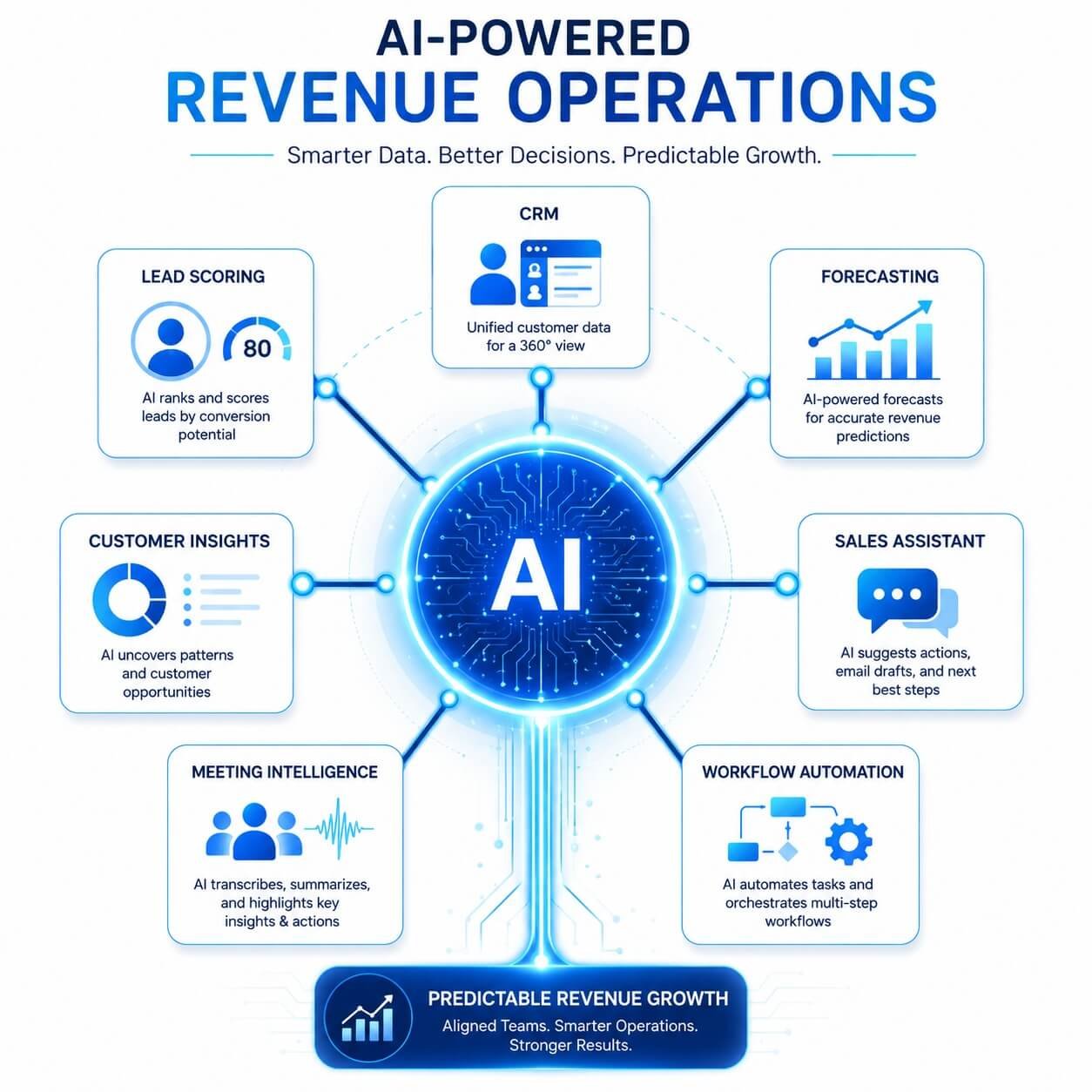
Over the next several years, AI is expected to play an even larger role in Revenue Operations.
Emerging trends include:
- Autonomous AI agents managing routine workflows.
- Real-time revenue forecasting based on live data.
- Hyper-personalized customer engagement.
- Predictive account management.
- Voice-driven CRM interactions.
- AI-generated executive reporting.
- Intelligent workflow optimization.
- Cross-functional AI collaboration across marketing, sales, finance, and customer success.
Organizations that adopt these capabilities strategically will be better positioned to scale efficiently and respond quickly to changing market conditions.
Responsible AI Implementation
Successfully integrating AI into Revenue Operations requires more than deploying intelligent tools. Organizations should establish clear governance policies, maintain high-quality data, monitor AI-generated recommendations, and keep human oversight for critical revenue decisions. This balanced approach helps improve accuracy, reduce bias, strengthen customer trust, and ensure AI supports long-term business objectives.
Building the Ideal Revenue Operations Technology Stack
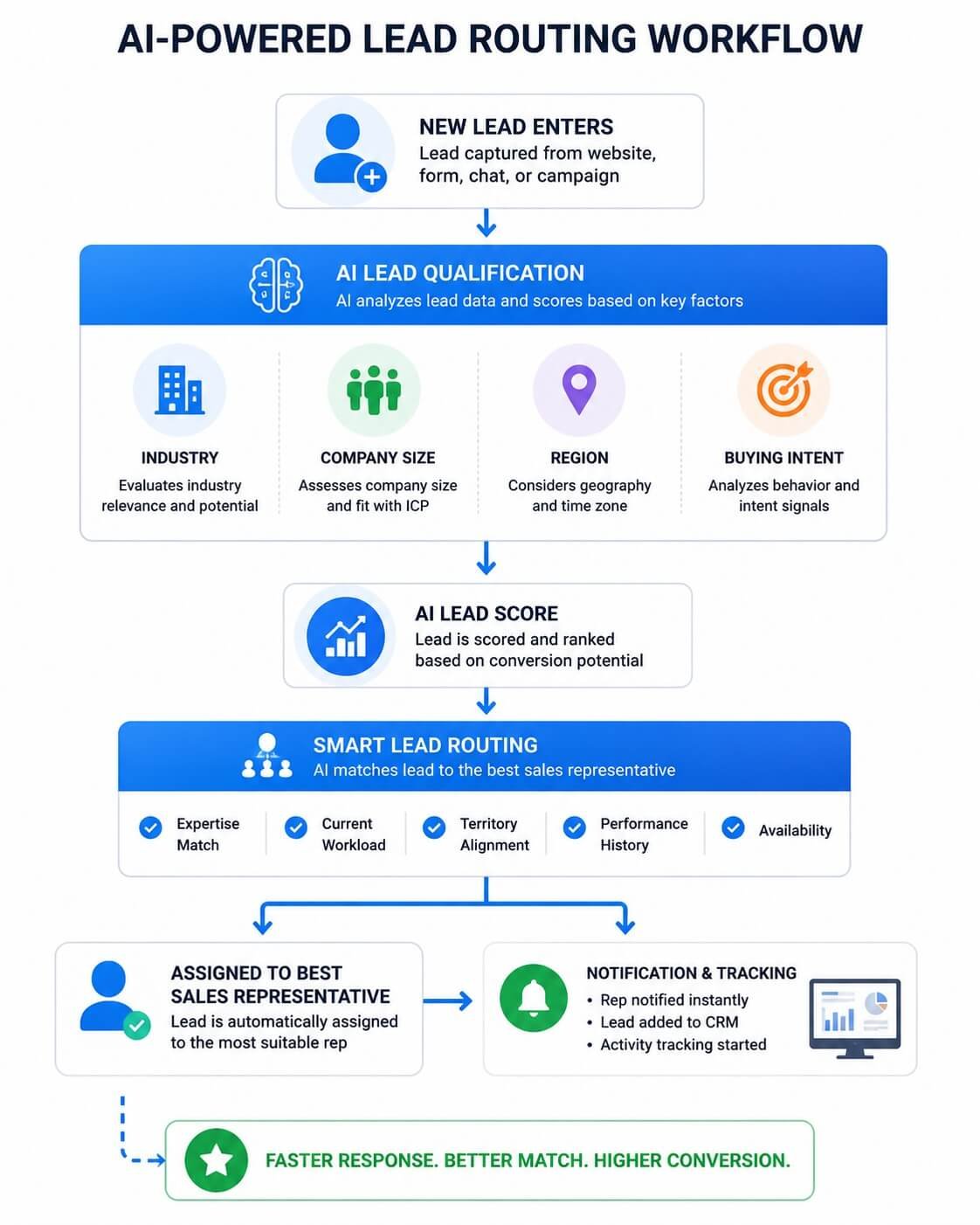
Technology is the backbone of every successful Revenue Operations strategy. However, many organizations make the mistake of purchasing more software than they actually need. As the business grows, teams adopt new tools independently, resulting in duplicate functionality, disconnected data, and increasing operational complexity.
A modern Revenue Operations technology stack should prioritize integration, automation, scalability, and data consistency over simply adding more applications. The goal is to create a connected ecosystem where information flows seamlessly between systems, enabling every team to work from a single source of truth.
Principles of an Effective RevOps Tech Stack
Before evaluating specific software, establish a set of guiding principles for your technology decisions.
Single Source of Truth
Your CRM should remain the authoritative source for customer and revenue data. And other systems contribute information, the CRM acts as the central hub that keeps records synchronized across the organization.
API-First Integration
Modern SaaS applications expose APIs that allow systems to exchange data automatically. Choosing tools with robust APIs simplifies integration and reduces reliance on manual imports or custom development.
Modular Architecture
Avoid selecting an all-in-one platform simply because it appears comprehensive. A modular architecture allows you to replace individual tools as your requirements evolve without rebuilding your entire technology ecosystem.
Automation Before Expansion
Before adding new software, determine whether existing platforms can automate the process. Introducing additional applications should solve a genuine business need rather than increase complexity.
Scalability
Select tools that can grow with your business. Migrating critical systems such as CRM or marketing automation can be disruptive and resource-intensive, so it’s worth considering long-term requirements early.
Core Layers of a Revenue Operations Tech Stack
Although every organization has unique needs, most RevOps environments include the following technology layers.
1. CRM Platform
The CRM serves as the operational center of your revenue engine. It stores customer records, tracks opportunities, manages pipeline activity, and provides visibility into revenue performance.
Essential CRM capabilities include:
- Contact management
- Deal tracking
- Pipeline management
- Activity history
- Workflow automation
- Reporting dashboards
- API integrations
- User permissions
As your business grows, the CRM becomes the foundation for AI models, forecasting, and executive reporting.
2. Marketing Automation
Marketing automation platforms help attract, engage, and qualify prospects before they reach the sales team.
Key capabilities include:
- Landing pages
- Forms
- Email campaigns
- Lead nurturing
- Behavioral tracking
- Dynamic segmentation
- Campaign reporting
- Lead scoring
A well-integrated marketing platform ensures qualified prospects enter the sales pipeline with complete engagement histories.
3. Workflow Automation Platform
Workflow automation platforms connect applications that would otherwise operate independently. These platforms automate repetitive tasks such as:
- CRM updates
- Notifications
- Lead routing
- Customer onboarding
- Contract approvals
- Invoice generation
- Data synchronization
Rather than replacing existing software, they orchestrate how systems work together.
4. AI Layer
The AI layer enhances operational efficiency through intelligent decision-making.
Common capabilities include:
- Predictive lead scoring
- Forecasting
- Opportunity analysis
- Email generation
- Meeting summaries
- Customer insights
- Workflow recommendations
AI should augment human decision-making rather than replace it.
5. Business Intelligence
Business Intelligence platforms consolidate information from multiple systems into executive dashboards.
Typical dashboards include:
- Revenue forecasts
- Pipeline health
- Marketing ROI
- Customer acquisition cost
- Customer lifetime value
- Win rate
- Customer retention
- Sales productivity
Real-time reporting enables faster decision-making and improves visibility across departments.
6. Customer Success Platform
Customer Success software supports post-sale activities by helping teams manage onboarding, renewals, product adoption, and customer health. Integrated with CRM and support systems, these platforms provide early indicators of churn risk and expansion opportunities.
7. Communication & Collaboration
Revenue teams rely on communication platforms to coordinate activities and respond quickly to customer events.
Examples include:
- Internal messaging
- Meeting scheduling
- Video conferencing
- Task management
- Documentation
- Knowledge management
Workflow automation can generate notifications automatically when critical revenue events occur.
Recommended RevOps Technology Stack
The following categories represent a balanced technology stack for most organizations.
| Technology Layer | Business Purpose | Examples |
| CRM | Customer & pipeline management | HubSpot, Salesforce |
| Marketing Automation | Lead generation & nurturing | HubSpot Marketing Hub, ActiveCampaign |
| Workflow Automation | Business process automation | Make, n8n, Zapier |
| Data Enrichment | Customer intelligence | Clay, Apollo, Clearbit |
| AI Assistant | Content & productivity | ChatGPT, Claude |
| Sales Engagement | Prospect outreach | Lemlist, Instantly |
| Conversation Intelligence | Call recording & analysis | Fireflies, Otter |
| Analytics | Reporting & dashboards | Power BI, Looker Studio |
| Customer Success | Retention & renewals | Gainsight, Vitally |
| Project Management | Internal collaboration | ClickUp, Monday.com, Asana |
Selection Tips: Instead of choosing the most feature-rich tool in every category, prioritize platforms that integrate well with your existing systems and support your long-term workflow requirements.
Example RevOps Architecture
Website & Landing Pages
│
▼
Marketing Automation Platform
│
▼
Lead Capture & Qualification
│
▼
Workflow Automation Platform
│
┌──────────────────────┼──────────────────────┐
▼ ▼ ▼
CRM AI Intelligence Data Enrichment
│ │ │
└──────────────┬───────┴───────────────┬──────┘
▼ ▼
Sales Engagement Customer Success
│ │
└──────────────┬────────┘
▼
Business Intelligence
│
▼
Executive Revenue Dashboard
This architecture illustrates how each layer contributes to a connected revenue engine. Data flows between systems in real time, reducing manual effort and improving visibility across the organization.
Choosing the Right Stack by Business Size
The ideal RevOps stack varies depending on your organization’s size, complexity, and growth stage.
Startup
Primary Goals
- Build a repeatable sales process
- Centralize customer data
- Automate basic workflows
Recommended Focus
- CRM
- Marketing automation
- Workflow automation
- AI assistant
Avoid purchasing enterprise software before establishing consistent processes.
Small to Mid-Sized Business (SMB)
Primary Goals
- Improve operational efficiency
- Scale lead management
- Strengthen reporting
- Increase automation
Recommended Focus
- CRM
- Marketing automation
- Workflow automation
- AI-powered lead scoring
- Business intelligence
- Customer success platform
Enterprise
Primary Goals
- Support multiple business units
- Standardize global operations
- Improve forecasting
- Strengthen governance
Recommended Focus
- Enterprise CRM
- Advanced marketing automation
- AI-powered analytics
- Data warehouse
- Customer data platform (CDP)
- Business intelligence
- Enterprise security and compliance
Common Technology Stack Mistakes
Organizations often encounter avoidable issues when building their RevOps stack.
- Purchasing Too Many Tools
- Ignoring Integration
- Weak CRM Governance
- Automating Broken Processes
- Neglecting User Adoption
Technology Stack Evaluation Checklist
Before implementing a new platform, ask:
- Does it integrate with our CRM?
- Can it exchange data through APIs?
- Will it reduce manual work?
- Does it improve reporting accuracy?
- Can it scale as the business grows?
- Is the user experience intuitive?
- Does it meet our security and compliance requirements?
- Will it simplify or complicate our technology ecosystem?
If the answer to several of these questions is “no,” reconsider whether the platform aligns with your long-term RevOps strategy.
Choosing the Right Revenue Operations Technology Stack
Selecting a Revenue Operations technology stack should begin with business requirements rather than software features. Organizations should evaluate each platform based on integration capabilities, scalability, security, data governance, ease of adoption, and long-term vendor support. Prioritizing technologies that align with existing workflows and future growth objectives helps reduce implementation risks while maximizing the return on automation investments.
How to Implement Revenue Operations Automation: A Step-by-Step Roadmap
Implementing Revenue Operations Automation is not a software project—it’s a business transformation initiative. While technology is an important enabler, successful RevOps implementations begin with clearly defined processes, standardized data, and cross-functional alignment.
Many organizations invest in expensive platforms only to discover that their underlying workflows remain inefficient. Automating a broken process simply allows it to fail faster. A structured implementation roadmap helps minimize disruption, improve user adoption, and maximize return on investment.
Phase 1: Assess Your Current Revenue Process
Before introducing automation, document how your revenue engine currently operates. Map the complete customer journey, beginning with the first marketing interaction and ending with customer renewal or expansion.
General stages include:
- Visitor becomes a lead
- Marketing qualification
- Sales qualification
- Discovery meeting
- Opportunity creation
- Proposal
- Negotiation
- Closed Won
- Customer onboarding
- Product adoption
- Renewal
- Expansion
For each stage, identify:
- Teams involved
- Software used
- Manual tasks
- Data collected
- Approval processes
- Bottlenecks
- Reporting gaps
Questions to Ask
- Where do delays occur?
- Which tasks are repeated manually?
- Which systems don’t communicate?
- Where is customer data duplicated?
- Which reports require spreadsheets?
- Which workflows depend on individuals instead of automation?
Documenting the current state provides a baseline for measuring improvement.
Phase 2: Standardize Revenue Processes
Automation works best when processes are consistent. Before building workflows, define standardized procedures for each department.
Examples include:
Lead Management
- Lead source naming
- Qualification criteria
- Assignment rules
- Lifecycle stages
Opportunity Management
- Deal stages
- Exit criteria
- Forecast categories
- Required CRM fields
Customer Success
- Onboarding milestones
- Health score definitions
- Renewal process
- Escalation rules
Executive Reporting
- KPI definitions
- Dashboard ownership
- Reporting frequency
- Revenue attribution model
Standardization ensures every automation behaves predictably.
Phase 3: Clean and Consolidate Data
Poor data quality is one of the most common reasons Revenue Operations initiatives underperform. Before integrating systems or deploying AI, review your existing data.
General cleanup tasks include:
- Remove duplicate contacts
- Merge duplicate companies
- Standardize naming conventions
- Archive inactive records
- Validate email addresses
- Update lifecycle stages
- Correct inconsistent property values
Data Governance Checklist
- ✔ Required CRM fields
- ✔ Standard field definitions
- ✔ Duplicate prevention rules
- ✔ Validation workflows
- ✔ Data ownership
- ✔ Regular audits
Without trustworthy data, forecasting, reporting, and AI recommendations become unreliable.
Phase 4: Build Your Revenue Technology Stack
Once your processes and data are ready, implement the supporting technology. Instead of deploying every platform simultaneously, prioritize systems that provide the greatest operational impact.
Implementation order:
- CRM
- Marketing Automation
- Workflow Automation
- Data Enrichment
- Sales Engagement
- Customer Success
- Business Intelligence
- AI Capabilities
This phased approach reduces implementation risk and allows teams to adapt gradually.
Phase 5: Automate High-Impact Workflows
Not every process should be automated immediately. Start with repetitive, high-volume workflows that deliver measurable efficiency gains.
Examples include:
Marketing
- Lead capture
- Email nurturing
- Webinar registration
- Campaign attribution
Sales
- Lead routing
- CRM updates
- Proposal approvals
- Follow-up reminders
- Meeting scheduling
Customer Success
- Customer onboarding
- Renewal reminders
- Health score alerts
- Customer surveys
Finance
- Invoice creation
- Payment reminders
- Revenue reporting
Each successful automation builds confidence and encourages broader adoption.
Phase 6: Introduce AI Gradually
Artificial intelligence should enhance existing workflows rather than replace them. Begin with lower-risk applications that deliver immediate value.
Recommended starting points:
- AI lead scoring
- Email drafting
- Meeting summaries
- CRM enrichment
- Forecasting
- Customer sentiment analysis
After teams become comfortable with AI-assisted workflows, expand into predictive analytics, opportunity intelligence, and autonomous AI agents.
Phase 7: Create Executive Dashboards
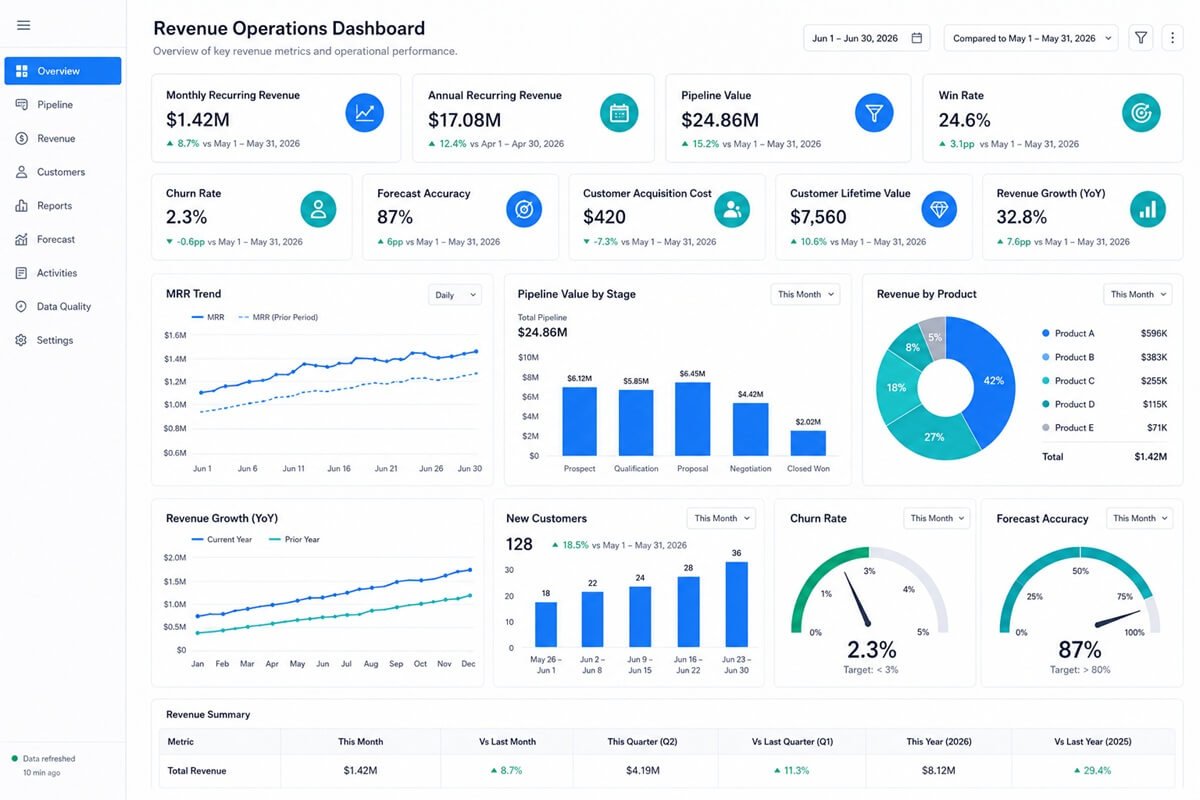
One of RevOps’ greatest advantages is visibility. Executives should have access to real-time dashboards rather than waiting for monthly reports. A comprehensive Revenue Operations dashboard typically includes:
Revenue Metrics
- Monthly Recurring Revenue (MRR)
- Annual Recurring Revenue (ARR)
- Revenue Growth Rate
Sales Metrics
- Pipeline Value
- Win Rate
- Average Deal Size
- Sales Cycle Length
Marketing Metrics
- Marketing Qualified Leads
- Customer Acquisition Cost
- Campaign ROI
Customer Success Metrics
- Churn Rate
- Net Revenue Retention
- Product Adoption
- Expansion Revenue
Real-time reporting enables faster, more informed decision-making.
Phase 8: Train Teams and Drive Adoption
Technology alone does not improve performance—people do. Successful implementations include structured onboarding and continuous training.
Training should cover:
- CRM best practices
- Workflow automation
- AI tools
- Reporting dashboards
- Data quality standards
- Security policies
Encourage feedback from end users to refine workflows and increase adoption.
Phase 9: Measure Performance and Optimize
Revenue Operations is an ongoing discipline, not a one-time deployment. Monitor key performance indicators to evaluate the effectiveness of your automation strategy.
Important metrics include:
- Lead response time
- Conversion rates
- Pipeline velocity
- Forecast accuracy
- Customer acquisition cost
- Customer lifetime value
- Churn rate
- Revenue growth
Review workflows regularly to identify bottlenecks and opportunities for improvement.
Example Revenue Operations Implementation Timeline
| Phase | Timeline | Primary Objective |
| Discovery & Assessment | Weeks 1–2 | Document current processes and identify bottlenecks |
| Process Standardization | Weeks 3–4 | Define consistent workflows and lifecycle stages |
| Data Cleanup | Weeks 5–6 | Improve CRM quality and governance |
| Technology Deployment | Weeks 7–10 | Implement and integrate core platforms |
| Workflow Automation | Weeks 11–14 | Automate repetitive, high-impact processes |
| AI Enablement | Weeks 15–18 | Introduce predictive insights and AI-assisted workflows |
| Dashboard & Reporting | Weeks 19–20 | Launch executive reporting and KPI monitoring |
| Optimization | Ongoing | Refine workflows, improve adoption, and expand automation |
Although timelines vary by organization size, a phased rollout reduces risk and allows teams to adapt without overwhelming day-to-day operations.
Common Implementation Mistakes
Even well-funded RevOps initiatives can fail if organizations overlook foundational principles.
- Automating Inefficient Processes
- Skipping Data Cleanup
- Lack of Executive Sponsorship
- Focusing on Tools Instead of Outcomes
- Ignoring Change Management
- Building Too Many Automations
Revenue Operations Implementation Checklist
Use this checklist to guide your rollout:
- ✔ Document the customer lifecycle.
- ✔ Standardize revenue processes.
- ✔ Clean and govern CRM data.
- ✔ Select an integrated technology stack.
- ✔ Automate repetitive workflows.
- ✔ Introduce AI incrementally.
- ✔ Build executive dashboards.
- ✔ Train users and encourage adoption.
- ✔ Monitor KPIs continuously.
- ✔ Review and optimize workflows regularly.
Measuring Implementation Success
Successful Revenue Operations Automation should be evaluated using measurable business outcomes rather than implementation completion alone. Organizations should track key performance indicators such as lead response time, sales cycle length, conversion rates, forecast accuracy, customer retention, pipeline velocity, and revenue growth.
Regular performance reviews help identify optimization opportunities and ensure automation continues to deliver long-term business value.
Real-World Revenue Operations Automation Workflow Examples
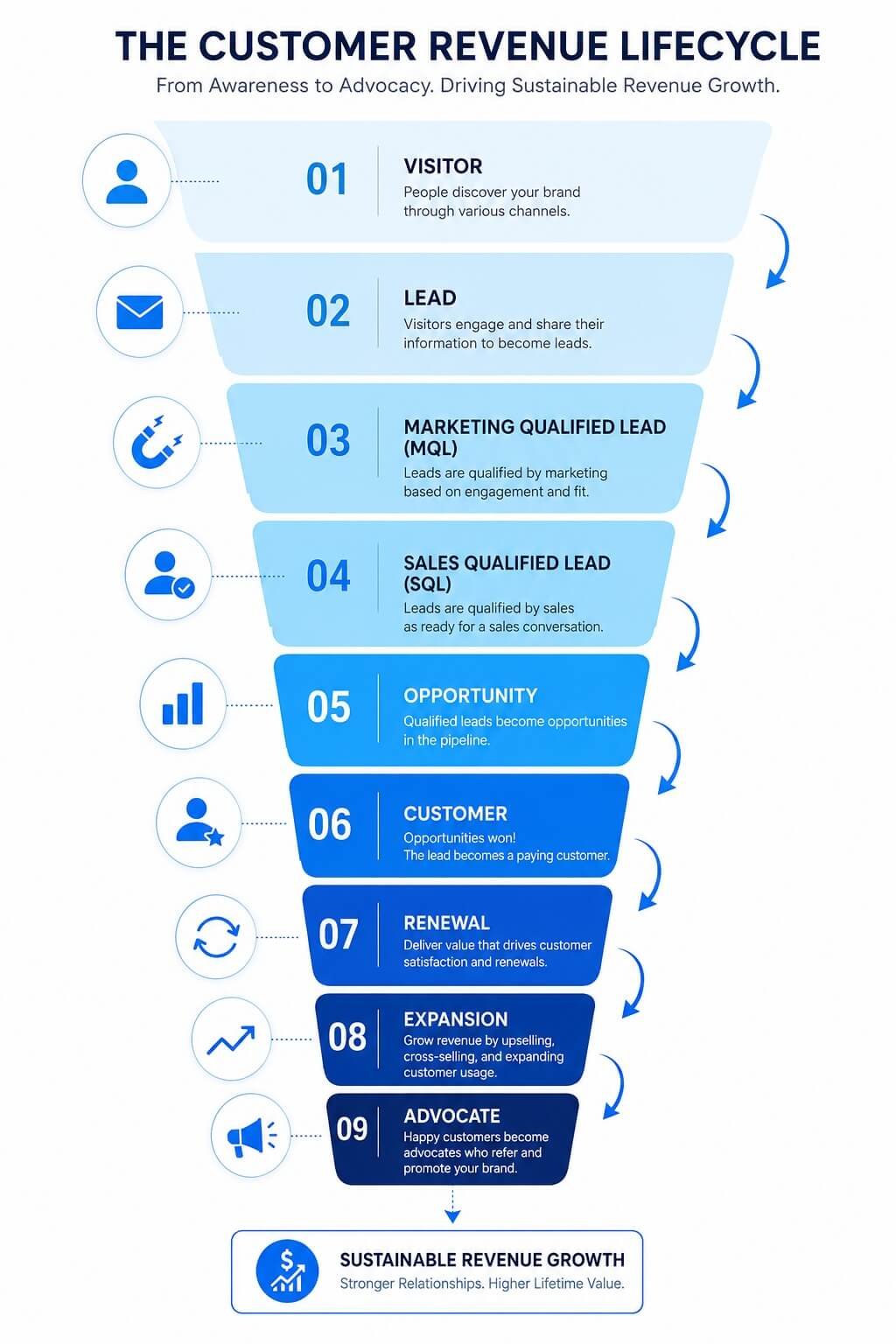
Revenue Operations Automation is most valuable when it connects every stage of the customer journey into a single, intelligent system. Rather than relying on disconnected tools and manual handoffs, modern RevOps uses automation and AI to coordinate marketing, sales, customer success, and finance. The following examples illustrate how these workflows operate in real business environments.
Workflow Example 1: Visitor-to-Customer Automation
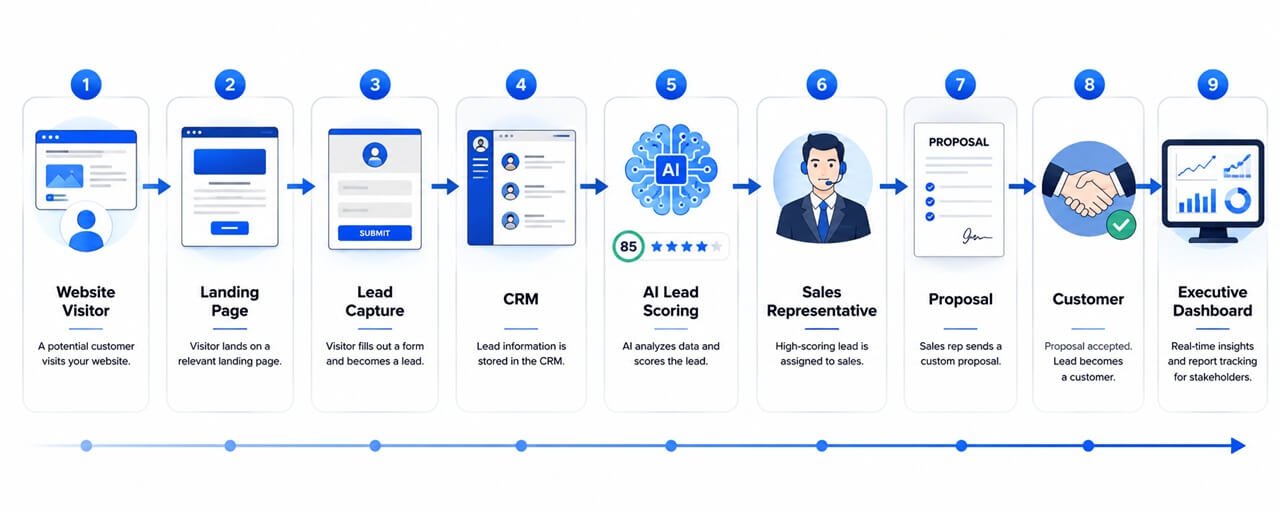
This is one of the most common Revenue Operations workflows. It begins when a visitor interacts with your website and continues through lead qualification, sales engagement, deal management, and customer onboarding.
Workflow Overview
Website Visitor
│
▼
Landing Page
│
▼
Form Submission
│
▼
CRM Contact Created
│
▼
Company Data Enrichment
│
▼
AI Lead Score
│
▼
Lead Routing
│
▼
Personalized Email Sequence
│
▼
Meeting Scheduled
│
▼
Sales Opportunity
│
▼
Proposal Sent
│
▼
Deal Closed
│
▼
Customer Onboarding
│
▼
Executive Dashboard Updated
Business Benefits
- Eliminates manual data entry
- Reduces lead response time
- Improves lead qualification
- Standardizes sales processes
- Accelerates onboarding
- Provides real-time reporting
Workflow Example 2: AI-Powered SDR Workflow
Sales Development Representatives often spend hours researching prospects, updating CRM records, and drafting emails.
AI dramatically reduces this administrative workload.
Workflow
New Lead
│
▼
AI Research
│
▼
Company Enrichment
│
▼
Buying Intent Analysis
│
▼
Lead Priority Score
│
▼
Personalized Outreach Generated
│
▼
Email Sequence
│
▼
Meeting Booked
│
▼
Opportunity Created
AI Tasks
- Company research
- Prospect qualification
- Personalized messaging
- CRM updates
- Meeting scheduling
- Sales summaries
Business Outcome
Sales representatives spend more time engaging prospects and less time on repetitive administrative work.
Workflow Example 3: Marketing-to-Sales Handoff
One of the biggest operational challenges is ensuring qualified leads reach sales quickly and with complete context.
Workflow
Marketing Campaign
│
▼
Lead Captured
│
▼
Behavior Tracking
│
▼
AI Lead Score
│
▼
Qualification Rules
│
▼
Sales Assignment
│
▼
CRM Opportunity
│
▼
Sales Notification
Automation Actions
- Update CRM automatically
- Assign account owner
- Notify sales representative
- Schedule follow-up task
- Add lead to reporting dashboards
This eliminates delays caused by manual lead transfers.
Workflow Example 4: Customer Onboarding Automation
Closing a deal is only the beginning of the customer relationship. Automated onboarding improves customer experience while reducing operational effort.
Workflow
Deal Closed
│
▼
Customer Record Updated
│
▼
Welcome Email
│
▼
Implementation Tasks Created
│
▼
Product Access
│
▼
Training Resources
│
▼
Customer Success Assigned
│
▼
Health Score Monitoring
Benefits
- Faster onboarding
- Consistent customer experience
- Reduced implementation delays
- Better product adoption
- Higher customer satisfaction
Workflow Example 5: Customer Expansion & Renewal
Revenue Operations extends beyond customer acquisition. Existing customers often represent the greatest opportunity for long-term revenue growth.
Workflow
Product Usage
│
▼
Health Score
│
▼
AI Risk Analysis
│
├──────────────┐
▼ ▼
Healthy At-Risk
│ │
Upsell Success Alert
│ │
Renewal Intervention
│ │
Expansion Customer Recovery
AI Signals
- Product adoption
- Login frequency
- Support activity
- Feature usage
- Customer satisfaction
- Renewal history
This workflow enables Customer Success teams to engage proactively instead of reacting after problems occur.
Workflow Example 6: Executive Revenue Dashboard
Revenue Operations leaders need visibility into the entire business—not just isolated departmental metrics.
Data Flow
Marketing
│
Sales
│
Customer Success
│
Finance
│
Support
│
Website Analytics
│
▼
Revenue Data Warehouse
│
▼
Business Intelligence
│
▼
Executive Dashboard
Dashboard Metrics
Revenue Performance
- Monthly Recurring Revenue (MRR)
- Annual Recurring Revenue (ARR)
- Revenue Growth
Sales
- Pipeline Value
- Win Rate
- Sales Cycle Length
- Average Deal Size
Marketing
- Customer Acquisition Cost
- Marketing Qualified Leads
- Campaign ROI
Customer Success
- Net Revenue Retention
- Churn Rate
- Customer Health
- Expansion Revenue
Rather than combining spreadsheets manually, executives receive live insights from every connected platform.
Workflow Example 7: AI Revenue Forecasting
Forecasting is no longer limited to historical reports. Modern AI continuously evaluates pipeline health and predicts future revenue.
Workflow
CRM Pipeline
│
▼
Historical Revenue
│
▼
Sales Activities
│
▼
Customer Engagement
│
▼
AI Forecast Model
│
▼
Revenue Prediction
│
▼
Executive Alerts
AI Inputs
- Pipeline stage
- Deal value
- Sales velocity
- Customer engagement
- Historical conversion
- Market seasonality
- Win probability
Business Value
- More accurate revenue planning
- Earlier identification of pipeline risk
- Better hiring and budgeting decisions
- Increased executive confidence
What These Workflows Have in Common
Although each workflow serves a different purpose, they share several key characteristics:
- Automated Data Flow: Information moves between systems without manual intervention.
- AI-Enhanced Decision Making: Machine learning helps prioritize work and identify opportunities or risks.
- Cross-Functional Collaboration: Marketing, sales, customer success, and finance operate from the same data.
- Real-Time Visibility: Dashboards update automatically as customer interactions occur.
- Continuous Improvement: Performance metrics help teams refine workflows over time.
With these elements, Revenue Operations Automation creates a predictable, scalable revenue engine that supports growth without increasing operational complexity.
Expert Implementation Tips
Organizations beginning their RevOps journey should focus on a few high-impact workflows first.
- Automate lead capture and routing before expanding into more advanced processes.
- Standardize CRM fields and lifecycle stages to ensure data consistency.
- Introduce AI gradually, starting with lead scoring or meeting summaries.
- Track baseline metrics before implementing automation so you can measure improvements.
- Review workflows quarterly to identify bottlenecks and optimize performance as your business evolves.
These incremental improvements often deliver faster results than attempting to automate every process at once.
Selecting High-Impact Automation Opportunities
Organizations achieve the greatest return from Revenue Operations Automation by prioritizing workflows that directly influence revenue performance. High-impact initiatives often include lead management, opportunity progression, customer onboarding, renewal processes, and executive reporting.
Starting with measurable, business-critical workflows enables teams to demonstrate value quickly before expanding automation across the broader revenue lifecycle.
Revenue Operations KPIs Every Team Should Track
You can’t improve what you don’t measure. One of the biggest advantages of Revenue Operations Automation is the ability to monitor the entire revenue lifecycle using consistent, real-time metrics.
Instead of each department reporting different numbers, RevOps establishes a shared set of Key Performance Indicators (KPIs) that align marketing, sales, customer success, and executive leadership. The goal isn’t to track hundreds of metrics—it’s to focus on the KPIs that directly influence predictable revenue growth.
Why RevOps KPIs Matter
Traditional reporting often creates departmental silos:
- Marketing focuses on lead volume.
- Sales focuses on closed deals.
- Customer Success focuses on renewals.
- Finance focuses on revenue.
Revenue Operations connects these metrics into a unified performance framework that answers critical business questions:
- Are we attracting the right customers?
- How efficiently do leads move through the funnel?
- Where are opportunities getting stuck?
- How accurate are our forecasts?
- Are customers staying and expanding?
- Which activities drive long-term revenue?
With standardized KPIs, every team works toward the same business outcomes.
Revenue Operations KPI Framework
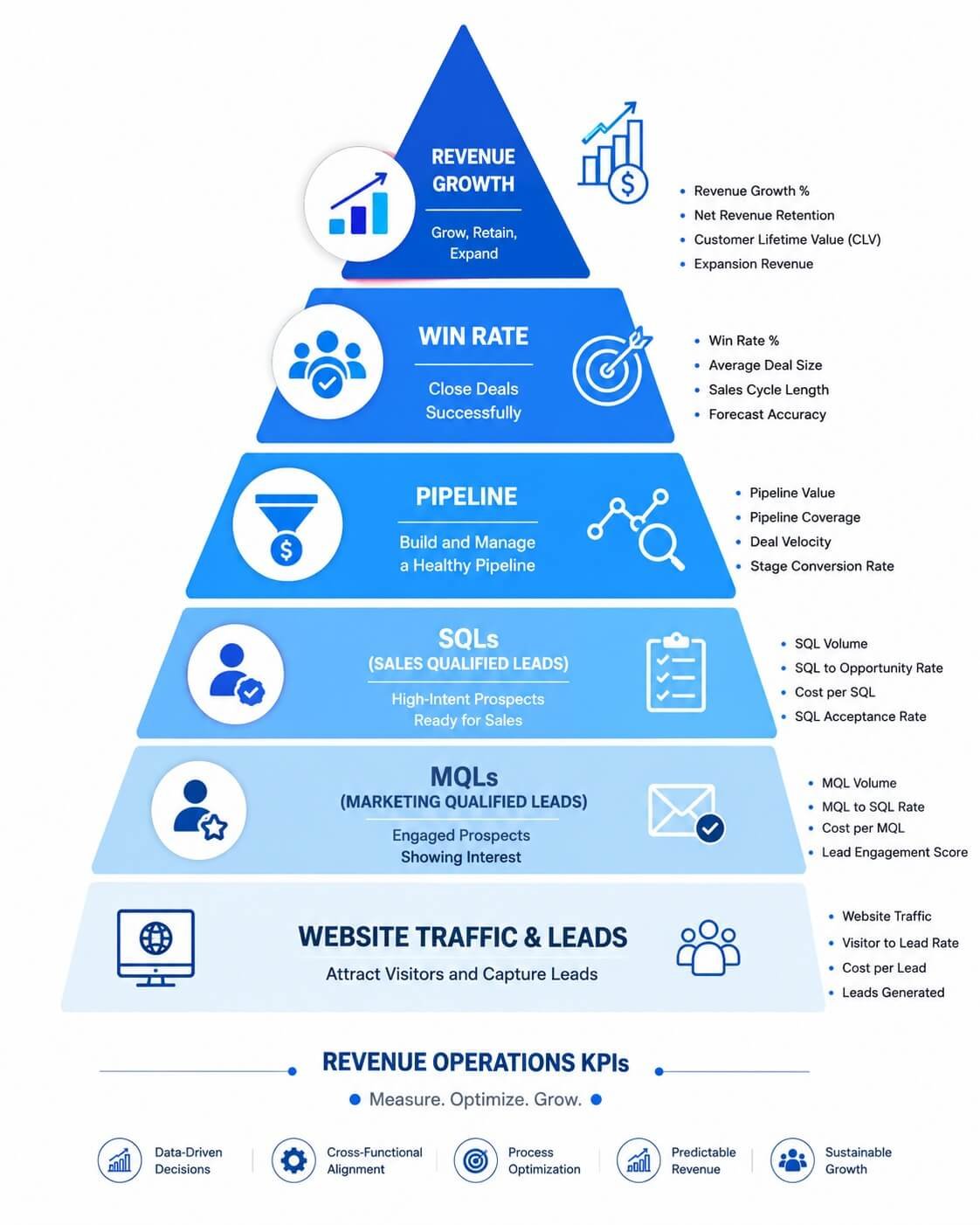
The most effective RevOps dashboards organize metrics into five categories:
- Marketing Performance
- Sales Performance
- Customer Success
- Financial Performance
- Operational Efficiency
Let’s explore each category.
1. Marketing KPIs
Marketing generates demand and feeds the revenue engine. RevOps measures not only lead volume but also lead quality and downstream impact.
Marketing Qualified Leads (MQLs)
Definition
Leads that meet predefined qualification criteria and are ready for sales review.
Formula
Number of Qualified Marketing Leads
Why It Matters
MQLs indicate whether marketing is attracting prospects that fit your ideal customer profile.
Sales Qualified Leads (SQLs)
Definition
Marketing-qualified leads that have been accepted and validated by the sales team.
Formula
Qualified Sales Opportunities
Optimization Tips
- Improve lead scoring.
- Align qualification criteria.
- Increase marketing-sales collaboration.
Lead-to-SQL Conversion Rate
Formula
(SQLs ÷ Total Leads) × 100
Higher conversion rates indicate stronger targeting and qualification.
Customer Acquisition Cost (CAC)
Formula
Total Sales + Marketing Costs
──────────────────────────────
New Customers Acquired
Lower CAC generally improves profitability, provided customer quality remains high.
Campaign ROI
Formula
(Revenue – Campaign Cost)
───────────────────────── × 100
Campaign Cost
Rather than measuring clicks or impressions alone, RevOps focuses on revenue generated by each campaign.
2. Sales KPIs
Sales metrics evaluate how efficiently opportunities move through the pipeline.
Win Rate
Formula
Closed Won Deals
──────────────── × 100
Total Opportunities
Higher win rates often reflect stronger qualification, messaging, and sales execution.
Sales Cycle Length
Measures the average number of days required to close a deal.
Shorter sales cycles generally indicate:
- Better lead qualification
- Efficient workflows
- Faster approvals
- Stronger customer engagement
Average Deal Size
Formula
Total Revenue
─────────────
Closed Deals
Tracking deal size helps identify pricing opportunities and market trends.
Pipeline Velocity
Pipeline Velocity estimates how quickly opportunities generate revenue.
Formula
Number of Opportunities × Average Deal Size × Win Rate
──────────────────────────────────────────────────────
Average Sales Cycle
A higher pipeline velocity indicates a healthier revenue engine.
Sales Activity Metrics
Examples include:
- Calls completed
- Emails sent
- Meetings scheduled
- Follow-ups completed
- Proposals delivered
These should support outcome-based KPIs rather than become goals themselves.
3. Customer Success KPIs
Revenue Operations extends beyond acquiring customers. Long-term growth depends on retention and expansion.
Customer Churn Rate
Formula
Customers Lost
────────────── × 100
Starting Customers
Reducing churn is often more cost-effective than acquiring new customers.
Net Revenue Retention (NRR)
One of the most important SaaS metrics.
Formula
Beginning Revenue
+ Expansion Revenue
− Churn
────────────────── × 100
Beginning Revenue
An NRR above 100% indicates existing customers generate increasing revenue over time.
Gross Revenue Retention (GRR)
Unlike NRR, GRR excludes expansion revenue. It measures how effectively a business retains existing revenue.
Customer Lifetime Value (LTV)
Formula
Average Revenue Per Customer
× Customer Lifespan
Higher LTV supports greater investment in customer acquisition.
Product Adoption Rate
Measures how actively customers use your product or service.
Common indicators include:
- Feature adoption
- Login frequency
- Active users
- Usage growth
- Time to value
4. Financial KPIs
These metrics provide executives with visibility into overall business performance.
Monthly Recurring Revenue (MRR)
Monthly subscription revenue generated from active customers. MRR provides a consistent measure of recurring business performance.
Annual Recurring Revenue (ARR)
ARR annualizes recurring subscription revenue.
Formula:
MRR × 12
Revenue Growth Rate
Measures revenue growth over time.
Formula
(Current Revenue − Previous Revenue)
─────────────────────────────────── × 100
Previous Revenue
Forecast Accuracy
Measures how closely predicted revenue matches actual results. Improving forecast accuracy helps leadership make better budgeting and hiring decisions.
Revenue Per Employee
Measures organizational efficiency.
Formula
Annual Revenue
──────────────
Number of Employees
5. Operational Efficiency KPIs
These metrics evaluate how effectively Revenue Operations supports the business.
Lead Response Time
The average time between lead creation and the first sales interaction. Research consistently shows that faster response times improve conversion rates.
CRM Data Completeness
Measures the percentage of customer records containing required information.
Examples:
- Industry
- Company size
- Owner
- Lifecycle stage
Poor CRM quality reduces automation effectiveness.
Automation Rate
Tracks how many business processes run automatically.
Examples include:
- Lead routing
- CRM updates
- Meeting scheduling
- Customer onboarding
- Invoice generation
Higher automation rates typically reduce manual administrative work.
Workflow Success Rate
Measures the percentage of automations that complete successfully.
Monitor:
- Failed integrations
- API errors
- Sync failures
- Approval delays
Reliable workflows are essential for maintaining operational efficiency.
AI Adoption Rate
Tracks how frequently employees use AI-powered features.
Examples include:
- AI email generation
- Forecast recommendations
- Meeting summaries
- Predictive lead scoring
Adoption metrics help determine whether AI investments are delivering value.
Revenue Operations Executive Dashboard
A RevOps executive dashboard should provide leadership with an at-a-glance view of the health of the revenue engine.
| Category | Core KPIs |
| Marketing | MQLs, SQLs, CAC, Campaign ROI |
| Sales | Pipeline Value, Win Rate, Sales Cycle, Average Deal Size |
| Customer Success | Churn, NRR, GRR, Product Adoption |
| Finance | MRR, ARR, Revenue Growth, Forecast Accuracy |
| Operations | Lead Response Time, CRM Data Quality, Automation Rate, Workflow Success |
Rather than overwhelming stakeholders with dozens of charts, focus on the KPIs that influence strategic decision-making.
Common KPI Mistakes
Many organizations undermine their RevOps initiatives by measuring the wrong metrics. Avoid these common mistakes:
- Measuring Activity Instead of Outcomes
- Different KPI Definitions Across Teams
- Tracking Too Many Metrics
- Ignoring Data Quality
- Reviewing Metrics Too Infrequently
- Best Practices for KPI Management
To maximize the value of your RevOps metrics:
- Align KPIs with business objectives.
- Establish standardized metric definitions.
- Automate data collection where possible.
- Review dashboards regularly.
- Use AI to identify trends and anomalies.
- Share performance insights across departments.
- Continuously refine KPIs as your business evolves.
Establishing a KPI Review Process
Revenue Operations KPIs deliver the greatest value when they are monitored consistently and tied to business objectives. Organizations should establish regular reporting cadences, define metric ownership, and review performance across marketing, sales, customer success, and finance using shared dashboards.
A structured KPI review process helps identify performance trends, uncover revenue bottlenecks, and support faster, data-driven decisions.
Best Revenue Operations Automation Tools (2026)
Choosing the right software is one of the most important decisions when building a Revenue Operations (RevOps) strategy. The goal isn’t to assemble the largest technology stack—it’s to select tools that integrate well, automate repetitive work, and provide accurate data across the entire customer lifecycle.
A successful RevOps stack should includes tools for:
- CRM
- Marketing automation
- Workflow automation
- AI assistants
- Data enrichment
- Sales engagement
- Conversation intelligence
- Business intelligence
- Customer success
- Project management
Rather than recommending a single platform for every business, the following categories explain where each type of tool fits into a modern revenue engine.
1. Customer Relationship Management (CRM)
Your CRM is the central hub of Revenue Operations. Every marketing campaign, sales opportunity, customer interaction, and revenue report depends on it.
Best CRM Platforms
| Platform | Best For | Key Strengths | Potential Limitations |
| HubSpot CRM | SMBs and growing businesses | Easy to use, strong marketing integration | Advanced features require higher-tier plans |
| Salesforce | Enterprise organizations | Highly customizable, extensive ecosystem | Steeper learning curve and implementation complexity |
| GoHighLevel | Agencies | Marketing, CRM, and automation in one platform | Less flexibility for enterprise use cases |
| Pipedrive | Small sales teams | Visual pipeline management | Limited enterprise reporting capabilities |
Who Should Choose What?
- Startups: HubSpot CRM or Pipedrive
- Agencies: GoHighLevel
- Mid-market companies: HubSpot or Salesforce
- Enterprise organizations: Salesforce
2. Workflow Automation Platforms
These platforms automate processes such as:
- Lead routing
- CRM synchronization
- Approval workflows
- Customer onboarding
- Notifications
- Invoice generation
Leading Automation Platforms
| Platform | Best For | Strengths |
| Make | Visual workflow automation | Powerful multi-step automation, flexible integrations |
| n8n | Technical teams | Self-hosting, advanced customization, AI workflows |
| Zapier | Beginners | Easy setup, extensive app library |
| Microsoft Power Automate | Microsoft ecosystem | Strong integration with Microsoft products |
Which One Should You Choose?
- Zapier: Ideal for organizations that want quick, no-code automation.
- Make: Best for businesses building advanced workflows across multiple platforms.
- n8n: Excellent for companies requiring full control, custom integrations, or AI-powered automation.
3. AI Assistants
AI has become a core component of modern Revenue Operations. Rather than replacing employees, AI improves productivity by automating repetitive tasks and supporting better decision-making.
Recommended AI Assistants
| Tool | Best For | Common Use Cases |
| ChatGPT | General productivity | Content creation, email drafting, workflow assistance |
| Claude | Long-form analysis | Documentation, research, strategic planning |
| Microsoft Copilot | Microsoft users | Document creation, spreadsheets, meetings |
| Google Gemini | Google Workspace | Collaboration, research, productivity |
Typical RevOps Applications
- Proposal drafting
- Meeting summaries
- Sales emails
- CRM note generation
- Customer research
- Internal documentation
- Executive reporting
4. Data Enrichment Platforms
High-quality data improves every aspect of Revenue Operations. Data enrichment tools automatically supplement CRM records with company intelligence and contact information.
Leading Data Enrichment Tools
| Tool | Strengths |
| Clay | AI-powered enrichment and workflow automation |
| Apollo | Prospecting and contact database |
| Clearbit | Company intelligence |
| ZoomInfo | Enterprise sales intelligence |
Benefits
- Better lead scoring
- Improved personalization
- More accurate segmentation
- Higher CRM quality
- Enhanced reporting
5. Sales Engagement Platforms
Sales engagement software helps representatives communicate consistently across email, phone, and social channels. Popular platforms include:
| Platform | Best Use Case |
| Lemlist | Personalized cold outreach |
| Instantly | High-volume email campaigns |
| Outreach | Enterprise sales engagement |
| Salesloft | Sales execution and coaching |
Automation features often include:
- Email sequences
- Follow-up reminders
- Call scheduling
- Performance analytics
- Template management
6. Conversation Intelligence
Every customer conversation contains valuable insights. Conversation intelligence platforms analyze meetings to improve sales performance and customer understanding.
Top Platforms
| Platform | Strengths |
| Fireflies | AI meeting transcription and summaries |
| Otter.ai | Real-time transcription |
| Gong | Enterprise revenue intelligence |
| Avoma | Meeting insights and coaching |
Common Features
- Call transcription
- AI-generated summaries
- Action item extraction
- Keyword analysis
- Sales coaching
Internal Link Opportunity: Link to Fireflies vs Otter AI.
7. Business Intelligence Platforms
Revenue Operations depends on accurate reporting. Business intelligence tools consolidate information from CRM, marketing automation, finance, and customer success platforms.
Common solutions include:
| Platform | Best For |
| Power BI | Microsoft ecosystem |
| Looker Studio | Google ecosystem |
| Tableau | Enterprise analytics |
| Metabase | Open-source reporting |
Typical dashboards include:
- Revenue forecasting
- Pipeline analysis
- Marketing ROI
- Customer retention
- Sales productivity
8. Customer Success Platforms
Revenue doesn’t stop after a deal closes. Customer Success software helps organizations retain customers and identify expansion opportunities.
Popular platforms include:
| Platform | Best For |
| Gainsight | Enterprise customer success |
| Vitally | SaaS growth companies |
| ChurnZero | Customer retention |
| Planhat | Customer lifecycle management |
Automation examples include:
- Health score monitoring
- Renewal reminders
- Customer onboarding
- Expansion alerts
9. Project & Work Management
Internal collaboration is another critical component of Revenue Operations. Recommended platforms include:
| Platform | Best For |
| ClickUp | Operations teams |
| Monday.com | Cross-functional collaboration |
| Asana | Task management |
| Notion | Documentation and knowledge sharing |
These platforms help coordinate implementation projects, onboarding processes, and cross-department initiatives.
Example RevOps Technology Stack by Business Size
Startup
| Category | Recommended Tool |
| CRM | HubSpot CRM |
| Automation | Zapier |
| AI | ChatGPT |
| Meetings | Fireflies |
| Analytics | Looker Studio |
Growing SMB
| Category | Recommended Tool |
| CRM | HubSpot |
| Automation | Make |
| AI | ChatGPT + Claude |
| Enrichment | Clay |
| Customer Success | Vitally |
| Analytics | Power BI |
Enterprise
| Category | Recommended Tool |
| CRM | Salesforce |
| Automation | Make or Power Automate |
| AI | Enterprise AI Platform |
| Enrichment | ZoomInfo |
| Revenue Intelligence | Gong |
| Customer Success | Gainsight |
| Analytics | Tableau |
How to Evaluate Revenue Operations Software
Before investing in any platform, evaluate it against these criteria:
| Evaluation Criteria | Why It Matters |
| API integrations | Ensures seamless data exchange |
| Ease of implementation | Reduces deployment time |
| Scalability | Supports business growth |
| AI capabilities | Improves productivity and insights |
| Reporting | Enables informed decision-making |
| Security | Protects sensitive customer data |
| User adoption | Drives long-term success |
| Total cost of ownership | Prevents unexpected expenses |
The best software is the one that aligns with your business goals, integrates with your existing systems, and simplifies operations—not necessarily the one with the longest feature list.
Common Software Buying Mistakes
Avoid these pitfalls when building your RevOps stack:
- Purchasing overlapping tools with duplicate functionality.
- Prioritizing features over usability.
- Ignoring integration capabilities.
- Underestimating implementation and training time.
- Choosing software without a clear business case.
- Expanding the stack before optimizing existing workflows.
Recommended RevOps Stack for WorkflowAISuite Readers
For most small to mid-sized businesses implementing Revenue Operations Automation, a balanced stack might include:
| Function | Recommended Category |
| CRM | HubSpot CRM |
| Marketing Automation | HubSpot Marketing Hub |
| Workflow Automation | Make or n8n |
| AI Assistant | ChatGPT and Claude |
| Data Enrichment | Clay |
| Sales Engagement | Lemlist |
| Meeting Intelligence | Fireflies |
| Analytics | Power BI or Looker Studio |
| Customer Success | Vitally |
| Documentation | Notion |
This combination provides strong automation capabilities while remaining flexible enough to scale as your business grows.
Technology Selection Considerations
Choosing the right Revenue Operations technology stack requires aligning technology with business objectives rather than simply adding more software. Organizations should prioritize platforms that integrate seamlessly, support standardized workflows, maintain high-quality data, and provide scalable automation. A well-planned technology ecosystem enables greater operational efficiency, more reliable reporting, and long-term revenue growth.
Common Revenue Operations Automation Mistakes (And How to Avoid Them)
Revenue Operations Automation has the potential to transform how organizations generate, manage, and retain revenue. However, technology alone does not guarantee success.
Many RevOps initiatives underperform because businesses focus on software before addressing processes, data quality, governance, and team alignment. Understanding these common mistakes can help you avoid costly implementation issues and build a scalable revenue engine.
1. Treating RevOps as a Technology Project
One of the most common misconceptions is that Revenue Operations is simply about purchasing a CRM or automation platform.
In reality, RevOps is a business strategy supported by technology. Without clearly defined processes and cross-functional collaboration, even the most advanced software will deliver limited value.
Better
Approach
Start by documenting:
- Customer lifecycle
- Sales process
- Marketing workflow
- Customer onboarding
- Renewal process
- Revenue reporting
Technology should automate an already well-designed system—not create one from scratch.
2. Poor CRM Data Quality
Revenue Operations depends on accurate, complete, and standardized data. If duplicate contacts, outdated information, or inconsistent lifecycle stages exist in your CRM, every downstream process—from reporting to AI forecasting—will be affected.
Common Data Problems
- Duplicate records
- Missing email addresses
- Incorrect industries
- Inconsistent naming conventions
- Missing ownership
- Invalid lifecycle stages
Best Practices
- Schedule regular CRM audits.
- Use validation rules.
- Automate duplicate detection.
- Define required fields.
- Assign data ownership.
Clean data is the foundation of successful automation.
3. Automating Broken Processes
Automation increases efficiency—but it also amplifies existing problems. If your sales approval process already contains unnecessary steps, automation will simply execute those inefficient steps more quickly.
Before creating workflows, ask:
- Can this process be simplified?
- Are all approvals necessary?
- Is information being entered multiple times?
- Can steps be eliminated?
- Optimize first.
- Automate second.
4. Building Too Many Automations
As organizations become more comfortable with workflow platforms, they sometimes create hundreds of disconnected automations.Over time this leads to Maintenance challenges
- Workflow conflicts
- Duplicate actions
- Difficult troubleshooting
- Poor documentation
Better Strategy
Build fewer, well-documented workflows that support core business processes. Prioritize quality over quantity.
5. Ignoring Cross-Department Alignment
Revenue Operations exists to eliminate departmental silos. If marketing, sales, customer success, and finance continue operating independently, automation cannot deliver its full value.
Common symptoms include:
- Different KPI definitions
- Separate reporting systems
- Conflicting lifecycle stages
- Duplicate customer records
- Manual handoffs
Successful RevOps requires shared ownership of the revenue process.
6. Measuring Activity Instead of Revenue Outcomes
Many organizations celebrate metrics such as:
- Emails sent
- Calls completed
- Meetings booked
While useful, these activity metrics don’t necessarily indicate business success. Revenue Operations should prioritize outcome-based KPIs, including:
Pipeline velocity
Win rate
- Customer acquisition cost
- Customer lifetime value
- Net Revenue Retention
- Forecast accuracy
Always connect operational metrics to revenue impact.
7. Overlooking User Adoption
Even the best automation platform fails if employees don’t use it.
Common adoption challenges include:
- Insufficient training
- Complex workflows
- Poor documentation
- Lack of executive support
- Resistance to change
Improve Adoption By
- Providing role-specific training
- Documenting workflows
- Collecting employee feedback
- Celebrating automation wins
- Continuously improving user experience
People remain the most important part of any Revenue Operations initiative.
8. Implementing AI Without Governance
AI can significantly improve Revenue Operations, but it requires thoughtful governance. Organizations should establish policies covering:
- Human review requirements
- Data privacy
- Security
- Compliance
- Bias monitoring
- AI transparency
- Access controls
Responsible AI ensures automation supports business goals while maintaining customer trust.
9. Choosing Tools That Don’t Integrate
Every disconnected application creates another operational silo. Before purchasing software, confirm it can integrate with your:
- CRM
- Marketing platform
- Customer Success software
- Analytics tools
- Communication platforms
- Workflow automation platform
Integration is often more valuable than advanced individual features.
10. Failing to Continuously Optimize
Revenue Operations is not a one-time implementation. As markets, customers, and technologies evolve, workflows should evolve as well.
Regular reviews help identify:
- Automation failures
- Bottlenecks
- New AI opportunities
- Reporting improvements
- Process inefficiencies
Continuous optimization is a defining characteristic of mature RevOps organizations.
Revenue Operations Best Practices
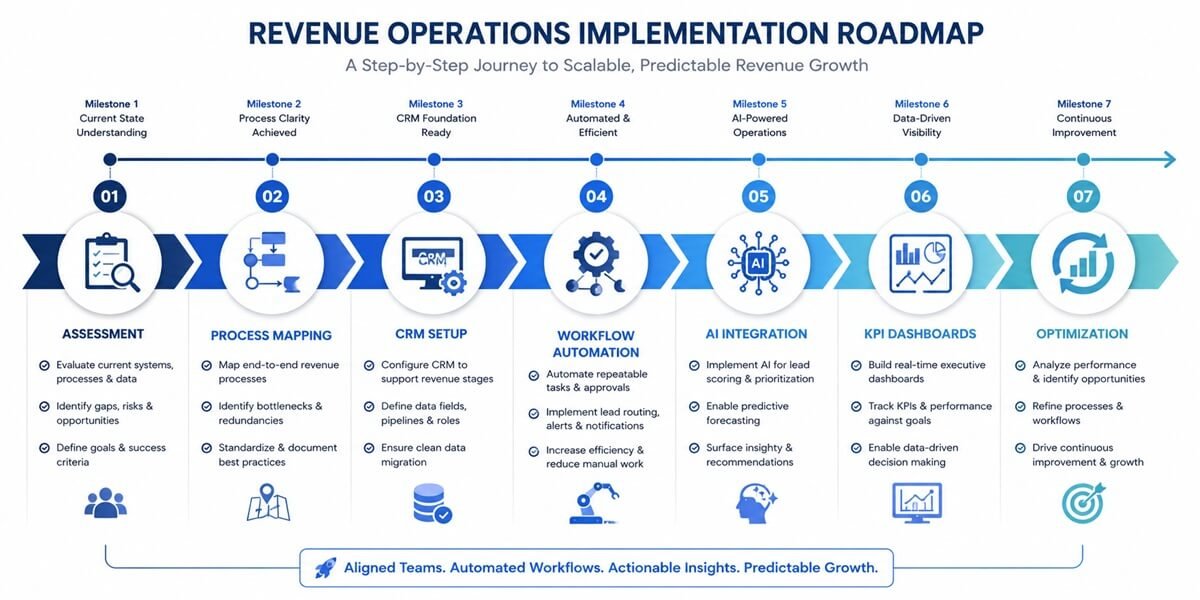
Successful organizations consistently follow these principles.
Standardize Before You Automate
- Keep CRM Data Clean
- Build Modular Workflows
- Focus on Customer Experience
- Align Departments Around Shared KPIs
- Introduce AI Incrementally
- Measure Business Outcomes
- Revenue Operations Maturity Model
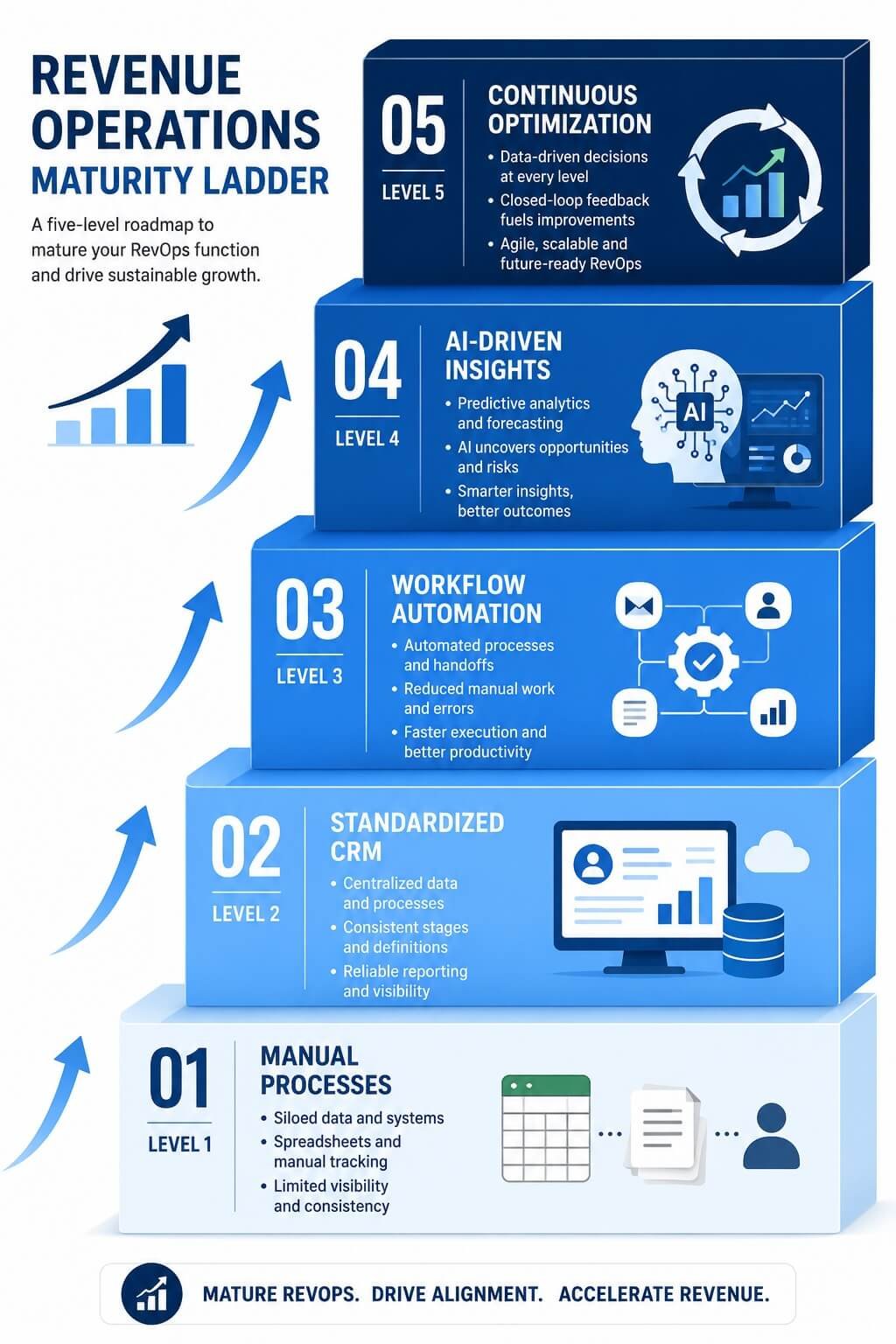
Use this framework to evaluate your organization’s current stage.
| Level | Characteristics |
| Level 1 – Manual | Spreadsheets, disconnected systems, manual reporting |
| Level 2 – Standardized | Documented processes and centralized CRM |
| Level 3 – Automated | Workflow automation across departments |
| Level 4 – Intelligent | AI-driven forecasting, lead scoring, and analytics |
| Level 5 – Optimized | Continuous improvement, predictive insights, autonomous workflows |
Most organizations are currently between Levels 2 and 4. Reaching Level 5 requires ongoing optimization, governance, and cross-functional collaboration.
Frequently Asked Questions (FAQs)
How long does it take to implement Revenue Operations Automation?
Implementation timelines depend on business size, existing technology, and process complexity. Small organizations with a centralized CRM may complete implementation within a few weeks, while enterprise organizations integrating multiple platforms often require several months. A phased rollout that prioritizes high-impact workflows typically delivers faster results and minimizes operational disruption.
Can small and medium-sized businesses benefit from Revenue Operations Automation?
Yes. Revenue Operations Automation is not limited to large enterprises. Small and medium-sized businesses can improve lead management, automate repetitive tasks, enhance customer communication, and gain better visibility into sales performance without significantly increasing operational costs. Cloud-based RevOps platforms make automation accessible for organizations of all sizes.
What is the biggest challenge when implementing Revenue Operations Automation?
The most common challenge is poor data quality. Inconsistent CRM records, duplicate contacts, disconnected systems, and undefined business processes can reduce the effectiveness of automation. Establishing standardized data governance and clear workflow ownership before implementation significantly improves long-term success.
How do you measure the success of Revenue Operations Automation?
Success should be measured using business outcomes rather than the number of automated workflows. Organizations commonly monitor pipeline velocity, lead response time, conversion rates, forecast accuracy, customer acquisition cost (CAC), net revenue retention (NRR), customer lifetime value (CLV), and overall revenue growth to evaluate automation performance.
Does Revenue Operations Automation require artificial intelligence?
No. Revenue Operations Automation can deliver significant value through workflow automation, CRM integration, and standardized processes alone. Artificial intelligence enhances these capabilities by providing predictive analytics, lead scoring, forecasting, and intelligent recommendations, but it is not a prerequisite for a successful RevOps strategy.
How often should Revenue Operations workflows be reviewed?
Organizations should review critical workflows and performance metrics at least quarterly, with ongoing monitoring of key revenue KPIs. Regular reviews help identify process bottlenecks, adapt automation to changing business requirements, and ensure workflows continue to support organizational goals.
Can Revenue Operations Automation integrate with existing business software?
Most modern Revenue Operations platforms support integration with CRM systems, marketing automation platforms, customer support software, ERP systems, analytics tools, and communication platforms through APIs and pre-built connectors. Successful integrations depend on maintaining consistent data structures and standardized business processes across systems.
What should businesses consider when choosing Revenue Operations software?
Organizations should evaluate integration capabilities, scalability, automation features, reporting and analytics, security, compliance, ease of use, vendor support, and total cost of ownership. The best solution is one that aligns with current business processes while providing the flexibility to support future growth and evolving revenue strategies.
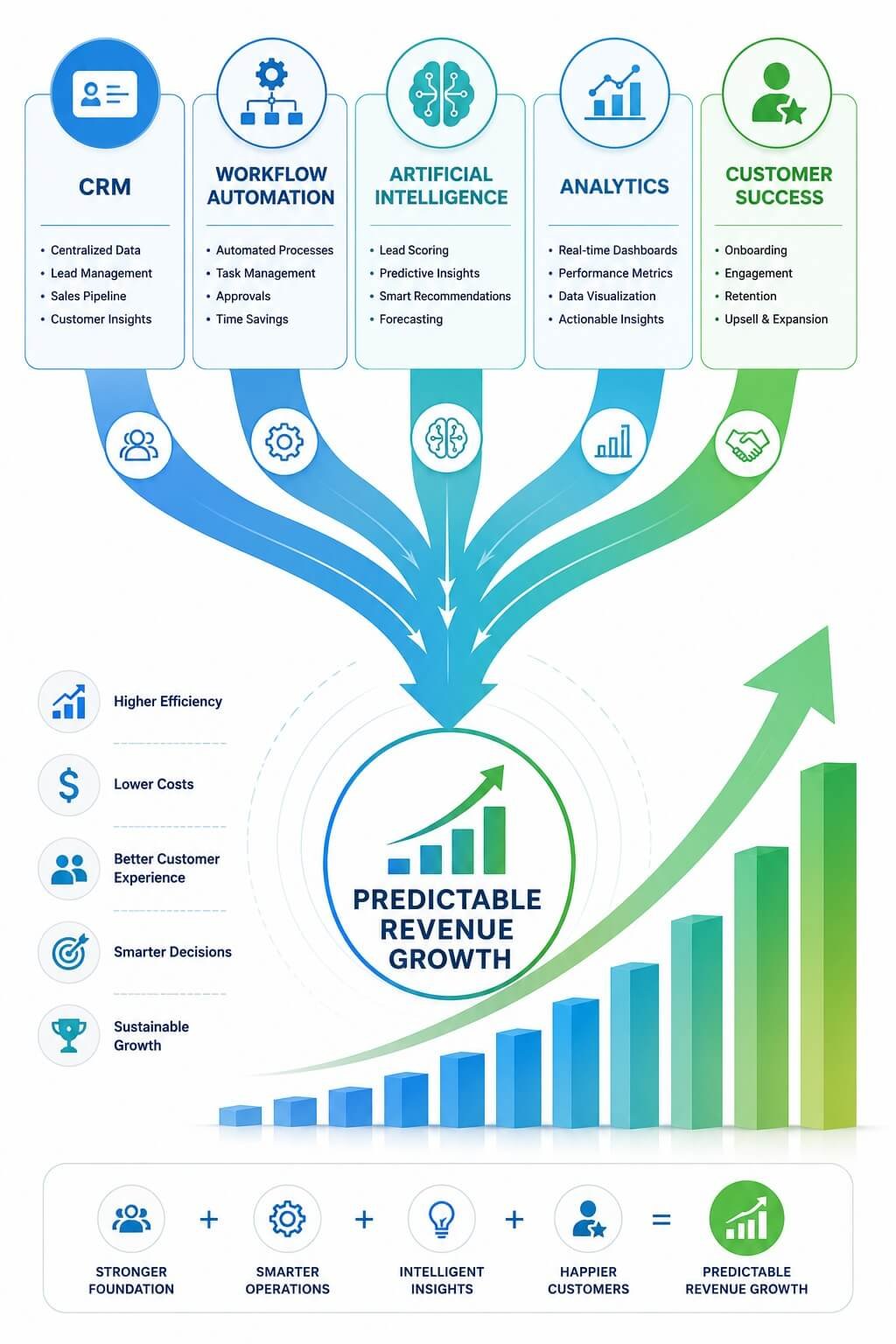
Conclusion
Revenue Operations Automation is no longer a competitive advantage reserved for large enterprises—it’s becoming a foundational capability for organizations that want predictable, scalable growth.
By unifying marketing, sales, customer success, and finance around shared data, standardized processes, and intelligent automation, businesses can eliminate operational silos, improve forecasting, and create a more consistent customer experience.
The journey doesn’t begin with purchasing software. It starts with understanding your current processes, improving data quality, and aligning teams around common revenue goals. From there, workflow automation and artificial intelligence can amplify efficiency, reduce manual work, and provide the insights needed to make better decisions.
Whether you’re implementing your first CRM, expanding your automation strategy, or introducing AI-powered revenue intelligence, focus on incremental improvements. Build a strong foundation, measure meaningful outcomes, and continuously refine your workflows as your business evolves.
Organizations that embrace Revenue Operations Automation today will be better positioned to adapt to changing markets, respond faster to customer needs, and build a predictable revenue engine that supports long-term business success.





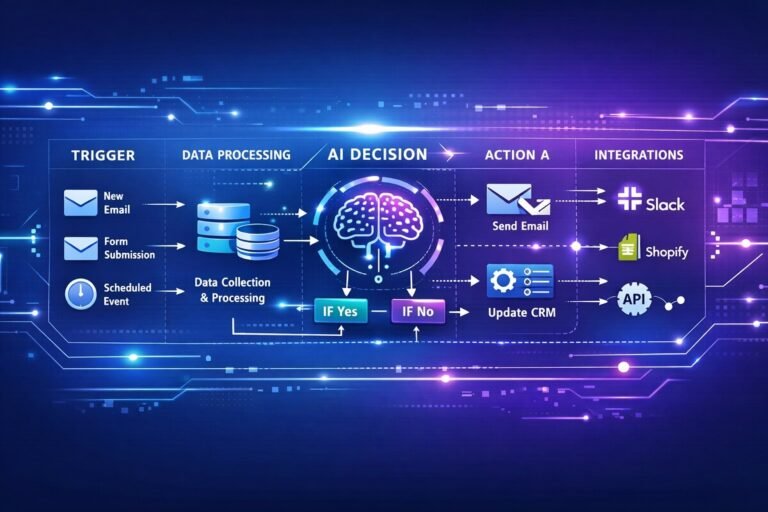

One Comment