GoHighLevel vs HubSpot: Which CRM Is Better in 2026?

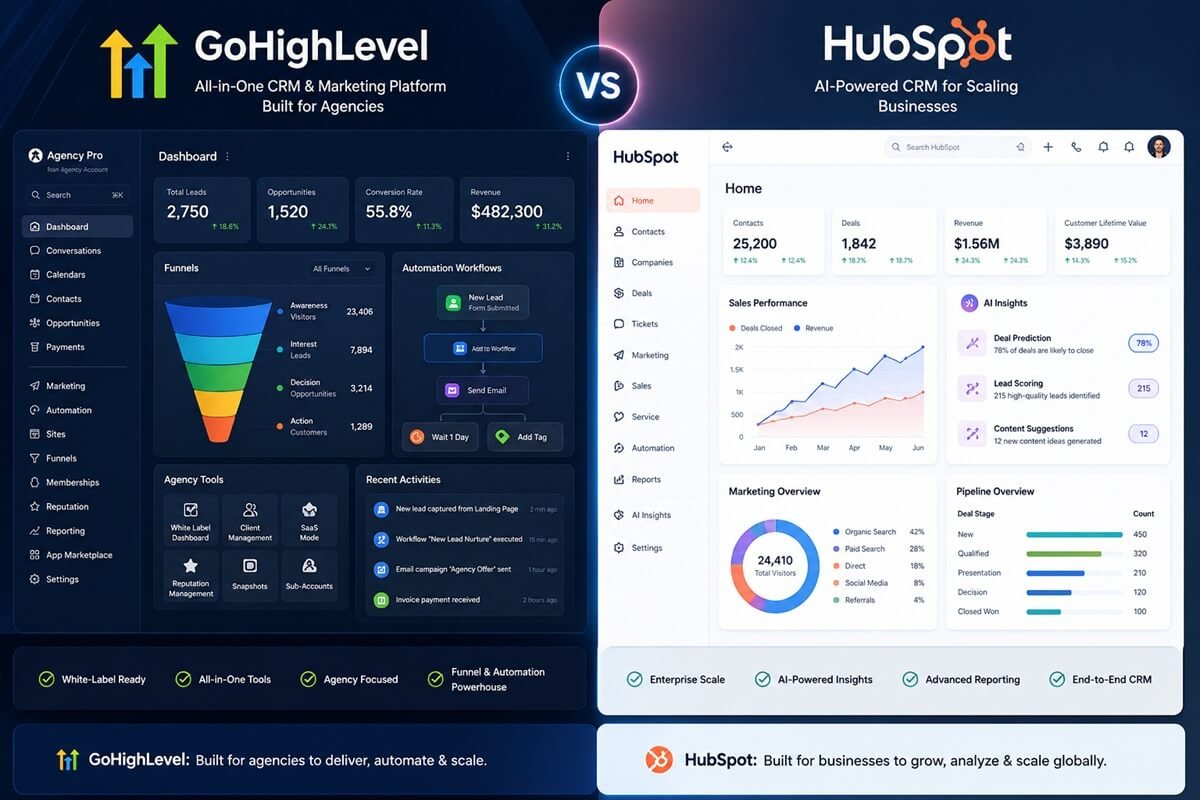
Choosing the right CRM is one of the most important decisions for any growing marketing agency. It directly affects how you manage clients, automate campaigns, track leads, and scale revenue.
Two platforms dominate this conversation today: GoHighLevel and HubSpot. While GoHighLevel is often praised for being an “all-in-one agency tool,” HubSpot has quietly evolved into one of the most powerful, AI-driven CRM ecosystems in the world.
So, the real question is not just which CRM is better—but:
Which CRM scales more sustainably, intelligently, and globally over time?
Let’s break it down.
Table of Contents
Quick Overview: GoHighLevel vs HubSpot
| Feature | GoHighLevel | HubSpot |
| Primary Focus | Marketing Agencies | Inbound marketing + enterprise CRM |
| Ease of Use | Moderate | Very high |
| Automation | Strong | Advanced + AI-powered |
| Scalability | Agency-based scaling | Enterprise-grade scaling |
| Ecosystem | Limited | Extremely large |
| AI capabilities | Basic to moderate | Advanced (AI-driven CRM) |
| Long-term stability | Good for agencies | Excellent for global businesses |
To understand how modern CRMs like HubSpot fit into larger systems, it’s important to look at how AI workflows explained shape automation, data flow, and business scalability.
How We Compared
To create this comparison, we evaluated GoHighLevel and HubSpot across the factors that matter most when selecting a CRM, including CRM functionality, marketing automation, sales tools, reporting, integrations, pricing, ease of use, AI capabilities, scalability, and customer support.
We also considered each platform’s target audience, long-term growth potential, and suitability for agencies versus growing businesses.
What is GoHighLevel?

GoHighLevel is an all-in-one CRM platform designed primarily for marketing agencies. It combines funnels, email marketing, SMS automation, pipeline management, and white-label capabilities. Its biggest strength is consolidation—you can run almost your entire agency from one system.
Key strengths:
- White-label CRM for agencies
- Built-in funnel builder
- SMS + email automation
- Client account management
- Affordable flat pricing
It is powerful, especially for agencies managing multiple clients—but it is still largely agency-operational focused, not enterprise-evolution focused.
Tools like GoHighLevel often rely on external integrations or automation platforms, similar to how businesses compare workflow automation tools like Zapier vs Make vs n8n to build scalable systems.
What is HubSpot?
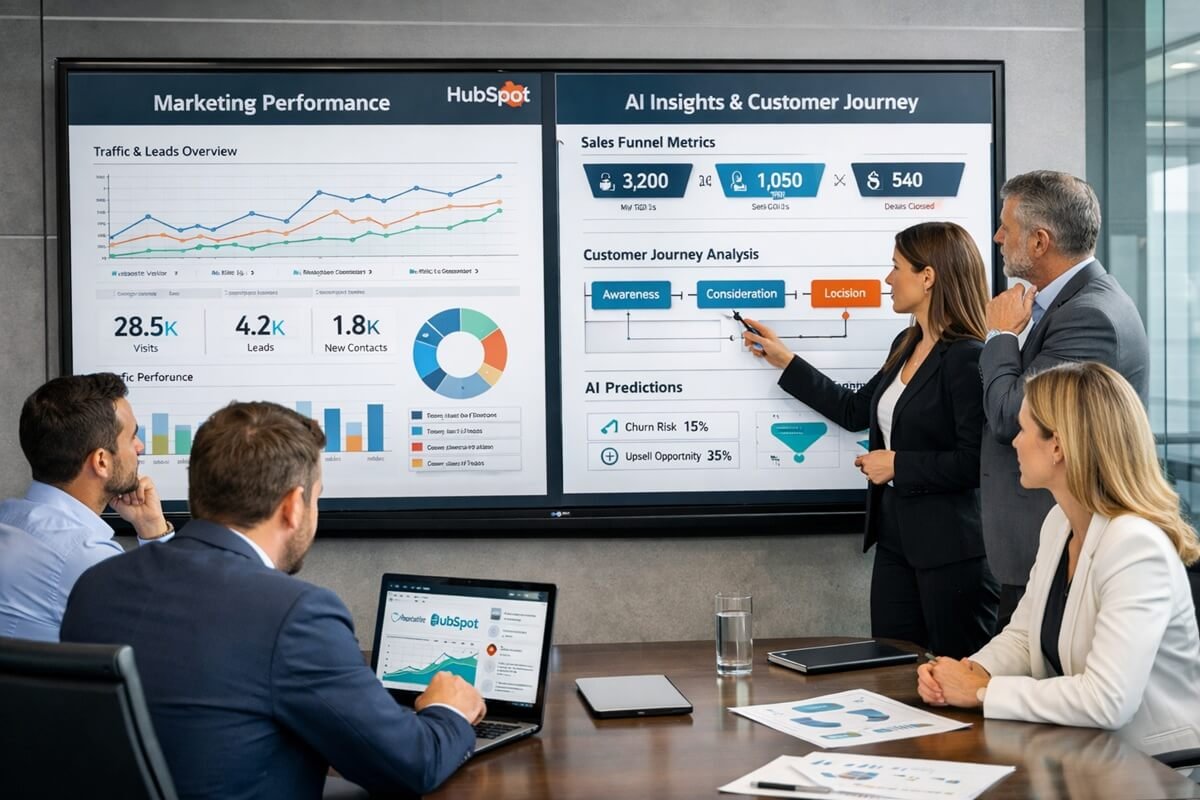
HubSpot is a full-scale CRM ecosystem designed for long-term business growth, from startups to enterprise-level organizations. Unlike many CRMs, HubSpot is not just a tool—it is a growth platform built around marketing, sales, service, operations, and AI.
Key strengths:
- Industry-leading CRM structure
- Powerful inbound marketing engine
- Deep analytics and reporting
- Massive integration ecosystem
- Advanced AI tools across workflows
- Scales from SMB to enterprise seamlessly
HubSpot’s strength is not just features—it’s system maturity and scalability over time. HubSpot aligns closely with modern AI marketing systems, where automation, CRM, and customer data are unified into one scalable growth engine.
Who This Comparison Is For
This comparison is designed for:
- ✔ Marketing agencies
- ✔ Small businesses
- ✔ SaaS companies
- ✔ Freelancers
- ✔ Sales teams
- ✔ Businesses planning to switch CRMs
GoHighLevel vs HubSpot: Feature-by-Feature Comparison
Compare GoHighLevel and HubSpot across the features that matter most, including CRM capabilities, automation, pricing, integrations, reporting, and scalability.
GoHighLevel vs HubSpot CRM Capabilities
Both platforms include core CRM functionality, but they are designed for different business models.
GoHighLevel centers its CRM around agency workflows. It lets agencies manage multiple client accounts, track leads, automate follow-ups, and organize customer pipelines from a single dashboard. Its multi-account structure and white-label options make it especially useful for agencies serving multiple clients.
HubSpot, on the other hand, focuses on building a complete customer relationship ecosystem. Beyond contact management, it connects marketing, sales, customer service, operations, and commerce into one unified platform. This makes it easier for growing businesses to maintain a complete customer history across every department.
Winner: Draw.
Choose GoHighLevel for agency-centric client management, while HubSpot is the stronger option for businesses that need an integrated CRM across multiple teams. Many businesses evaluating modern CRM platforms often compare them with other no-code CRM solutions before making a long-term investment.
GoHighLevel vs HubSpot Marketing Automation
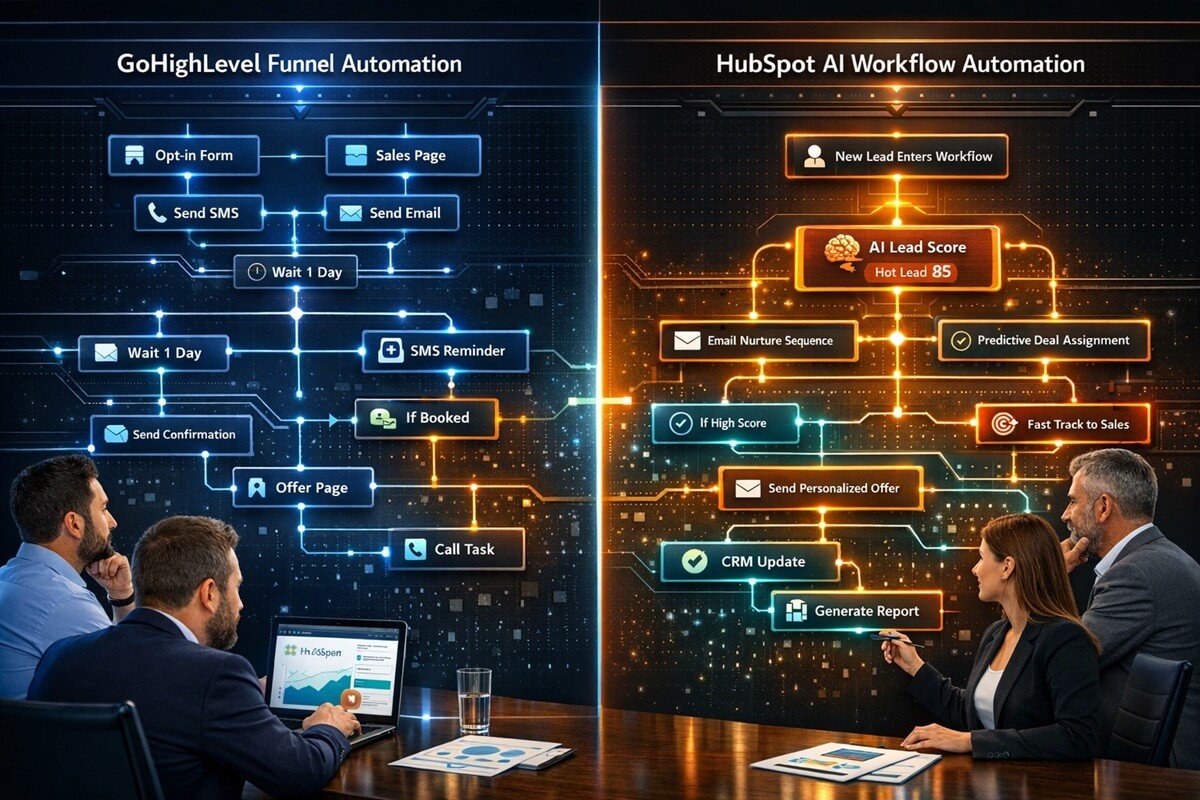
Automation is one of the biggest reasons businesses consider either platform.
GoHighLevel offers visual workflow builders, automated SMS and email campaigns, appointment reminders, reputation management, and lead nurturing sequences. These tools are designed to reduce repetitive work for agencies managing multiple client campaigns.
HubSpot provides advanced workflow automation across marketing, sales, and customer service. Users can trigger workflows based on contact behavior, lifecycle stages, deal activity, website interactions, and CRM data. AI-assisted automation and personalization add another layer of flexibility for larger organizations.
If your automation needs focus on client campaigns and funnels, GoHighLevel performs exceptionally well. If you require sophisticated cross-department automation and personalized customer journeys, HubSpot offers more depth.
Winner: HubSpot for advanced automation, GoHighLevel for agency workflows.
However, many organizations combine CRM platforms with structured AI workflow templates to automate lead nurturing, customer onboarding, and sales follow-up across multiple channels.
GoHighLevel vs HubSpot Sales Tools
Sales functionality differs significantly between the two platforms.
GoHighLevel includes customizable sales pipelines, appointment scheduling, two-way messaging, and built-in funnel management. These tools are designed to help agencies capture, qualify, and convert leads quickly.
HubSpot provides customizable pipelines, deal forecasting, task automation, quote generation, sales analytics, conversation intelligence, and AI-assisted prospecting. It also integrates closely with marketing and customer service data, giving sales teams greater visibility into the customer journey.
Small agencies appreciate GoHighLevel’s streamlined sales process, while growing companies often benefit from HubSpot’s broader sales ecosystem.
Winner: HubSpot.
Teams looking to standardize their sales process often complement CRM software with proven sales workflow templates that improve lead qualification, follow-up consistency, and pipeline management.
GoHighLevel vs HubSpot Reporting & Analytics
Reporting becomes increasingly important as a business grows.
GoHighLevel offers dashboards that track leads, campaigns, appointments, calls, and pipeline performance. Agencies can monitor client results without relying on multiple reporting tools.
HubSpot provides highly customizable dashboards, attribution reporting, revenue analytics, sales forecasting, customer journey reporting, and marketing performance insights. Businesses with multiple departments can analyze data across the entire customer lifecycle.
Businesses that rely heavily on forecasting and lead prioritization also benefit from AI predictive analytics, which helps identify high-value opportunities before they enter the sales pipeline.
For agencies focused on campaign reporting, GoHighLevel provides sufficient insight. Businesses requiring executive-level reporting and strategic decision-making will generally find HubSpot more comprehensive.
Winner: HubSpot.
GoHighLevel vs HubSpot Integrations
No CRM operates in isolation, making integrations an important consideration.
GoHighLevel integrates with popular marketing and communication platforms while also supporting API connections and automation tools. Most agency workflows can be built without extensive third-party software.
HubSpot maintains one of the largest CRM integration ecosystems available. Thousands of apps connect directly with HubSpot, including accounting, e-commerce, customer support, project management, advertising, analytics, and productivity tools.
Businesses expecting to scale across multiple software platforms will likely benefit from HubSpot’s larger ecosystem, whereas many agencies can comfortably operate within GoHighLevel’s integrated feature set.
Winner: HubSpot.
GoHighLevel vs HubSpot Ease of Use
Ease of use often depends on the type of business.
GoHighLevel combines numerous agency tools into one platform, reducing the need for multiple subscriptions. However, configuring funnels, automation, and client accounts can require a learning period.
HubSpot is widely recognized for its clean interface and intuitive navigation. Although advanced features require time to master, everyday CRM tasks are generally easier for new users.
Agencies already familiar with digital marketing workflows may adapt quickly to GoHighLevel, while businesses implementing their first CRM often find HubSpot easier to adopt.
Winner: HubSpot for beginners; GoHighLevel for experienced agency users.
GoHighLevel vs HubSpot Customer Support
Reliable support becomes increasingly valuable as businesses expand.
GoHighLevel provides documentation, community resources, onboarding assistance, and customer support tailored to agencies. Its active user community also offers practical implementation advice.
HubSpot supplements traditional support with an extensive knowledge base, certification courses, community forums, onboarding services, and partner networks. Businesses investing heavily in CRM adoption often benefit from these additional educational resources.
Organizations seeking structured learning and long-term training may prefer HubSpot, while agencies focused on rapid deployment may find GoHighLevel’s resources sufficient.
Winner: HubSpot.
GoHighLevel vs HubSpot Pricing
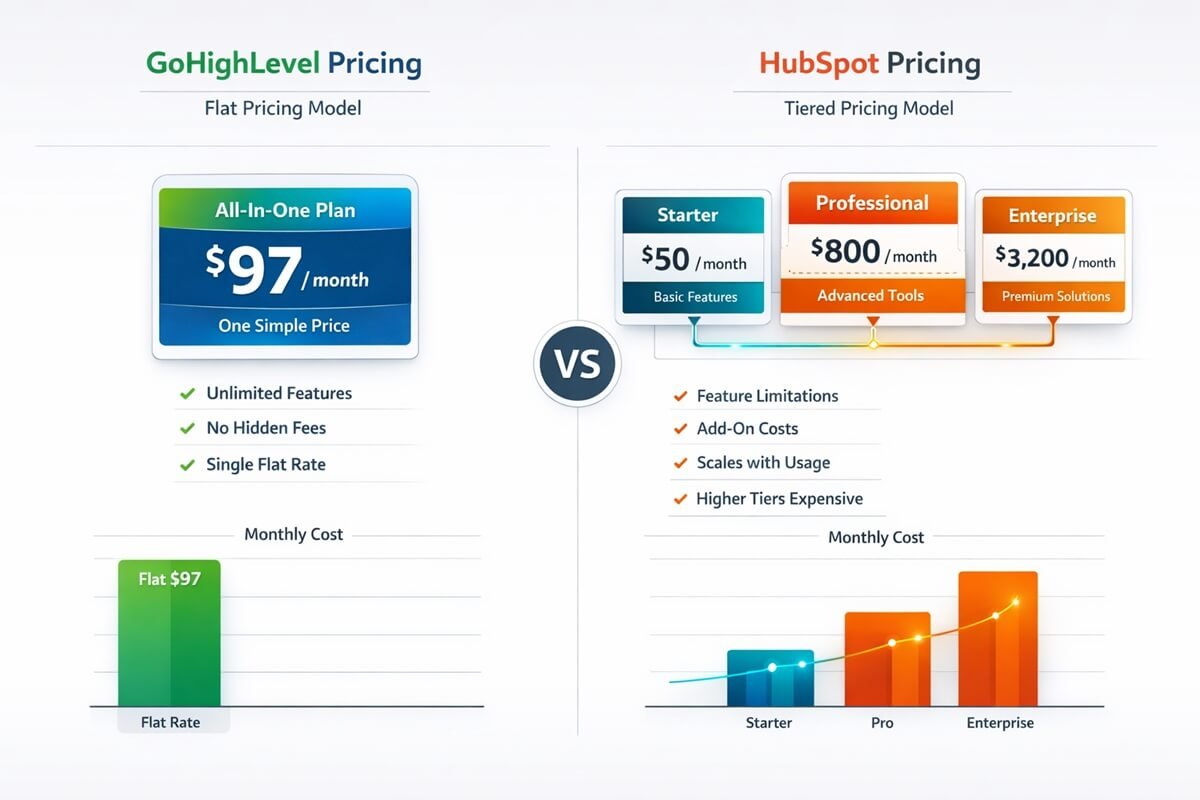
Pricing is often one of the biggest deciding factors when choosing a CRM, but the two platforms use very different pricing models.
GoHighLevel offers predictable subscription plans with features geared toward agencies, making it easier to estimate monthly costs as you add more client accounts.
HubSpot provides a free CRM and paid plans that scale with additional users, contacts, and advanced features. While this flexibility works well for growing businesses, costs can increase significantly as your organization expands.
For smaller agencies that want predictable expenses, GoHighLevel may offer better value. Businesses that need enterprise-grade functionality, advanced analytics, and specialized tools may find HubSpot’s higher pricing worthwhile.
| Pricing Factor | GoHighLevel | HubSpot |
| Free Plan | No | Yes |
| Entry Cost | Lower | Free tier available |
| Pricing Model | Flat subscription | Tiered plans |
| Best Value | Agencies | Growing businesses |
| Enterprise Scaling | Moderate | Excellent |
Winner: It depends on your budget and growth plans. GoHighLevel offers more predictable pricing, while HubSpot provides greater flexibility and advanced capabilities as your business scales.
GoHighLevel vs HubSpot: Strengths & Trade-Offs
| Feature | GoHighLevel | HubSpot |
| Agency Management | ⭐⭐⭐⭐⭐ | ⭐⭐⭐⭐☆ |
| White-Label Features | ⭐⭐⭐⭐⭐ | ⭐☆☆☆☆ |
| Marketing Automation | ⭐⭐⭐⭐☆ | ⭐⭐⭐⭐⭐ |
| AI Features | ⭐⭐⭐☆☆ | ⭐⭐⭐⭐⭐ |
| Reporting & Analytics | ⭐⭐⭐☆☆ | ⭐⭐⭐⭐⭐ |
| Ease of Use | ⭐⭐⭐☆☆ | ⭐⭐⭐⭐☆ |
| Integrations | ⭐⭐⭐⭐☆ | ⭐⭐⭐⭐⭐ |
| Pricing Value | ⭐⭐⭐⭐⭐ | ⭐⭐⭐☆☆ |
| Enterprise Scalability | ⭐⭐⭐☆☆ | ⭐⭐⭐⭐⭐ |
As AI becomes more integrated into CRM platforms, understanding how AI agent workflows coordinate tasks across marketing, sales, and customer support can help businesses build more scalable automation systems.
Our Recommendation by Business Type
Every business has different CRM requirements. The table below summarizes which platform is generally the better fit based on your business type and growth goals.
| Business Type | Recommended CRM | Why |
|---|---|---|
| Freelancer | GoHighLevel | Affordable all-in-one toolkit |
| Small Agency | GoHighLevel | White-label and client management |
| Growing Agency | Depends | Balance of cost and advanced features |
| SaaS Company | HubSpot | Strong marketing and sales alignment |
| B2B Business | HubSpot | Advanced CRM and reporting |
| Enterprise | HubSpot | Scalability and ecosystem |
Which CRM Should You Choose?
Before choosing a CRM, consider these key questions:
- Will you primarily manage multiple client accounts? → GoHighLevel is built with agencies in mind.
- Do you need one platform for marketing, sales, and customer service? → HubSpot provides a more unified CRM ecosystem.
- Is predictable monthly pricing a priority? → GoHighLevel’s flat-rate plans may offer better value.
- Will your business require advanced reporting, AI, and enterprise integrations as it grows? → HubSpot is better equipped for long-term scalability.
Your answer depends less on which platform has more features and more on how well it aligns with your business model and future growth plans.
Key Takeaways:
- 🏆 Best for agencies: GoHighLevel
- 🏆 Best for enterprise growth: HubSpot
- 🏆 Best AI capabilities: HubSpot
- 🏆 Best white-label solution: GoHighLevel
- 🏆 Best reporting: HubSpot
- 🏆 Best value for small agencies: GoHighLevel
❓ FAQs about GoHighLevel vs HubSpot
Is HubSpot better than GoHighLevel for agencies?
HubSpot is generally better for agencies that manage high-value clients, enterprise accounts, and data-driven marketing systems. It offers advanced reporting, AI-powered insights, and a strong inbound marketing ecosystem.
GoHighLevel, however, is more focused on service delivery, automation funnels, and white-label CRM operations, making it ideal for agencies that want to resell services or manage multiple client accounts under one system.
Can HubSpot replace GoHighLevel?
Yes, HubSpot can replace GoHighLevel in many cases, especially when an agency is evolving into a more structured or enterprise-level business.
However, the replacement depends on workflow needs:
- HubSpot replaces GoHighLevel in CRM structure, analytics, and scalability
- GoHighLevel remains stronger in white-label branding, funnel building, and agency reselling models
So, while HubSpot is more powerful long-term, GoHighLevel is more specialized for agency operations.
Can GoHighLevel replace HubSpot?
GoHighLevel can replace HubSpot for many small businesses and marketing agencies that primarily need CRM, marketing automation, appointment scheduling, and sales funnels. However, organizations requiring enterprise-level reporting, extensive integrations, and advanced AI features may find HubSpot a better long-term solution.
Which CRM is easier to use?
HubSpot is generally easier for new CRM users thanks to its intuitive interface, guided onboarding, and extensive learning resources. GoHighLevel has a steeper learning curve because it combines multiple agency tools into one platform, but experienced marketers often appreciate its all-in-one approach.
Is GoHighLevel cheaper than HubSpot?
In most cases, yes. GoHighLevel offers predictable flat-rate pricing, making it a cost-effective option for agencies managing multiple clients. HubSpot provides a free CRM and scalable paid plans, but costs can increase as your contact database, users, and feature requirements grow.
Which CRM has better automation?
Both platforms offer powerful automation, but they excel in different areas. GoHighLevel focuses on agency workflows, lead nurturing, SMS campaigns, and funnel automation, while HubSpot provides more advanced cross-team workflows, AI-assisted automation, and customer lifecycle management. The better choice depends on your business needs.
Which CRM offers better reporting?
HubSpot provides more advanced reporting with customizable dashboards, attribution reporting, revenue analytics, and customer journey insights. GoHighLevel includes useful reporting for agencies and campaign management but is generally more operational than strategic in its analytics capabilities.
Does HubSpot support white-label CRM?
No. HubSpot does not offer the same level of white-label functionality as GoHighLevel. Agencies that want to rebrand the platform with their own logo, domain, and client experience will generally find GoHighLevel the stronger option.
Which CRM integrates with more apps?
HubSpot has one of the largest CRM integration ecosystems, with thousands of native integrations covering marketing, sales, customer support, finance, and productivity tools. GoHighLevel integrates with many popular applications and automation platforms, but its overall ecosystem is smaller than HubSpot’s.
Which CRM is best for long-term business growth?
The best CRM depends on your long-term goals. GoHighLevel is an excellent choice for agencies focused on delivering client services through an all-in-one platform. HubSpot is generally better for businesses planning to scale across marketing, sales, customer service, and operations with advanced automation, analytics, and enterprise-ready capabilities.
Conclusion
The best CRM is the one that supports your next stage of growth—not just your current workflow. GoHighLevel excels as an all-in-one platform for agencies that need client management, white-label services, and streamlined automation. HubSpot is popular for businesses looking for a scalable CRM ecosystem with advanced analytics, AI-powered capabilities, and collaboration across multiple teams.
Agencies planning to expand their service offerings also consider how AI automation agency services can improve operational efficiency and client retention. By matching your CRM to your long-term objectives rather than today’s requirements alone, you’ll be better positioned to avoid costly migrations and support sustainable growth.
Official Sources
The information in this comparison is based on official product documentation and publicly available resources from the platform providers. For the latest feature updates, pricing, and integrations, visit:
- HubSpot Product & Pricing: https://www.hubspot.com/products
- GoHighLevel Product & Pricing: https://www.gohighlevel.com/pricing
- HubSpot App Marketplace: https://ecosystem.hubspot.com/marketplace/apps
- GoHighLevel Integrations: https://help.gohighlevel.com/support/solutions/folders/155000000994


One Comment